Coalition Politics and Regional Party Dominance in State Elections
Source:The Hindu ↗
Why It Matters
The article serves as a contemporary case study on the evolving power dynamics between national and regional political parties in India, which is crucial for GS2 topics concerning the functioning of political parties, federalism, and the nature of coalition politics.
Summary
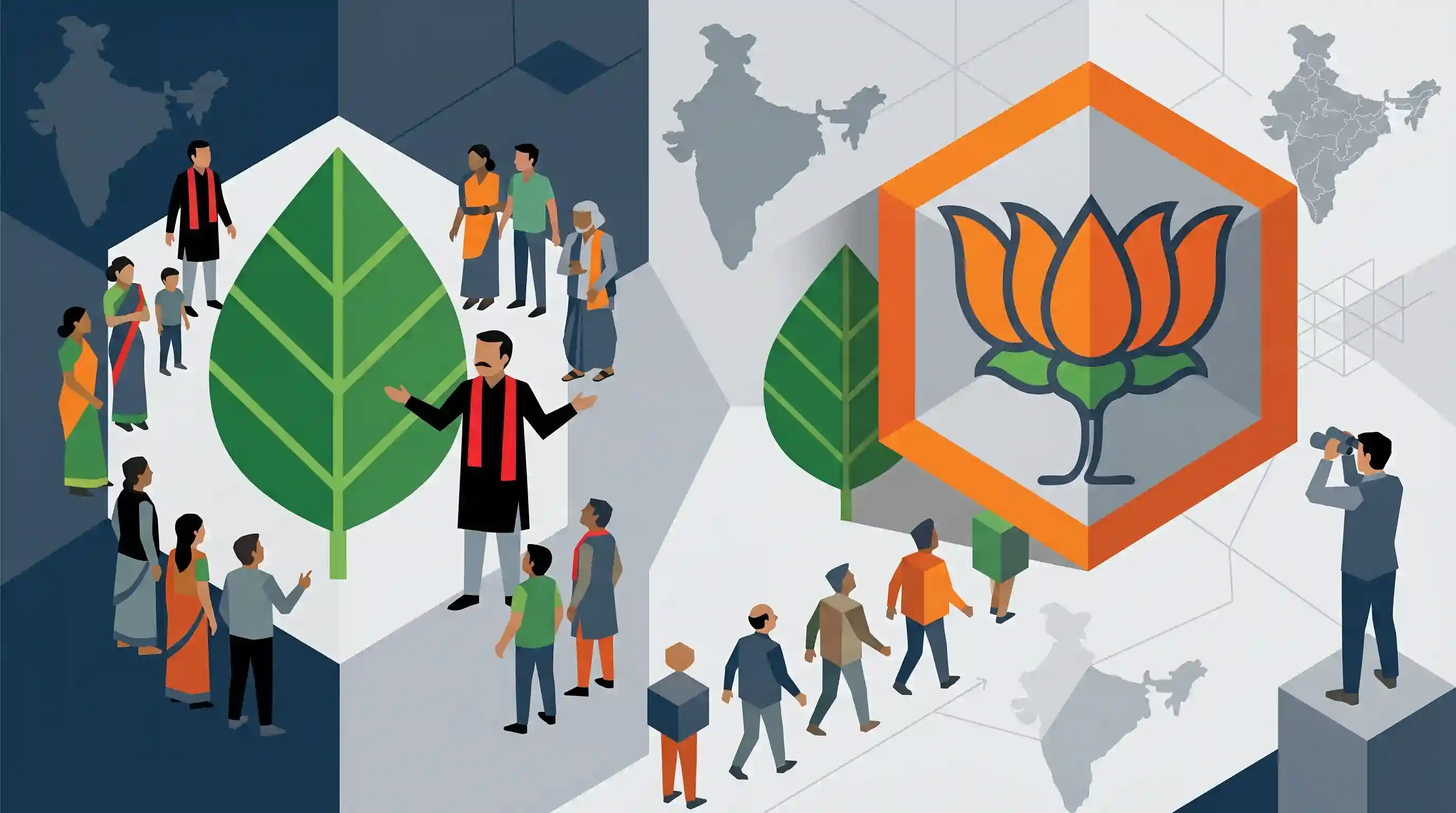
CPI(M) State secretary P. Shanmugam has questioned the AIADMK's role in the National Democratic Alliance (NDA) seat-sharing process for the upcoming Tamil Nadu Assembly elections. Pointing out that some alliance partners prefer negotiating directly with the BJP, Shanmugam suggested that the national party is overshadowing the AIADMK. The observation draws attention to the shifting power balance between regional and national parties within electoral coalitions.
Key Points
- CPI(M) leader P. Shanmugam claimed that the BJP, rather than the AIADMK, appears to be dictating seat-sharing terms within the NDA in Tamil Nadu.
- Despite AIADMK general secretary Edappadi K. Palaniswami asserting his party leads the NDA in the State, some alliance partners prefer direct talks with the BJP.
- The development highlights a potential power shift in the State's coalition dynamics, with a national party allegedly dominating a traditional regional heavyweight.
- The rhetoric recalled former Chief Minister Jayalalithaa's 2014 Lok Sabha campaign slogan 'Modi or Lady,' underscoring the historical autonomy of the AIADMK.
Important Terms
National Democratic Alliance (NDA)

A center-right political coalition in India led by the BJP. Formed in 1998, it represents a major shift from single-party dominance to alliance-based governance.
UPSC context
GS-II/Polity; tests knowledge of coalition dynamics and the evolution of India's multi-party system.
Bharatiya Janata Party (BJP)
A major national party advocating Hindutva and economic reforms. Established in 1980, it is the lead member of the NDA and the current ruling party at the Center.
UPSC context
GS-II/Governance; relevant for understanding the party system and the impact of national parties on federalism.
AIADMK
A prominent regional Dravidian party in Tamil Nadu founded in 1972. It emphasizes welfarism and social justice, often playing a pivotal role in national coalition math.
UPSC context
GS-II/Polity; tests the role of regional parties in balancing central power and state-specific issues.
Communist Party of India (Marxist) [CPI(M)]
A left-wing national party formed in 1964. It follows Marxist-Leninist ideology and has historically led governments in West Bengal, Kerala, and Tripura.
UPSC context
GS-II/Polity; tests understanding of political ideologies and the history of India's Left movement.
Coalition Politics
A governance model where multiple parties cooperate to form a government when no single party wins an absolute majority. Dominant in India from 1989–2014.
UPSC context
GS-II/Polity; essential for questions on parliamentary democracy, consensus-building, and political stability.
Seat Sharing
An agreement between alliance partners to distribute constituencies among themselves, ensuring only one candidate from the alliance contests each "seat" to avoid vote-splitting.
UPSC context
GS-II/Electoral Politics; tests practical knowledge of electoral strategies under the First-Past-the-Post system.
Prelims Trap
"Pre-poll alliances are formally registered as distinct political entities under the Election Commission of India."
Under Section 29A of the RPA, 1951, the Election Commission of India registers individual political parties, but it does not register or recognize alliances.
Static Concepts Connected
How does a political party get recognized as a State Party?
- Assembly benchmark: Secures at least 6% of valid votes polled in the State Assembly election and wins at least 2 seats.
- Seat threshold: Wins 3% of total seats in the Legislative Assembly or at least 3 seats, whichever is higher.
- Alternative vote rule: Secures 8% of the total valid votes polled in the State at a General Election to LS or Assembly, with no seat requirement.
How does the 'First Past the Post' (FPTP) system influence coalition politics?
- Vote splitting: Like-minded parties are forced to form pre-poll alliances to prevent the splitting of their shared voter base.
- Regional concentration: Geographically concentrated regional parties can convert local dominance into seats, enabling them to act as kingmakers in fractured mandates.
Cross-Topic Patterns
ONOE vs. Regional Autonomy
The push for simultaneous elections (ONOE) raises structural fears among regional parties that synchronized campaigning will subsume local issues under well-funded national narratives.
Federalism and the Party System
India's coalition era (1989-2014) strengthened federalism by making regional parties indispensable at the Centre. The return of single-party national dominance alters this bargaining power.

Expect a Mains question linking 'One Nation One Election' to the structural decline of regional parties and its impact on federalism.
Linked PYQs · 1
Linked PYQs · 1
- 2022MainsGS2
“While the national political parties in India favour centralisation, the regional parties are in favour of State autonomy.” Comment.
