Tamil Nadu Anti NEET Bill Rejection and Federalism Friction
Source:Indian Express ↗
Why It Matters
This development provides a practical case study of constitutional friction between the Centre and States regarding subjects on the Concurrent List (Education). It highlights the mechanisms of the Governor's reservation of a Bill for the President (Article 200/201) and the Doctrine of Federal Supremacy. It also raises crucial social justice questions about equity, standardized testing, and access to medical education.
Summary
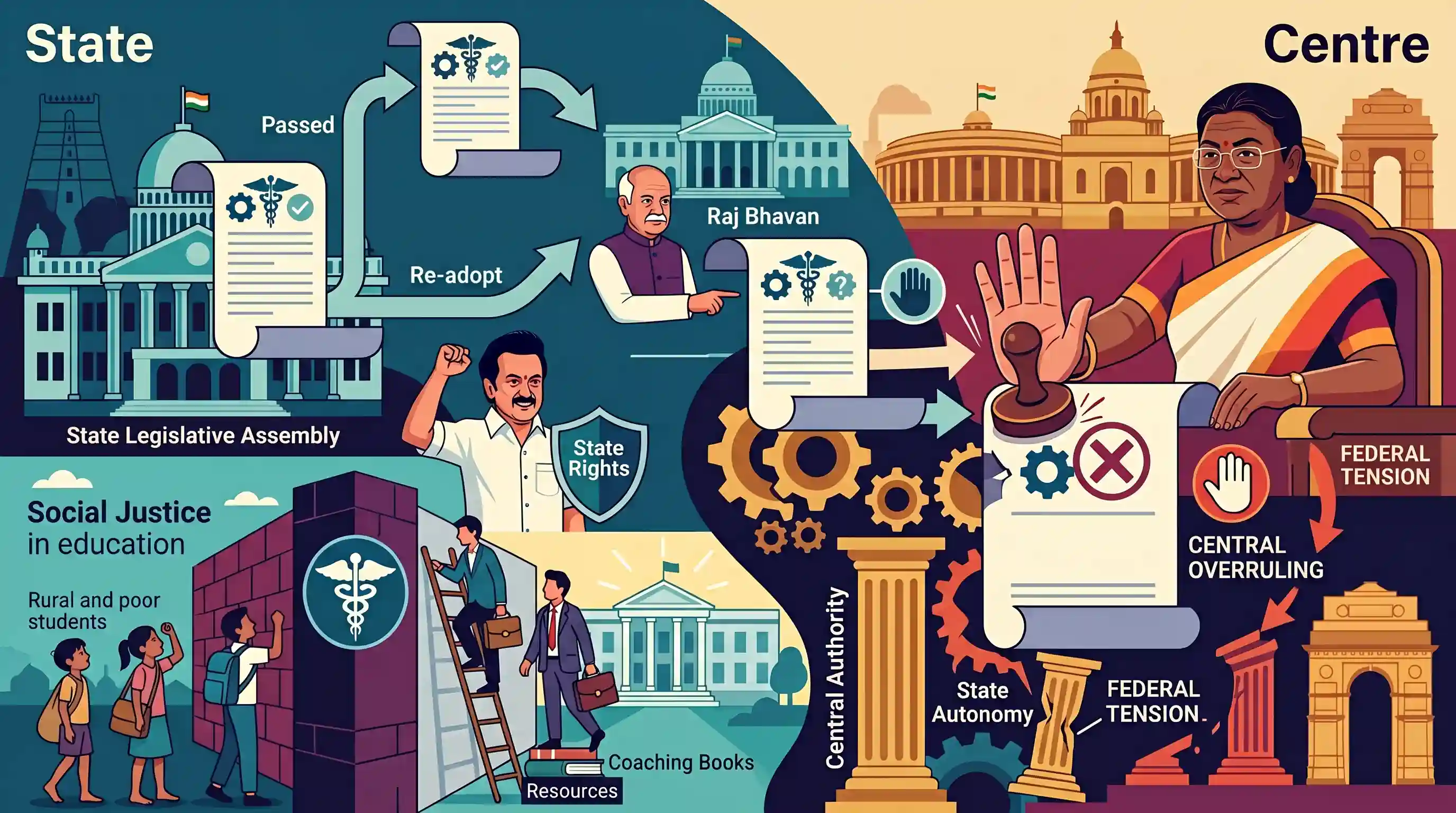
President Droupadi Murmu has rejected Tamil Nadu's anti-NEET Bill, which sought to exempt the state's students from the National Eligibility cum Entrance Test (NEET) and replace it with Class XII board marks for undergraduate medical admissions. Chief Minister M K Stalin strongly condemned the decision, describing it as a "dark chapter in federalism" and an infringement on state autonomy. Stalin argued that NEET systematically disadvantages rural, poor, and marginalized students, favoring urban students with access to coaching. The Bill was first passed in 2021, returned by Governor R N Ravi, and re-adopted by the assembly before being sent to the President. Stalin announced plans to contest the decision legally and politically, emphasizing education's placement on the Concurrent List and the necessity to protect states' rights.
Key Points
- President Droupadi Murmu rejected the Tamil Nadu Assembly's anti-NEET Bill, which sought to use Class XII marks for medical admissions instead of the NEET exam.
- Tamil Nadu Chief Minister M K Stalin termed the rejection a "dark chapter in federalism," arguing it infringes upon the state's legislative rights and autonomy.
- The state government contends that NEET systematically disadvantages rural and economically disadvantaged students who cannot afford private coaching, favoring urban, affluent candidates.
- Under the Constitution, because Education is on the Concurrent List, a state law that contradicts a central law requires the President's assent to prevail in that state (Article 254).
- The Bill was originally passed in 2021, returned by Governor R N Ravi, unanimously re-adopted by the state assembly, and then reserved for the President's consideration.
Important Terms
National Eligibility cum Entrance Test (NEET)

Uniform national entrance examination for undergraduate and postgraduate medical and dental courses in India, conducted by the National Testing Agency (NTA).
UPSC context
GS II (Education Policy/Governance); GS III (Social Justice). Key for debates on merit vs. regional equity in professional education.
Tamil Nadu Admission to Undergraduate Medical Degree Courses Bill, 2021
State legislation seeking to exempt Tamil Nadu from NEET, instead making Class XII marks the basis for medical admissions to protect rural and marginalized students.
UPSC context
GS II (Polity/Federalism). Illustrates the conflict between state social justice goals and national uniform standards.
Article 201 (Presidential Assent)
Constitutional provision empowering the President to either grant or withhold assent to a State Bill reserved by the Governor for presidential consideration.
UPSC context
GS II (State Legislature/Presidential Powers). Tests knowledge of the President's absolute veto over state legislation in specific cases.
Article 254 (Doctrine of Repugnancy)
Constitutional rule resolving conflicts between Central and State laws on Concurrent List subjects; Central law prevails unless State law receives Presidential assent.
UPSC context
GS II (Centre-State Relations). Vital for understanding how states can legally override Parliamentary legislation on shared subjects.
Concurrent List (Education)
Entry 25 of List III in the Seventh Schedule, allowing both Union and State governments to legislate on education, including medical education.
UPSC context
GS II (Federalism/Seventh Schedule). Highlights the jurisdictional overlap that leads to legal and political friction between levels of government.
Federalism
A constitutional framework where power is shared between the Centre and States; CM Stalin's critique centers on 'asymmetric' power over state legislative intent.
UPSC context
GS II (Federal Structure). Central to discussions on state autonomy, the Governor's role, and the limits of central interference.
Prelims Trap
The President is bound to give assent if a returned state bill is re-passed.
Unlike the Governor under Art 200, the President enjoys an absolute veto over state bills under Art 201 and is not bound to give assent even upon re-adoption.
Static Concepts Connected
What are the President's powers under Article 201?
- Absolute Veto: The President can declare or withhold assent to a state bill reserved by the Governor, effectively exercising an absolute veto.
- Reconsideration binding bypass: Can direct the Governor to return a non-money bill. Even if the state legislature re-passes it, the President is not constitutionally bound to assent.
- No Time Limit: The Constitution does not prescribe a time limit for the President to make a decision, allowing for a de facto pocket veto.
How is legislative repugnancy resolved under Article 254?
- General Rule: If a State law and Central law clash on a Concurrent List subject, the Central law generally prevails.
- Exception (Art 254(2)): A State law can prevail locally if it is reserved for the President's consideration and receives their assent.
- Parliamentary Override: Even if a state law receives Presidential assent, Parliament retains the power to enact a new law overriding it at any time.
Cross-Topic Patterns
42nd Amendment & Cooperative Federalism
The shift of 'Education' to the Concurrent List in 1976 underpins the NEET friction, linking GS2 federalism directly to historical constitutional amendments.
Standardized Testing & Social Justice
The argument that NEET favors urban-affluent students bridges constitutional law with GS2 vulnerability themes, questioning if one-size-fits-all policies violate social equity.

A multi-statement question on Article 201 (Presidential veto on re-passed state bills) and Article 254(2) repugnancy is highly likely in 2026.
Linked PYQs · 4
Linked PYQs · 4
- 2024MainsGS2
What changes has the Union Government recently introduced in the domain of Centre-State relations ? Suggest measures to be adopted to build the trust between the Centre and the States and for strengthening federalism.
- 2019MainsGS2
From the resolution of contentious issues regarding distribution of legislative powers by the courts, 'Principle of Federal Supremacy' and 'Harmonious Construction' have emerged. Explain.
- 2025PrelimsGS1
Consider the following statements : I. The Constitution of India explicitly mentions that in certain spheres the Governor of a State acts in his/her own discretion. II. The President of India can, of his/her own, reserve a bill passed by a State Legislature for his/her consideration without it being forwarded by the Governor of the State concerned. Which of the statements given above is/are correct?
- 2024MainsGS2
What are the aims and objects of recently passed and enforced, The Public Examination (Prevention of Unfair Means) Act, 2024? Whether University/State Education Board examinations, too, are covered under the Act ?
