Tamil Nadu Seat Sharing Highlights Coalition Bargaining Dynamics
Source:Indian Express ↗
Why It Matters
Understanding the shifting bargaining power between national and regional parties is essential for analyzing the nature of coalition governments, the impact of electoral politics on federal dynamics, and the broader functioning of India's multi-party democracy.
Summary
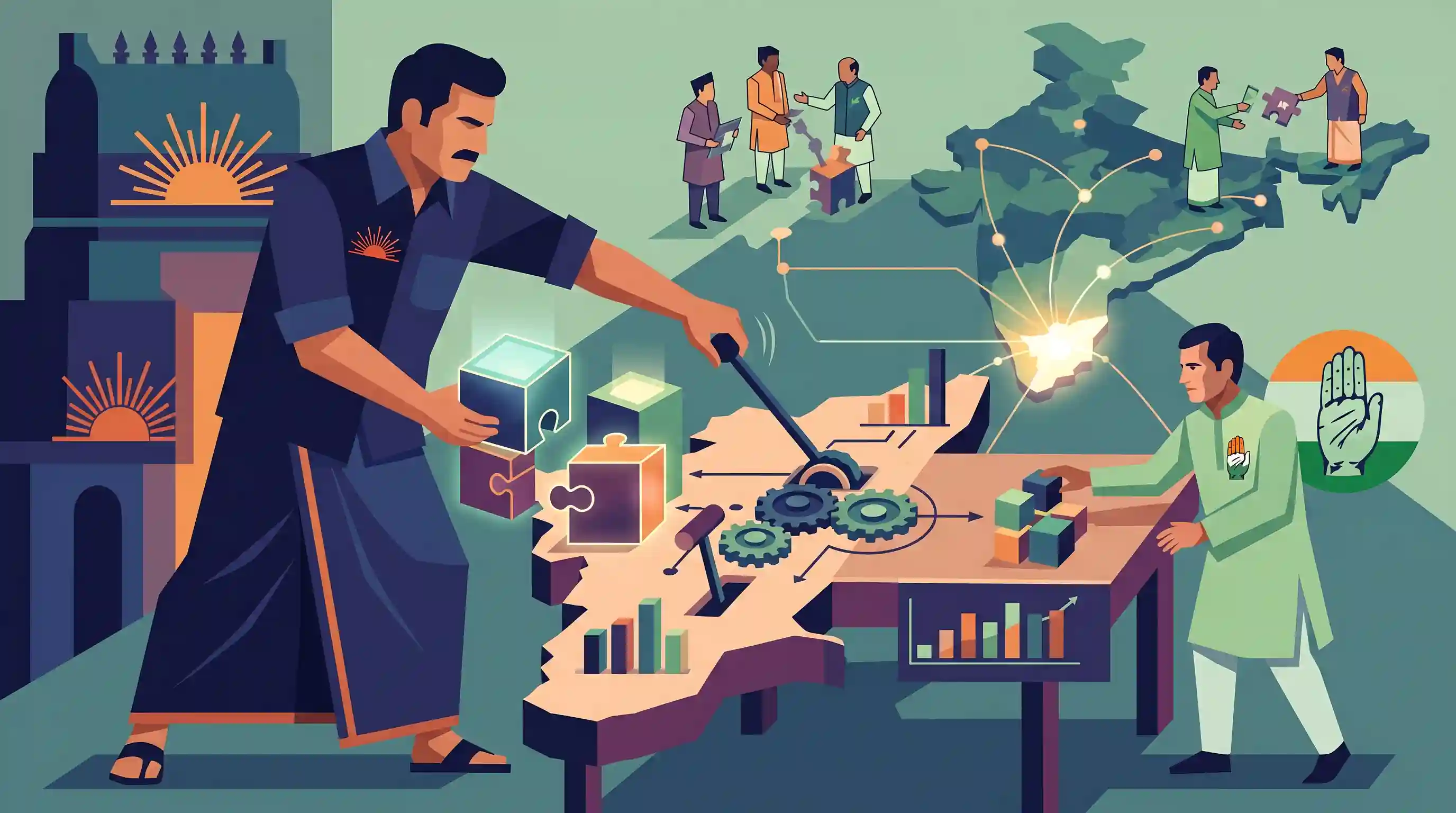
The article examines the escalating tensions within the DMK-Congress alliance in Tamil Nadu during seat-sharing negotiations. It highlights how the DMK, a dominant regional player, is asserting its leverage over the Congress, a national party with a weakened organizational presence in the state. This political brinkmanship underscores the shifting dynamics of coalition politics in India, where regional parties increasingly dictate terms and protect their political space. The scenario provides insight into the broader narrative of national versus regional political power, electoral interdependence, and the changing landscape of party alliances in Indian federalism.
Key Points
- The seat-sharing negotiations between the DMK and the Congress in Tamil Nadu reflect the complex dynamics of coalition politics and political posturing ahead of elections.
- The dominant regional party (DMK) is leveraging its strength against a weakened national party (Congress), illustrating the shift in bargaining power from the center to regional actors in state alliances.
- The tensions highlight the struggle for political space, where national parties depend on regional allies to maintain electoral relevance in certain states while regional parties seek to maximize their own footprint.
- This alliance dynamic exemplifies broader trends in Indian electoral politics, where regional parties fiercely guard their local dominance and assert autonomy against centralization by national parties.
Important Terms
Dravida Munnetra Kazhagam (DMK)

A major regional political party in Tamil Nadu, rooted in the Dravidian movement, advocating for social justice, linguistic pride, and state autonomy.
UPSC context
GS Paper 2: Functions and responsibilities of the Union and the States; role of regional parties in federalism.
Indian National Congress (INC)
India's oldest national party, following a 'big tent' centrist ideology; it often leads or participates in alliances like the Secular Progressive Alliance (SPA) or INDIA bloc.
UPSC context
GS Paper 2: Political parties, their ideologies, and evolution of the party system in India.
Coalition Politics
A power-sharing arrangement between two or more political parties to form a government or contest elections when no single party has a clear majority.
UPSC context
GS Paper 2: Parliamentary democracy, coalition dynamics, and their impact on governance and stability.
Regional Parties
Parties whose influence is limited to a specific region or state, focusing primarily on local issues and regional identity to counterbalance central dominance.
UPSC context
GS Paper 2: Federal structure, decentralization of power, and representation of diverse regional aspirations.
Seat-sharing
An electoral agreement within an alliance where partners decide which party will contest specific constituencies to avoid splitting the vote and maximize winning chances.
UPSC context
Prelims/GS 2: Electoral processes and the strategic dynamics of multi-party alliances in India.
Political Federalism
The constitutional division of power between the Centre and States; in India, this is often characterized by 'Cooperative Federalism' or 'Bargaining Federalism'.
UPSC context
GS Paper 2: Issues and challenges pertaining to the federal structure; Centre-State relations.
Prelims Trap
"The Election Commission regulates pre-poll alliances and seat-sharing agreements between recognized political parties."
The ECI recognizes National/State parties under the Symbols Order 1968, but pre-poll alliances and seat-sharing deals are purely political and entirely outside ECI regulation.
Static Concepts Connected
What are the conditions for recognition as a State Party?
- Assembly vote+seats: 6% valid votes in an assembly election plus at least 2 assembly seats.
- LS vote+seats: 6% valid votes in a Lok Sabha election from the state plus at least 1 LS seat.
- Seat-only criteria: 3% of total assembly seats or 3 seats (whichever is more).
- Vote-only criteria: 8% of total valid votes polled in the state in LS or Assembly elections.
How do regional parties influence the Indian federal structure?
- Bargaining Federalism: They force the Center to negotiate policy and financial allocations, preventing unilateral centralization by national parties.
- Deepening Representation: They ensure specific ethnic, linguistic, and regional aspirations are accommodated in national policy-making.
- Executive Check: Regional allies in a coalition can veto or stall contentious central legislation, acting as an informal democratic safeguard.
Cross-Topic Patterns
Coalition shifts + Anti-Defection Law
Pre-poll alliances are not legally recognized under the Tenth Schedule, meaning parties can break pre-poll coalition pacts post-election without individual MLAs facing defection charges.
Regionalism + Article 263 demands
Strong regional parties frequently demand the institutionalization of the Inter-State Council (Article 263) to resolve center-state policy disputes and check absolute centralization.

Expect a GS2 Mains question on how asymmetric bargaining by regional parties shifts India from cooperative to bargaining federalism.
Linked PYQs · 1
Linked PYQs · 1
- 2022MainsGS2
“While the national political parties in India favour centralisation, the regional parties are in favour of State autonomy.” Comment.
