Tamil Nadu agriculture budget and land use management
Source:The Hindu ↗
Why It Matters
This provides a practical state-level case study on integrated agricultural management, showcasing how to reverse the decline in cultivable area, boost GSVA through double-cropping, and address man-animal conflicts (wild boars) alongside climate resilience initiatives like agroforestry.
Summary
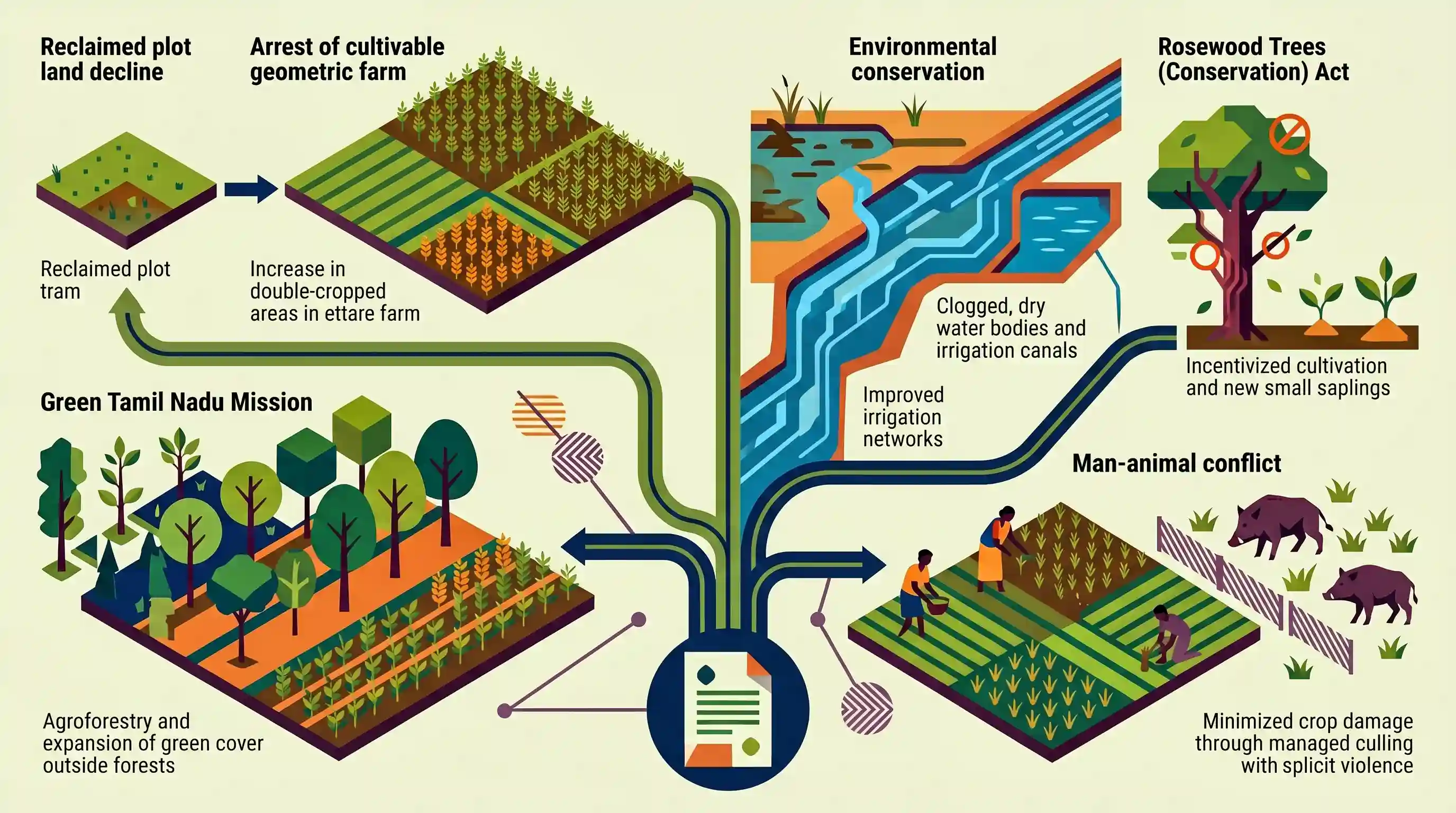
Tamil Nadu has presented its Interim Agriculture Budget for 2026-27, highlighting key achievements such as arresting the decline in cultivable land and increasing the double-cropped area. The budget emphasizes climate resilience through the Green Tamil Nadu Mission, which promotes agroforestry to expand green cover outside forests. Additionally, the State allowed the Tamil Nadu Rosewood Trees (Conservation) Act, 1994, to expire to incentivize cultivation and introduced guidelines for culling wild boars to minimize crop damage. Extensive efforts were also made to restore rural waterbodies and irrigation networks.
Key Points
- Tamil Nadu presented its Interim Agriculture Budget for 2026-27 with an outlay of ₹47,248.24 crore.
- The State successfully arrested the decline in cultivable land, expanding the double-cropped area to 13.99 lakh hectares in 2024-25.
- Agroforestry is being heavily promoted under the Green Tamil Nadu Mission to achieve 33% tree/forest cover and improve climate resilience.
- The Tamil Nadu Rosewood Trees (Conservation) Act, 1994, was allowed to expire in February 2025 to encourage farmers to cultivate rosewood.
- Guidelines for culling wild boars have been enforced to protect agricultural crops from damage, addressing ongoing man-animal conflict issues.
Important Terms
Interim Agriculture Budget 2026-27 (Tamil Nadu)

The state's dedicated financial plan for 2026-27 focusing on arresting cultivable land decline, increasing double-cropped areas, and enhancing farmer income through climate-resilient initiatives and desilting.
UPSC context
GS Paper 3 (Agriculture/Budgeting). Tests understanding of state-specific agricultural policies and the 'separate agri-budget' model.
Green Tamil Nadu Mission
An ambitious flagship afforestation initiative aiming to increase Tamil Nadu's green cover from ~23.8% to 33% by planting 265 crore native tree seedlings over a decade.
UPSC context
GS Paper 3 (Environment/Climate Change). Relevant for carbon sequestration targets and NDC commitments under the Paris Agreement.
Tamil Nadu Rosewood Trees (Conservation) Act, 1994
A 1994 legislation that regulated the felling of Dalbergia latifolia; allowed to expire in 2025 to encourage farmers to grow and trade high-value timber on private lands.
UPSC context
GS Paper 3 (Agroforestry). Illustrates policy shifts from 'prohibitive conservation' to 'incentive-based cultivation' in social forestry.
Wild Boar Culling Guidelines (Tamil Nadu)
A 2024-25 framework dividing forest-adjacent areas into three zones (A, B, C) to manage crop damage, permitting regulated culling of wild boars only in Zone C (beyond 5km).
UPSC context
GS Paper 3 (Environment/Man-Animal Conflict). Tests knowledge of the Wildlife (Protection) Act, 1972 and 'vermin' status.
Agriculture and Farmers' Welfare Department (Tamil Nadu)
The nodal state department responsible for implementing the separate agriculture budget, desilting irrigation networks, and promoting organic farming and horticultural productivity.
UPSC context
GS Paper 2 & 3. Relevant for institutional roles in decentralized agricultural planning and welfare administration.
Prelims Trap
"Wild boars are listed under Schedule V of the Wildlife Protection Act when culled."
The WPA Amendment 2022 removed the dedicated Schedule V. The Centre now uses Section 62 to declare specific species as vermin without a separate schedule.
Static Concepts Connected
What is Cropping Intensity and how is it calculated?
- Formula: The ratio of Gross Cropped Area (GCA) to Net Sown Area (NSA), usually expressed as a percentage (GCA/NSA x 100).
- Significance: It indicates how many times the same agricultural land is cultivated in a year. Higher intensity relies heavily on assured irrigation.
How does the Wildlife Protection Act handle 'vermin' declarations?
- Central Authority: Only the Central Government (under Section 62) can declare any wild animal as vermin for a specified period and area, usually upon a State's request.
- Schedule Limitations: Species listed in Schedule I (enjoying the highest degree of protection) cannot be declared as vermin under any circumstances.
- Post-2022 Amendment: The 2022 amendment eliminated the dedicated Schedule V. Vermin culling is now handled via direct exemption from protection schedules.
Cross-Topic Patterns
Agroforestry + NDC Carbon Sink goals
Deregulating transit rules for high-value timber like rosewood encourages private cultivation, directly supporting India's UNFCCC commitment to create an additional 2.5-3 billion tonne carbon sink via tree cover.
Crop Depredation + PMFBY
Rising human-wildlife conflict forces states to tackle wild boar culling, bridging environmental law (WPA) with localized agriculture risk mechanisms like the PM Fasal Bima Yojana (PMFBY) for crop damage.

Expect a 2026 multi-statement Prelims question testing the WPA 2022 changes to vermin declaration alongside Cropping Intensity definitions.
Linked PYQs · 5
Linked PYQs · 5
- 2019MainsGS3
Elaborate the impact of National Watershed Project in increasing agricultural production from water-stressed areas.
- 2020MainsGS3
What are the challenges and opportunities of food processing sector in the country? How can income of the farmers be substantially increased by encouraging food processing?
- 2019MainsGS3
It is argued that the strategy of inclusive growth is intended to meet the objectives of inclusiveness and sustainability together. Comment on this statement.
- 2014MainsGS3
Environmental Impact Assessment studies are increasingly undertaken before a project is cleared by the Government. Discuss the environmental impacts of coal-fired thermal plants located at coal pitheads.
- 2016MainsGS3
Rehabilitation of human settlements is one of the important environmental impacts which always attracts controversy while planning major projects. Discuss the measures to be adopted to mitigate the impact of the recent incidents of cloudbursts in many places of Uttarakhand.
