Ancient Tamil Brahmi Inscriptions Discovered in Egypt
Source:The Hindu ↗
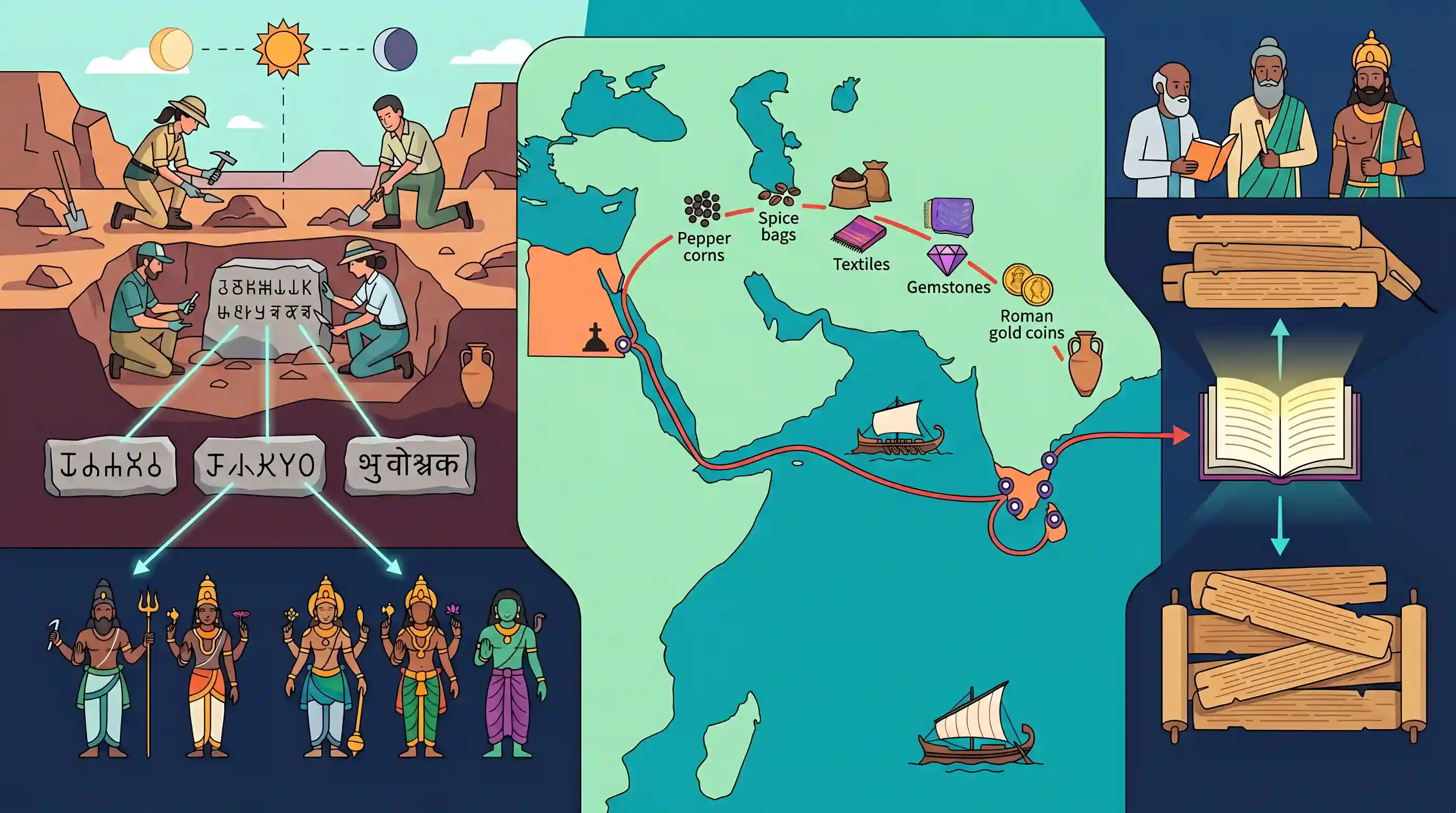
Why It Matters
UPSC frequently asks questions on ancient South Indian history, specifically the Sangam Age, its literature (Purananooru, Silappatikaram), and maritime trade (Muziris, Poompuhar). This discovery directly links Indian epigraphy with global history, reinforcing the importance of the Malabar Coast in the Indo-Roman trade network and validating Sangam texts.
Summary
Recent archaeological discoveries in Egypt's Valley of the Kings have uncovered close to 30 inscriptions in Tamil Brahmi, Prakrit, and Sanskrit, dating back to the 1st–3rd centuries C.E. Identified by researchers Charlotte Schmid and Ingo Strauch, the inscriptions bear Tamil names and reference Chera deities, providing concrete epigraphical evidence of robust ancient maritime trade between South India (ancient Tamilagam) and the Roman Empire. The findings highlight the historical significance of the Red Sea route and ports like Berenike, whilst independently corroborating accounts of ancient trade and Chera kings detailed in classical Sangam literature, particularly the Purananooru.
Key Points
- Nearly 30 inscriptions in Tamil Brahmi, Prakrit, and Sanskrit were discovered in Egypt's Valley of the Kings, dating from the 1st to 3rd Centuries C.E.
- The findings confirm robust, direct maritime trade links between ancient Tamilagam (especially the Chera kingdom on the Malabar Coast) and the Roman Empire via the Red Sea port of Berenike.
- The inscriptions feature Tamil names (like Cikai Koṟraṉ and Cātaṉ), some of which reference the ancient Chera warrior goddess Koṟṟavai.
- This epigraphical evidence in Egypt corroborates the historical accuracy of Sangam literature, such as the Purananooru, regarding ancient South Indian trade networks and Chera kings.
Important Terms
Sangam literature

Earliest available Tamil literature (c. 300 BCE–300 CE), composed by assemblies of poets under Pandyan patronage. It is a primary source for ancient South Indian socio-political history.
UPSC context
GS Paper I (Art & Culture); tests knowledge of early South Indian literary traditions and societal structures.
Purananooru
A foundational Sangam anthology within the Ettuthogai, consisting of 400 poems on 'Puram' (external) themes like war, heroism, and the ethical conduct of kings and chieftains.
UPSC context
GS Paper I (Ancient History); tests understanding of Sangam genres and warrior ethics of ancient Tamilakam.
Tamil Brahmi
The earliest script used for writing Tamil, adapted from the Brahmi system. It is found on cave walls, pottery, and coins, serving as critical epigraphical evidence of early literacy.
UPSC context
GS Paper I (Ancient History/Art & Culture); tests knowledge of ancient Indian scripts and epigraphy.
Chera Dynasty
One of the 'three crowned kings' of ancient Tamilakam, ruling over present-day Kerala and western Tamil Nadu. They dominated the lucrative spice trade with the Roman Empire.
UPSC context
GS Paper I; tests knowledge of ancient South Indian dynasties and their maritime economic significance.
Berenike
An ancient Greco-Roman port on Egypt's Red Sea coast. It was a vital hub for Indo-Roman maritime trade, where Indian pepper, textiles, and artifacts have been excavated.
UPSC context
Prelims/GS I; tests awareness of ancient maritime trade routes and Indo-Mediterranean cultural links.
Indo-Roman trade
Vibrant maritime commerce (c. 1st century BCE–3rd century CE) where India exported luxury goods like pepper and gems in exchange for Roman gold, wine, and glass.
UPSC context
GS Paper I (Ancient History/Economy); tests understanding of early globalization and ancient trade balances.
Prelims Trap
Indian merchant inscriptions in ancient Egypt were exclusively confined to Red Sea coastal port settlements.
The Valley of the Kings discovery proves Indian traders penetrated deep inland into Egypt's Nile cultural zone, well beyond coastal outposts like Berenike.
Static Concepts Connected
What are the five Sangam landscapes (Tiṇai) and their chief deities?
- Kurinji & Mullai: Kurinji (mountains) is associated with Murugan/Seyyon. Mullai (pastoral forests) is associated with Vishnu/Mayon.
- Marutham & Neithal: Marutham (agricultural plains) worships Indra/Vendan. Neithal (coastal regions) is associated with Varuna.
- Palai: Palai (arid/desert zones) is associated with Korravai, the warrior goddess directly referenced in the newly found Egyptian inscriptions.
Which key ancient ports facilitated Indo-Roman trade on the Indian peninsula?
- West Coast: Muziris, Tyndis, and Nelcynda (Chera ports) were primary West Coast hubs for exporting pepper, pearls, and ivory to Rome.
- East Coast: Arikamedu (near Puducherry) served as a massive East Coast Indo-Roman trading station, dyeing center, and bead manufacturing hub.
- Foreign Nodes: Berenike and Myos Hormos on the Red Sea coast acted as the primary Egyptian reception ports for Indian goods.
Cross-Topic Patterns
Archaeology corroborating Sangam poetry
Recent excavations in Keezhadi and epigraphy in Egypt validate the socio-economic trade narratives of texts like Purananooru, previously dismissed by some historians as mere poetic exaggeration.
Numismatics and Indo-Roman trade surpluses
The massive export of Chera pepper to the Roman Empire depleted Roman treasuries, leaving behind substantial hoards of Roman gold and silver coins (Aurei/Denarii) across South India.

Expect a multi-statement question in 2026 linking Sangam texts (Purananooru), Tamil Brahmi inscriptions in Egypt, and Chera ports.
Linked PYQs · 4
Linked PYQs · 4
- 2022PrelimsGS1
Which one of the following statements about Sangam literature in ancient South India is correct?
- 2023PrelimsGS1
With reference to ancient South India, Korkai, Poompuhar and Muchiri were well known as
- 2020PrelimsGS1
With reference to the period of Gupta dynasty in ancient India, the towns Ghantasala, Kadura and Chaul were well known as
- 2023PrelimsGS1
Which one of the following explains the practice of 'Vattakirutal' as mentioned in Sangam poems?
