Ladakh Autonomy Demands and MHA Dialogue Stalemate
Source:The Hindu ↗
हे का महत्त्वाचे आहे
This article addresses important questions of regional autonomy, federal governance, tribal rights under the Sixth Schedule, and the political integration and aspirations of Union Territories in India.
सारांश
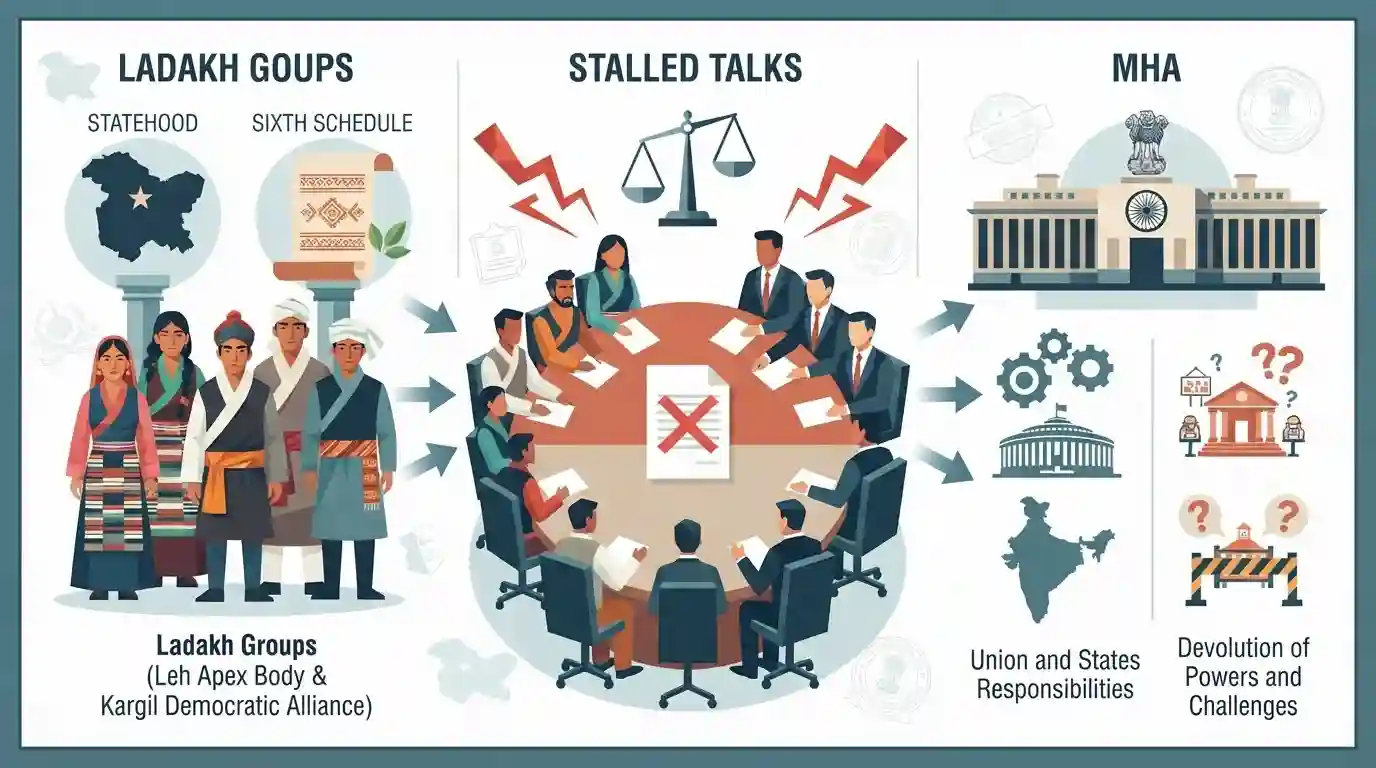
High-level talks between civil society groups from Ladakh (Leh Apex Body and Kargil Democratic Alliance) and the Ministry of Home Affairs have failed to resume due to disagreements over the government's proposal, as regional groups press firmly for statehood and Sixth Schedule protections.
मुख्य मुद्दे
- Talks between Ladakh leadership groups (Leh Apex Body and Kargil Democratic Alliance) and the Ministry of Home Affairs (MHA) have hit a roadblock.
- The stalemate stems from a rift over the Central government's alternative proposal regarding constitutional protections and autonomy demands.
- Ladakh groups continue to demand statehood, inclusion under the Sixth Schedule of the Constitution, job reservations, and a separate Lok Sabha seat for Leh and Kargil.
महत्त्वाच्या संज्ञा
Sixth Schedule

A constitutional provision under Article 244(2) and 275(1) providing for Autonomous District Councils (ADCs) to protect the land, culture, and identity of tribal populations in Assam, Meghalaya, Tripura, and Mizoram.
UPSC context
UPSC Mains GS Paper 2: Salient features of the Indian Constitution, federalism, and tribal area administration.
Leh Apex Body (LAB)
A prominent regional coalition representing civil society and political groups in the Leh district of Ladakh, spearheading demands for statehood, constitutional safeguards, and Sixth Schedule protections.
UPSC context
UPSC Mains GS Paper 2: Regional aspirations, governance challenges, and devolution of powers in Union Territories.
Kargil Democratic Alliance (KDA)
A joint front of socio-political, religious, and political organisations from the Kargil district of Ladakh, collaborating with the Leh Apex Body to demand democratic rights and regional autonomy.
UPSC context
UPSC Mains GS Paper 2: Issues relating to federal structure, regional movements, and administrative autonomy in border regions.
Ministry of Home Affairs (MHA)
The apex executive ministry of the Union Government responsible for internal security, domestic policy, centre-state relations, and the administration of Union Territories in India.
UPSC context
UPSC Mains GS Paper 2: Structure, organization, and functioning of the Executive and Union administration.
पूर्वपरीक्षा सापळा
Ladakh groups are demanding inclusion under the Sixth Schedule, which can be extended to any Union Territory by a simple parliamentary majority.
Aspirants often assume Union Territories or any region with high tribal population can automatically demand or be granted Sixth Schedule status, whereas it is constitutionally restricted to specific states in the Northeast.
संबंधित स्थिर संकल्पना
What are the key constitutional provisions and governance powers associated with the Sixth Schedule?
- Articles & States: Constitutional Basis: Governed by Articles 244(2) and 275(1) for tribal areas in Assam, Meghalaya, Tripura, and Mizoram.
- ADCs & Powers: Autonomous Councils: Creates Autonomous District Councils (ADCs) and Regional Councils with legislative, judicial, and executive powers over land, forests, and customary law.
- Governor Authority: Governor's Role: The Governor is empowered to create, reorganize, or alter district boundaries and approve or withhold assent to council laws.
आंतर-विषय नमुने
Sixth Schedule vs Asymmetrical Federalism
Sixth Schedule extension demands in Ladakh and parts of Northeast mirror ongoing debates on federal flexibility and asymmetrical devolution under Article 371.
Border Governance and National Security
Strategic border regions like Ladakh test the delicate balance between national security administration and decentralized democratic self-governance.

Expect a statement-based prelims question on Sixth Schedule constitutional provisions, specifically ADCs' powers and eligible states vs UTs.
संबंधित PYQ · 2
संबंधित PYQ · 2
- 2025MainsGS2
Discuss the nature of Jammu and Kashmir Legislative Assembly after the Jammu and Kashmir Reorganization Act, 2019. Briefly describe the powers and functions of the Assembly of the Union Territory of Jammu and Kashmir.
- 2025PrelimsGS1
Consider the following statements : With reference to the Constitution of India, if an area in a State is declared as Scheduled Area under the Fifth Schedule I. the State Government loses its executive power in such areas and a local body assumes total administration II. the Union Government can take over the total administration of such areas under certain circumstances on the recommendations of the Governor Which of the statements given above is/are correct?
