India Engagement with Taliban Tests Realpolitik and Norms
Source:Indian Express ↗
Why It Matters
This issue underscores the classic tension between national interest (realism) and ethical foreign policy (idealism). It is crucial for GS2 (India-Afghanistan relations) and GS4 (Ethics in International Relations), prompting candidates to analyze the limits of diplomatic pragmatism when dealing with extremist regimes.
Summary
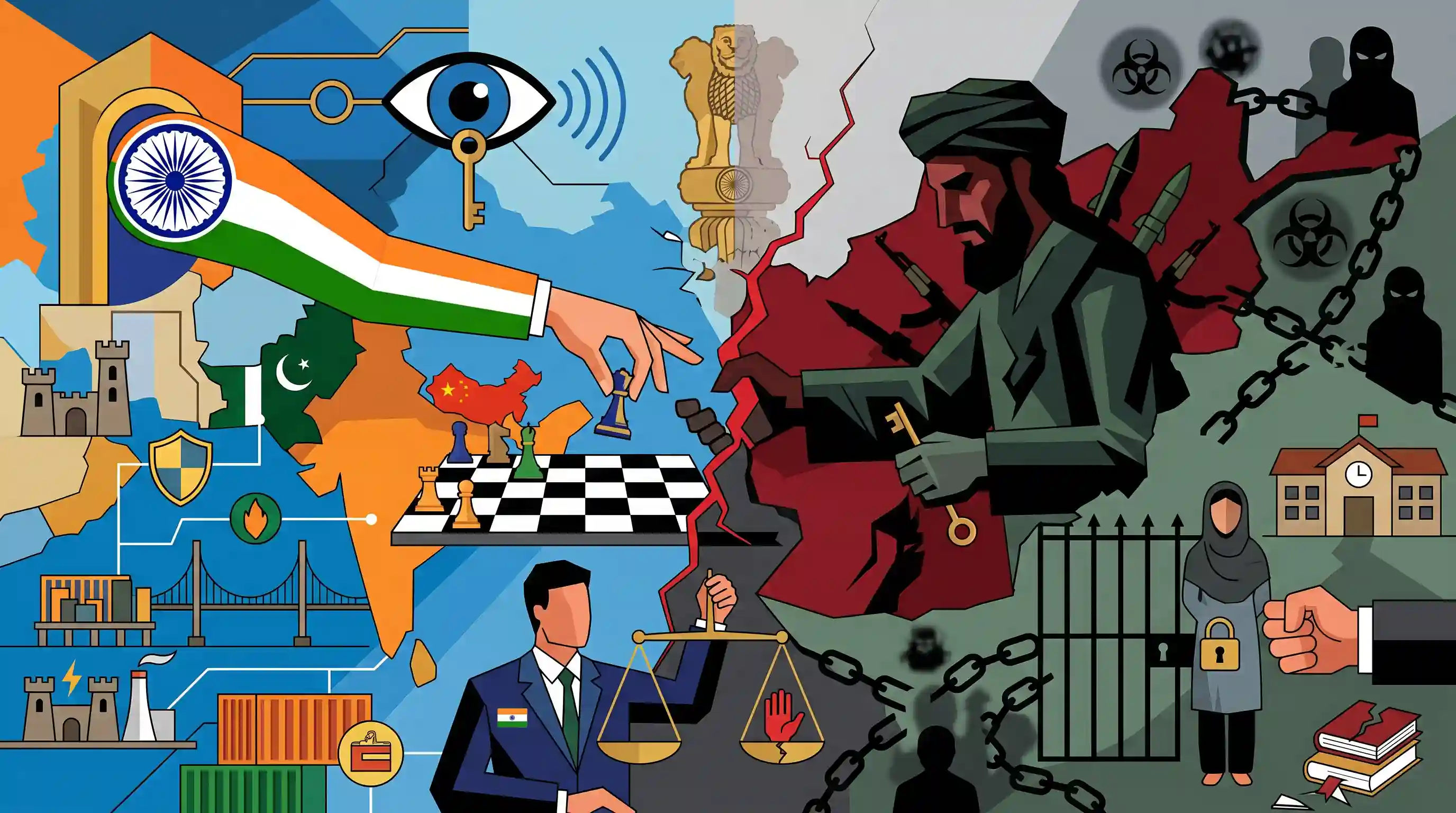
The article provides a critical analysis of India's recent diplomatic overtures toward the Taliban regime in Afghanistan, characterizing the engagement as 'complicity, not diplomacy.' It highlights the moral and strategic dilemma of interacting with an extremist, unrecognised government that systematically violates human rights, particularly women's rights. While India's shift is driven by realpolitik—aiming to secure strategic interests, counter rival influences (Pakistan and China), and gather security intelligence—the author warns that this approach risks legitimizing terror-linked networks and undermining India's democratic values on the global stage.
Key Points
- India's evolving Afghanistan policy has shifted from principled distance to pragmatic engagement, as evidenced by the presence of a Taliban representative in India.
- The article criticizes this engagement as 'complicity' rather than diplomacy, pointing to the Taliban's severe human rights abuses, particularly against women and minorities.
- India's realpolitik approach is driven by the need to counter Pakistani and Chinese influence, protect regional investments, and monitor transnational terror threats.
- Engaging with an unrecognized, extremist regime poses long-term security risks and challenges India's normative diplomatic stance and moral standing as a democratic leader.
Important Terms
Taliban

A Deobandi-Islamic fundamentalist political movement and de facto government of Afghanistan since August 2021. It is widely unrecognized internationally due to human rights violations and its extremist ideology.
UPSC context
GS Paper II: India and its Neighborhood; GS Paper III: Regional security threats and cross-border terrorism.
Haqqani Network
A lethal, semi-autonomous insurgent group within the Taliban, designated as a terrorist organization by the UN. It has historical ties to Al-Qaeda and was responsible for the 2008/2009 Indian Embassy bombings.
UPSC context
GS Paper III: Security challenges; GS Paper II: Bilateral relations and threats to Indian interests.
Realpolitik
A system of politics based on practical and realistic considerations (such as national security and economic gain) rather than moral, ethical, or ideological premises.
UPSC context
GS Paper IV: Ethics in International Relations; GS Paper II: Foreign policy strategies.
Ministry of External Affairs (MEA)
The Indian government ministry responsible for conducting foreign relations, managing diplomatic missions, and formulating India’s stance on international issues like the Afghanistan crisis.
UPSC context
GS Paper II: Statutory, regulatory and various quasi-judicial bodies; India's Foreign Policy.
Technical Mission
A mid-level diplomatic office India established in Kabul in 2022 to coordinate humanitarian aid and development, recently upgraded to full Embassy status in 2025.
UPSC context
GS Paper II: Neighborhood relations and diplomatic maneuvers; evolutionary stages of India-Afghanistan ties.
Gender Apartheid
A system of institutionalized discrimination and segregation based on gender, specifically used to describe the Taliban’s total exclusion of women from education, employment, and public life.
UPSC context
GS Paper IV: Ethical concerns in International Relations; GS Paper II: Social Justice and Human Rights.
Prelims Trap
India has officially recognized the Taliban government in Afghanistan to secure its investments.
India operates under a strict "engagement without recognition" policy. It maintains a technical mission and interacts factually, but denies formal legal (de jure) recognition.
Static Concepts Connected
De facto vs. De jure recognition in International Relations
- De facto: Acknowledging a regime's physical control over territory without formally endorsing its legal legitimacy (e.g., India's current stance on the Taliban).
- De jure: Formal, legal recognition of a state or government, which confers full diplomatic privileges, immunities, and sovereign legitimacy.
What are India's key infrastructure investments in Afghanistan?
- Zaranj-Delaram Route: A 218-km route built by the BRO connecting the Afghan Garland Highway to the Iran border, serving as the crucial link to Chabahar port.
- Salma Dam: Also known as the Afghan-India Friendship Dam, it is a major hydroelectric and irrigation project built by India in Herat province.
- Afghan Parliament: Constructed by India as a symbol of democratic cooperation, though currently occupied by the unrecognized Taliban regime.
Cross-Topic Patterns
Realpolitik across borders: Myanmar and Afghanistan
India's pragmatic engagement with the Taliban mirrors its approach to the Myanmar Junta: prioritizing border security, intelligence sharing, and countering Chinese influence over democratic idealism.
Critical minerals and the strategic vacuum
Afghanistan’s untapped lithium and rare earth minerals drive China's proactive diplomacy, forcing India to maintain a regional presence to avoid a complete strategic lockout in the neighborhood.

Mains 2026: Expect a GS2 or GS4 question evaluating 'engagement without recognition' via India's policies on the Taliban and Myanmar Junta.
Linked PYQs · 3
Linked PYQs · 3
- 2015MainsGS4
At the international level, the bilateral relations between most nations are governed on the policy of promoting one's own national interest without any regard for the interest of other nations. This leads to conflicts and tensions between the nations. How can ethical consideration help resolve such tensions? Discuss with specific examples.
- 2020MainsGS4
‘The will to power exists, but it can be tamed and be guided by rationality and principles of moral duty.’ Examine this statement in the context of international relations.
- 2021MainsGS3
Analyse the complexity and intensity of terrorism, its causes, linkages and obnoxious nexus. Also suggest measures required to be taken to eradicate the menace of terrorism.
