NHRC and Supreme Court Push for Repealing Leprosy Laws
Source:The Hindu ↗
Why It Matters
Highlights the active role of the NHRC and the judiciary in addressing statutory discrimination against a vulnerable patient group, illustrating the intersection of public health, fundamental rights, and legal reform.
Summary
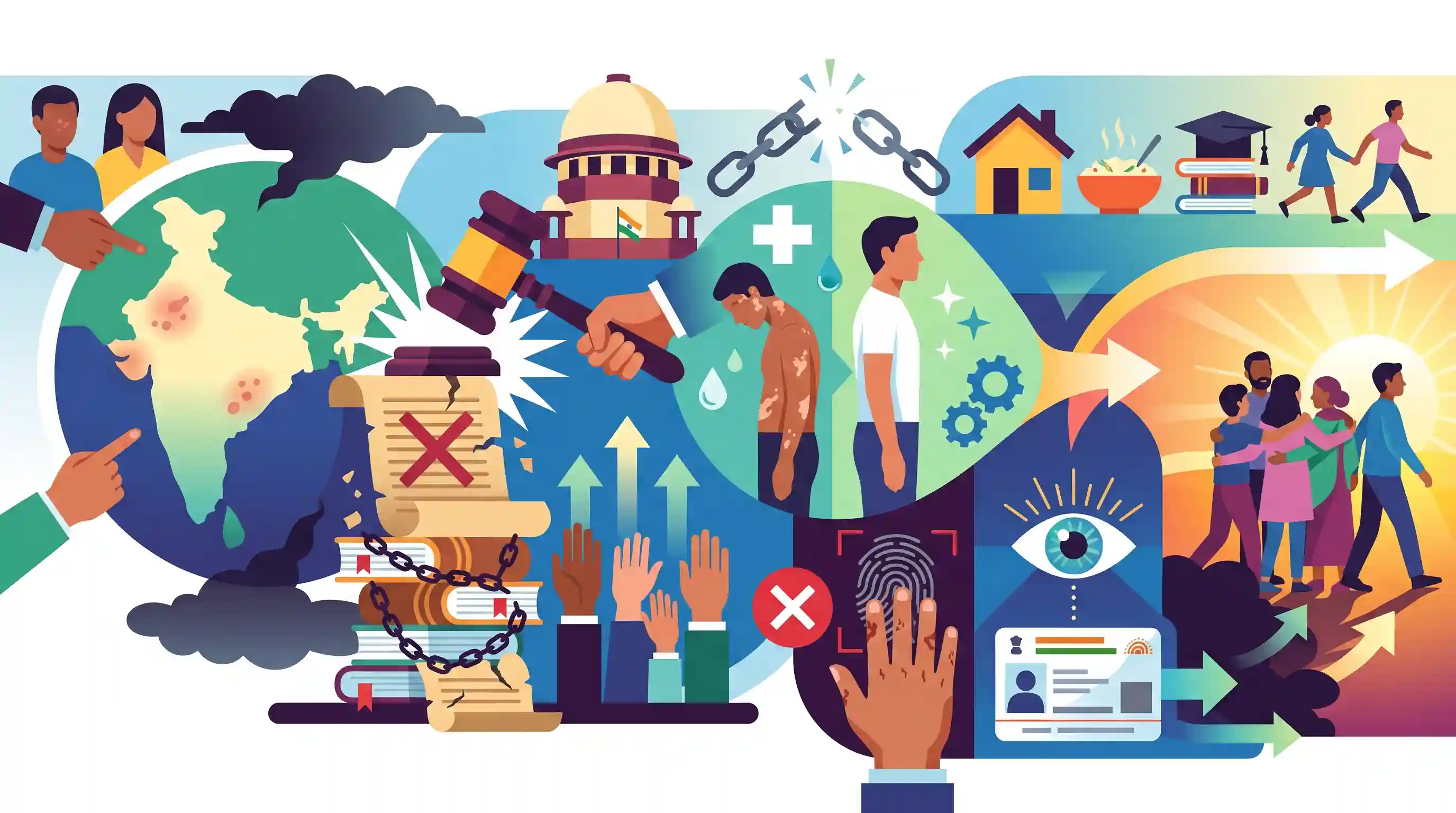
The editorial welcomes the Supreme Court's intervention to address 97 discriminatory laws against leprosy patients, highlighted by the NHRC. Despite India accounting for 57% of global cases, leprosy is fully curable and non-infectious with proper medical intervention. The NHRC has recommended repealing derogatory laws, ensuring basic rights, and utilizing iris scans for Aadhaar enrolment for those with fingertip nerve damage. The Centre and States are urged to urgently repeal these archaic provisions and eliminate the lingering social stigma.
Key Points
- The Supreme Court has intervened following an NHRC submission revealing 97 central and state laws that discriminate against persons with leprosy.
- These archaic laws deny basic rights such as access to public transport, running for elected office, employment, and business operations.
- India accounts for 57% of global leprosy cases, which are caused by the bacterium Mycobacterium leprae, though the condition is now fully curable and non-infectious.
- The NHRC recommended early identification, replacing derogatory legal terminology, and using iris scans instead of fingerprints for Aadhaar enrolment due to nerve damage in leprosy patients.
- The editorial urges the Centre and States to swiftly repeal these antediluvian provisions and launch remedial actions to ensure dignity and fundamental rights.
Important Terms
National Human Rights Commission (NHRC)

An independent statutory body established in 1993 to protect and promote human rights. It acts as a "watchdog" for rights related to life, liberty, equality, and dignity guaranteed by the Constitution.
UPSC context
GS Paper II: Statutory Bodies. Tests understanding of institutional mechanisms for protecting the human rights of vulnerable populations.
Supreme Court of India
The apex judicial body in India and guardian of the Constitution. It interprets laws and issues binding directions to the government to safeguard fundamental rights and social justice.
UPSC context
GS Paper II: Judiciary. Tests knowledge of judicial activism and its role in upholding constitutional guarantees for marginalized groups.
Unique Identification Authority of India (UIDAI)
A statutory authority established under the Aadhaar Act, 2016. It is responsible for Aadhaar enrolment, authentication, and managing the world's largest biometric ID system, including protocols for persons with disabilities.
UPSC context
GS Paper II: Statutory Bodies. Tests knowledge of the executive's role in implementing technology-based identity systems for inclusive governance.
Aadhaar
A unique 12-digit identification number issued to Indian residents based on biometric and demographic data. It serves as a universal identity platform for targeting government welfare benefits and services.
UPSC context
GS Paper II & III: Welfare Schemes and E-governance. Tests understanding of digital identity management and challenges in inclusive service delivery.
Prelims Trap
India has successfully eradicated leprosy and achieved zero incidence of the disease.
Confusing 'elimination as a public health problem' (<1 case per 10,000) with 'eradication' (zero cases). India still accounts for 57% of global cases despite its 2005 elimination status.
Static Concepts Connected
What is the difference between disease eradication and elimination?
- Disease Elimination: Reducing disease incidence to a defined low target level (e.g., <1 per 10,000 for leprosy) in a specific geographical area. Requires continued measures.
- Disease Eradication: Permanent global reduction to zero of the specific pathogen, meaning routine interventions are no longer needed (e.g., Smallpox).
What powers does the NHRC hold regarding archaic or discriminatory laws?
- Statutory Review: Under the Protection of Human Rights Act, 1993, NHRC can review laws and constitutional safeguards, recommending measures for effective implementation.
- Advisory but Persuasive: Its recommendations are non-binding. However, it can approach the Supreme Court (as in this leprosy case) to force judicial intervention against systemic violations.
Cross-Topic Patterns
Biometric failures and welfare exclusion
Aadhaar fingerprint dependency often marginalizes those with manual labor wear or diseases like leprosy. NHRC's push for iris-only authentication connects public health realities with DBT and welfare governance challenges.
Archaic statutes vs Article 21 Rights
The existence of 97 discriminatory statutes against a curable disease highlights legislative inertia, testing the bounds of Article 14 (Equality) and Article 21 (Right to Dignity) against archaic state laws.

Expect a 2026 Prelims question mixing disease definitions (elimination vs eradication) with UIDAI/Aadhaar biometric exception mechanisms.
Linked PYQs · 3
Linked PYQs · 3
- 2014MainsGS2
National Human Rights Commission (NHRC) in India can be most effective when its tasks are adequately supported by other mechanisms that ensure the accountability of a government. In light of the above observation assess the role of NHRC as an effective complement to the judiciary and other institutions in promoting and protecting human rights standards.
- 2023MainsGS2
“Development and welfare schemes for the vulnerable, by its nature, are discriminatory in approach.” Do you agree? Give reasons for your answer.
- 2020MainsGS2
In order to enhance the prospects of social development, sound and adequate health care policies are needed particularly in the fields of geriatric and maternal health care. Discuss.
