Strategic recalibration in India West Asia bilateral relations
Source:The Hindu ↗
Why It Matters
This highlights the evolution and complexities of India's West Asia policy. It directly addresses the transition from a 'balancing act' to a more explicit alignment with Israel, providing necessary context for evaluating bilateral ties and regional dynamics like I2U2 and IMEC for GS-2 International Relations questions.
Summary
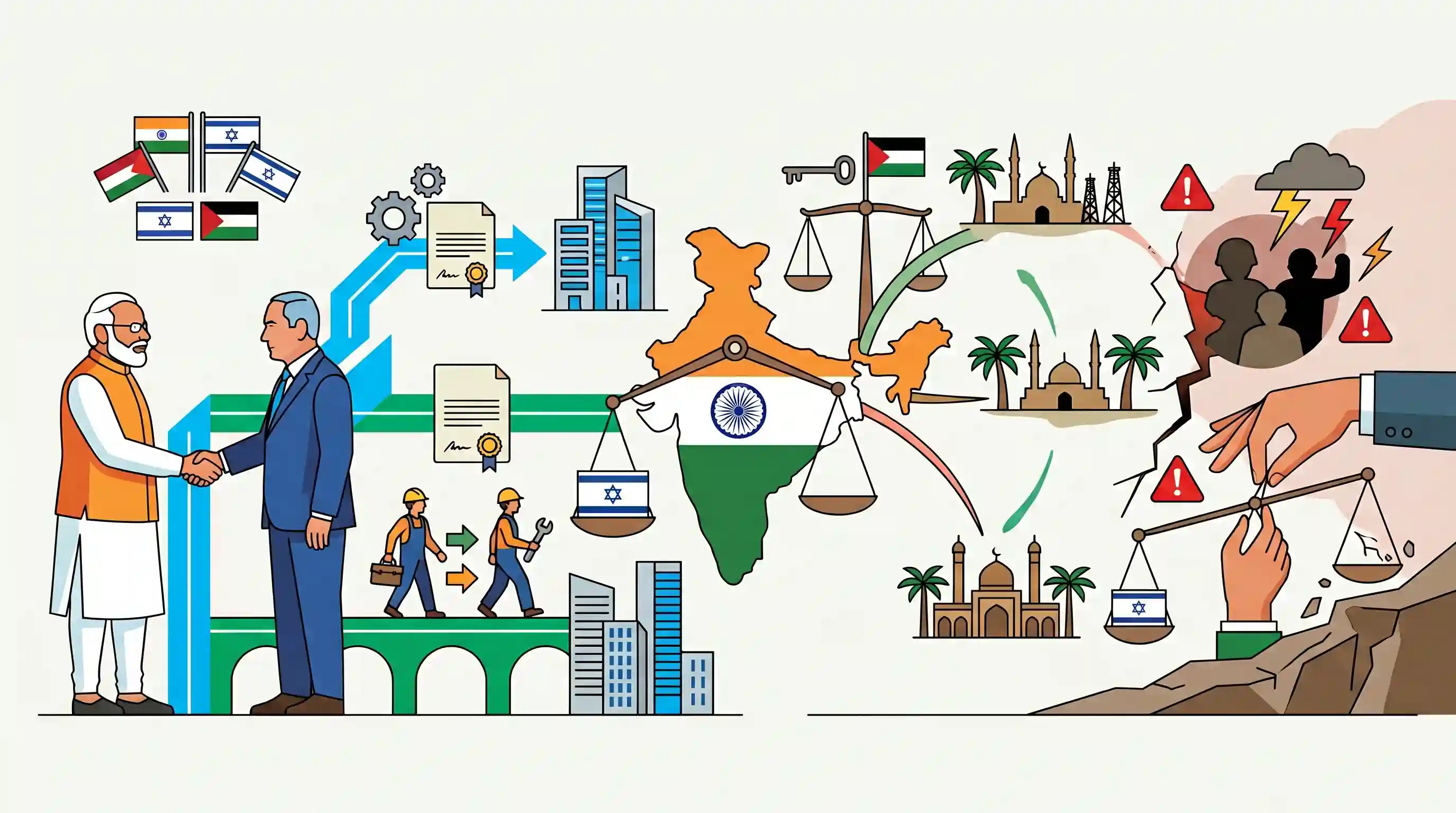
Prime Minister Narendra Modi's recent visit to Israel signifies a deepening of bilateral relations, marked by the signing of MoUs in various sectors and an agreement for the employment of Indian workers. However, this deepening alliance underscores a shift in India's historically calibrated approach to West Asia. Traditionally, India has balanced its relationships among Israel, Palestine, the Arab world, and Iran. While recent realignments in the Middle East—such as the Abraham Accords and the formation of I2U2—have facilitated India-Israel ties, the editorial warns that taking overt sides during ongoing regional conflicts may jeopardize India's broader strategic balance and relations with other key West Asian nations.
Key Points
- Prime Minister Narendra Modi’s visit to Israel resulted in four MoUs covering AI, agriculture, culture, and education, and an agreement to employ 50,000 Indian workers in Israel.
- India's traditional West Asia policy has involved a delicate balancing act among Israel, the Arab world, Iran, and Palestine.
- The growing closeness between India and Israel reflects a strategic alignment that leverages the Abraham Accords and multi-lateral groupings like I2U2.
- The editorial cautions that explicitly aligning with Israel—especially in the context of the ongoing conflict in Gaza—risks upsetting India's calibrated balance with other vital West Asian partners.
Important Terms
De-hyphenation Policy

India's diplomatic strategy of treating relations with Israel and Palestine as separate bilateral tracks, allowing robust cooperation with Israel without making it conditional on the Palestinian issue.
UPSC context
GS Paper 2 (International Relations). Tests understanding of India's shift from ideological to interest-based diplomacy in West Asia.
Abraham Accords
U.S.-brokered 2020 agreements normalizing diplomatic ties between Israel and several Arab nations (UAE, Bahrain, Morocco, Sudan), facilitating India's broader strategic engagement in the region.
UPSC context
GS Paper 2 (Regional Groupings). Evaluates impact of Middle Eastern realignments on India’s maritime and economic security.
I2U2 Grouping
A four-nation strategic partnership (India, Israel, UAE, USA) focused on joint investments in water, energy, transportation, space, health, and food security; often called the 'West Asian Quad.'
UPSC context
GS Paper 2 (International Relations). Important for analyzing India's leadership in new minilateral frameworks for economic development.
India-Middle East-Europe Economic Corridor (IMEC)
A multimodal transport network linking India, the Middle East, and Europe via rail and sea, serving as a strategic alternative to China's Belt and Road Initiative (BRI).
UPSC context
GS Paper 2 & 3 (Connectivity/Infrastructure). Relates to global supply chains and India's response to Chinese regional influence.
Strategic Autonomy
The ability to pursue independent foreign policy and national interests without being coerced into alliances or taking sides in rivalries between other powers.
UPSC context
GS Paper 2 (India’s Foreign Policy). Tests the candidate's ability to evaluate India's multi-alignment strategy amidst global polarization.
Prelims Trap
"India's de-hyphenation policy formally abandons its historical support for the Palestinian Two-State solution."
De-hyphenation means engaging Israel and Palestine independently based on merit. India has not abandoned its official support for a sovereign, independent Palestinian state.
Static Concepts Connected
What is India's 'De-hyphenation' policy in West Asia?
- Independent tracks: Dealing with two rival nations (Israel and Palestine) independently, rather than viewing one relationship through the lens of the other.
- Strategic autonomy: It allows India to upgrade its Special Strategic Partnership with Israel without diluting its historical developmental and diplomatic support for Palestine.
What is the core focus of the I2U2 minilateral grouping?
- Geoeconomic focus: Unlike traditional security alliances, I2U2 (India, Israel, UAE, USA) focuses strictly on joint investments in six areas: water, energy, transportation, space, health, and food security.
- Member synergies: It leverages Israeli technology, UAE capital, and US backing to address Indian agricultural and infrastructural challenges, utilizing the geopolitical space opened by the Abraham Accords.
Cross-Topic Patterns
Remittances vs Diaspora Security
Sending 50,000 workers to Israel highlights the dual edge of labor mobility agreements: boosting forex remittances while increasing the diplomatic burden of civilian evacuations in conflict zones (e.g., Operation Ajay).
Iran Connectivity and Chabahar Dilemma
Overtly aligning with Israel risks alienating Iran, potentially jeopardizing India's strategic investments in the Chabahar Port and the International North-South Transport Corridor (INSTC) that bypass Pakistan.
Minilaterals replacing Non-Alignment
Groupings like I2U2 and IMEC reflect India's shift from traditional non-alignment to issue-based multi-alignment, leveraging US-backed Arab-Israeli normalization to secure geoeconomic supply chains.

Expect a 2026 mains question on whether India's 'de-hyphenation' in West Asia is eroding into an overt, risk-prone alignment with Israel.
Linked PYQs · 2
Linked PYQs · 2
- 2018MainsGS2
“India’s relations with Israel have, of late, acquired a depth and diversity, which cannot be rolled back.” Discuss.
- 2022MainsGS2
How will I2U2 (India, Israel, UAE and USA) grouping transform India's position in global politics?
