Pedestrian footpaths as a fundamental right under Article 21
Source:The Hindu ↗
Why It Matters
This judgment is crucial for UPSC aspirants as it illustrates the Supreme Court's ongoing expansion of the scope of Article 21 (Right to Life) to include civic infrastructure. It also highlights the accountability of the government in implementing statutory provisions like Section 162 of the Motor Vehicles Act concerning emergency healthcare.
Summary
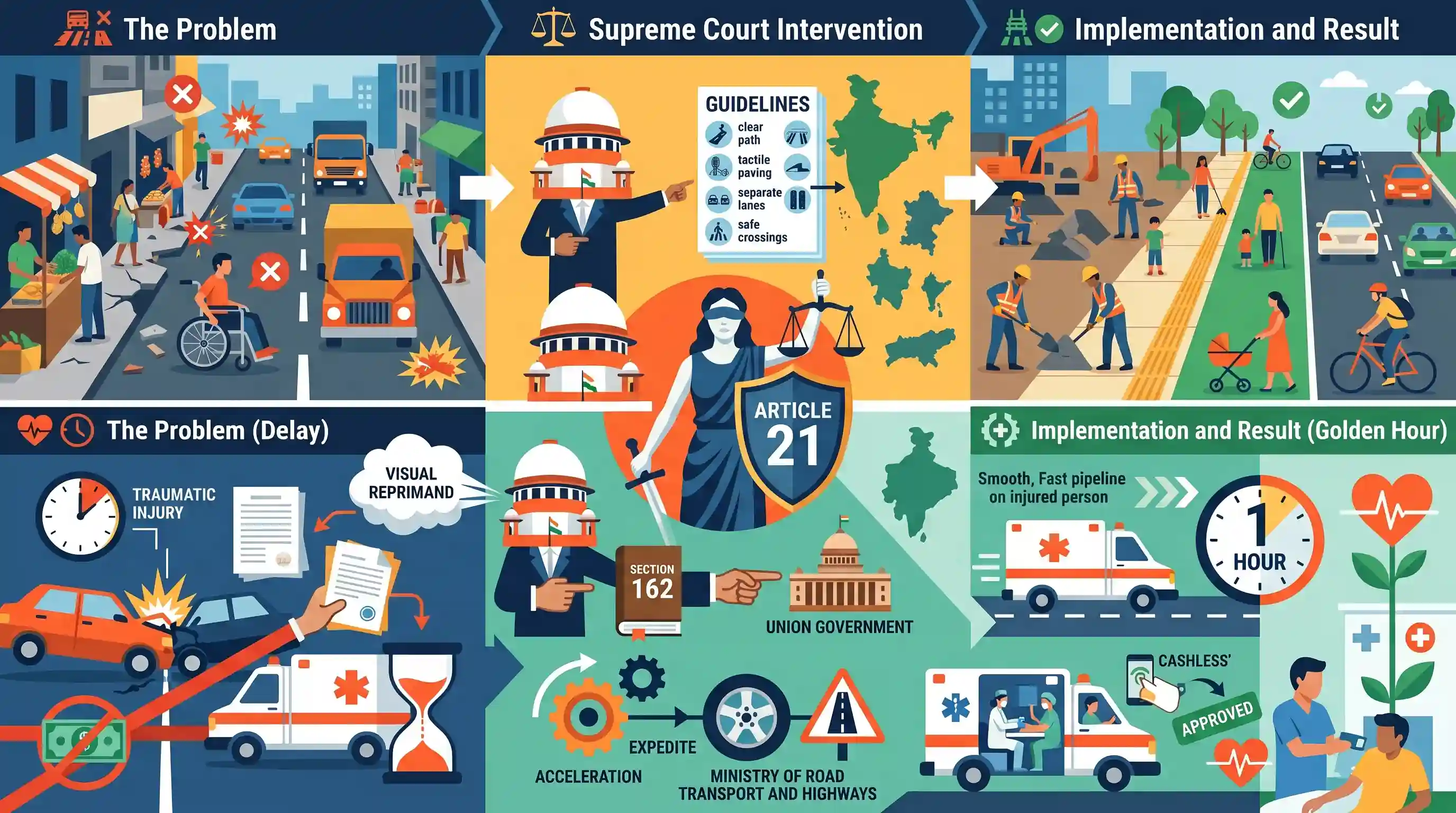
The Supreme Court of India has recognized the availability of proper footpaths and clear roads for pedestrians as a fundamental right protected under Article 21 (right to life). In an effort to curb road accidents, the Court ordered States and Union Territories to formulate guidelines for pedestrian infrastructure. Furthermore, the bench reprimanded the Union government for the delay in rolling out a nationwide scheme for cashless medical treatment for road accident victims during the crucial 'golden hour,' as mandated by Section 162 of the Motor Vehicles Act, directing the Ministry of Road Transport and Highways to expedite its implementation.
Key Points
- The Supreme Court declared that having proper footpaths and unhindered access to roads for pedestrians is a fundamental right under Article 21 (right to life).
- The Court directed all States and Union Territories to submit affidavits detailing the steps taken to frame guidelines ensuring functional and safe footpaths.
- The ruling is a response to the alarming number of road accidents in India, with over 1.6 lakh fatalities recorded annually, many of which involve pedestrians.
- The Supreme Court also heavily criticized the Union government's delay in implementing a nationwide cashless medical treatment scheme for road accident victims during the 'golden hour'.
- Section 162 of the Motor Vehicles Act mandates this emergency medical care, and the Ministry of Road Transport and Highways (MoRTH) has been directed to provide an update on its rollout.
Important Terms
Article 21 of the Indian Constitution

Guarantees the right to life and personal liberty. The Supreme Court recently expanded its scope to include the right to safe, unobstructed footpaths and trauma care as essential for dignity.
UPSC context
GS Paper II: Fundamental Rights and Judiciary. Tests understanding of judicial activism and the expansion of constitutional rights.
Golden Hour
The first 60 minutes after a traumatic injury when prompt medical care is most likely to prevent death or permanent disability. It is legally defined in the Motor Vehicles Act.
UPSC context
GS Paper II/III: Social Justice (Health) and Infrastructure. Critical for questions on road safety and emergency response systems.
Motor Vehicles Act (Section 162)
Mandates the Central Government to frame a scheme for cashless medical treatment of road accident victims during the 'golden hour,' regardless of insurance status or immediate payment.
UPSC context
GS Paper II: Governance and Laws. Tests knowledge of statutory provisions for public safety and health governance.
Cashless Medical Treatment Scheme
A statutory initiative providing emergency care up to ₹1.5 lakh per victim for the first 7 days following a road accident, funded by the Motor Vehicle Accident Fund.
UPSC context
GS Paper II/III: Government Schemes and Health Policy. Important for evaluating social security measures and accident response.
Motor Vehicle Accident Fund (MVAF)
A central fund established to provide compensation for 'hit and run' accidents and to finance the cashless medical treatment of road accident victims.
UPSC context
GS Paper III: Economy and Infrastructure. Relates to the financing mechanisms of public welfare and road safety initiatives.
S. Rajasekaran v. Union of India
The landmark Public Interest Litigation (PIL) that led to Supreme Court directives on pedestrian safety, the Good Samaritan law, and the implementation of cashless trauma care.
UPSC context
GS Paper II: Important Judgments. Significant for its role in shaping India's road safety and emergency care legal framework.
National Road Safety Board
A statutory body mandated under Section 215B of the Motor Vehicles Act to advise the government on road safety standards, infrastructure, and technology.
UPSC context
GS Paper II/III: Institutional Framework and Governance. Relevant for road safety management and institutional reforms.
Prelims Trap
The Golden Hour cashless treatment scheme is entirely a State mandate since 'Public Health' is a State subject.
While health is a State subject, framing the cashless emergency treatment scheme for accident victims is a Central Government statutory mandate under Section 162 of the Motor Vehicles Act.
Static Concepts Connected
What are key expansions of Article 21 relevant to urban infrastructure and livelihood?
- Right to Livelihood: Established in the Olga Tellis case, protecting pavement dwellers from arbitrary eviction without providing a reasonable alternative accommodation.
- Right to Clean Environment: Recognized in the M.C. Mehta cases, ensuring citizens have fundamental access to pollution-free air and water in urban spaces.
- Right to Safe Roads: Recently emphasized by the SC, guaranteeing pedestrians unobstructed and safe footpaths as an intrinsic part of the right to a dignified life.
How does the Motor Vehicles Act protect accident victims during emergencies?
- Golden Hour Definition: Statutorily defined in the Act as the crucial 60-minute window post-trauma where prompt medical care is most likely to prevent death.
- Good Samaritan Protection: Shields bystanders who assist accident victims from civil or criminal liability, police harassment, and forced witness status.
- Cashless Treatment Mandate: Section 162 mandates the Central Government to formulate a scheme for immediate cashless medical care for victims, bypassing procedural financial bottlenecks.
Cross-Topic Patterns
Urban Mobility & Fundamental Rights
Urban planning deficits, such as missing footpaths, are increasingly litigated as Article 21 violations, bridging infrastructure schemes (AMRUT, Smart Cities) directly with constitutional human rights.
Centralizing Emergency Trauma Care
While "Public Health" is fundamentally a State subject (List II), emergency accident care is governed by the Central Motor Vehicles Act, highlighting nuanced legislative overlaps.

Expect a prelims statement interlinking the statutory definition of 'Golden Hour' in the MV Act with the expanded scope of Article 21.
Linked PYQs · 3
Linked PYQs · 3
- 2023MainsGS2
“The Constitution of India is a living instrument with capabilities of enormous dynamism. It is a constitution made for a progressive society.” Illustrate with special reference to the expanding horizons of the right to life and personal liberty.
- 2019MainsGS1
How is efficient and affordable urban mass transport key to the rapid economic development of India?
- 2021PrelimsGS1
Consider the following statements : 1. 'Right to the City' is an agreed human right and the UN-Habitat monitors the commitments made by each country in this regard. 2. 'Right to the City' gives every occupant of the city the right to reclaim public spaces and public participation in the city. 3. 'Right to the City' means that the State cannot deny any public service or facility to the unauthorized colonies in the city. Which of the statements given above is/are correct?
