Japan Snap Election Results and National Security Posture
Source:The Hindu ↗
Why It Matters
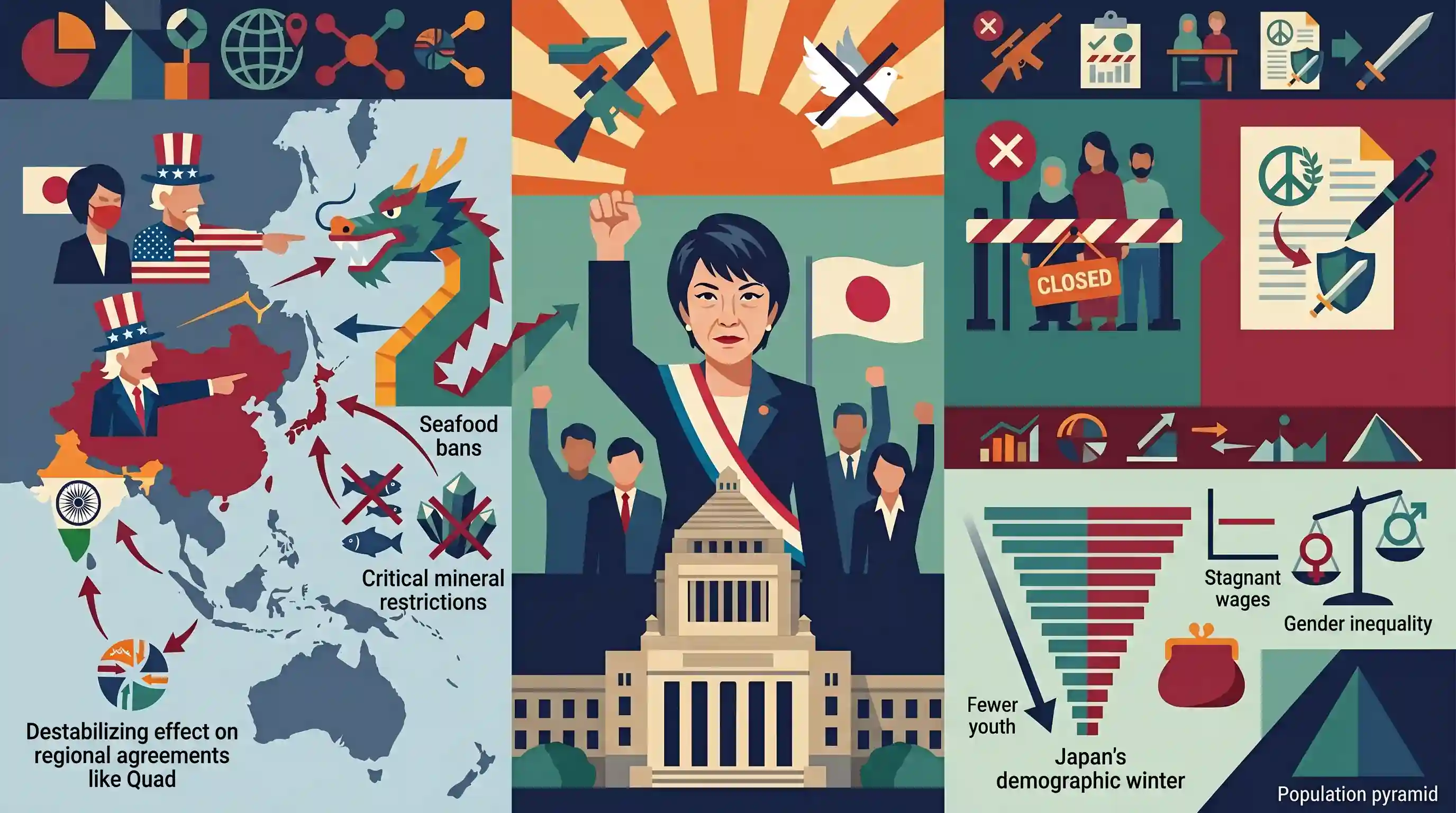
Japan's shift from constitutional pacifism to a more aggressive, militarised posture alters the balance of power in the Indo-Pacific. This shift directly impacts India's strategic calculations, Quad dynamics, supply chain resilience, and the broader global effort to manage an assertive China.
Summary
The editorial analyzes the decisive snap election victory of Sanae Takaichi, Japan's first female Prime Minister, whose Liberal Democratic Party (LDP) secured a supermajority. Despite this historic milestone for gender representation, Takaichi's right-wing nationalist agenda—characterized by anti-immigration policies, constitutional revisionism away from pacifism, and hawkish stances on China and Taiwan—threatens regional stability. Her statements have already triggered economic retaliation from Beijing regarding seafood and critical minerals. The editorial urges Takaichi to prioritize pressing domestic issues like Japan's demographic winter, stagnant wages, and gender inequality, rather than aggravating geopolitical tensions in the Indo-Pacific under external pressure from the US.
Key Points
- Sanae Takaichi led the Liberal Democratic Party (LDP) to a sweeping snap election victory, securing a supermajority and becoming Japan's first female Prime Minister.
- Takaichi champions a conservative, nationalist agenda marked by stricter immigration rules, tax cuts, and a push for greater militarisation.
- She advocates for revising Japan's pacifist constitution and suggested Japan would militarily defend Taiwan, provoking Chinese economic retaliation through seafood bans and critical mineral export limits.
- Japan is facing pressure from the US administration to adopt a more muscular security posture to counter China in the Indo-Pacific.
- The editorial urges Takaichi to prioritize pressing domestic challenges—such as an ageing population, stagnant wages, and gender disparities—over hawkish foreign policies that could destabilize the region.
Important Terms
Liberal Democratic Party (LDP)

Japan's dominant conservative political party, governing almost continuously since 1955. It advocates for pro-business policies, a strong U.S. alliance, and traditionally seeks to revise Japan’s pacifist constitution.
UPSC context
GS II (International Relations); tests understanding of political systems of major powers and their impact on India’s strategic interests.
Demographic Winter
A prolonged period of sub-replacement fertility rates (below 2.1) and rapid population aging, leading to a shrinking workforce, economic stagnation, and increased dependency ratios.
UPSC context
GS I (Population Issues); directly appeared in UPSC 2024 Mains. Tests socio-economic impacts of global demographic shifts.
Constitutional Revisionism
The political movement to amend Japan’s 1947 "Peace Constitution," specifically Article 9, to formally recognize the military and expand the Self-Defense Forces' (SDF) role in regional security.
UPSC context
GS II (International Relations); relevant for security dynamics in the Indo-Pacific and Japan's evolving defense posture.
Indo-Pacific
A geopolitical construct integrating the Indian and Pacific Oceans into a single strategic space, central to global trade, maritime security, and countering regional hegemony.
UPSC context
GS II (International Relations); tests knowledge of global groupings (QUAD), maritime security, and India’s Act East Policy.
Supermajority
A requirement for a proposal to gain significantly more than half the total votes (often two-thirds). In Japan, this allows the ruling coalition to override upper house vetoes.
UPSC context
GS II (Comparative Politics); tests understanding of legislative processes and political stability in democratic nations.
Economic Retaliation
The use of trade barriers, sanctions, or import bans by a nation to punish another's political decisions or security policies, often disrupting global supply chains.
UPSC context
GS III (Economics/Security); relevant for discussions on trade wars, supply chain resilience, and "weaponization" of trade.
Prelims Trap
Under its current constitution, Japan can legally deploy offensive military forces to defend Taiwan.
Article 9 of Japan's constitution explicitly renounces war and prohibits maintaining offensive military forces. Takaichi is pushing to revise this; it is not currently permitted.
Static Concepts Connected
What defines a 'Demographic Winter' in advanced economies like Japan?
- Sub-replacement fertility: A sustained period where birth rates fall far below the replacement level of 2.1, coupled with rising life expectancies and an ageing population.
- Economic stagnation: Leads to a shrinking workforce, rising dependency ratios, and severe strain on national pension and healthcare systems.
- Policy dilemma: Forces governments to choose between unpopular pro-immigration policies, raising taxes, or relying heavily on automation to sustain productivity.
What are the core features of Article 9 of the Japanese Constitution?
- Renunciation of war: Japan permanently renounces war as a sovereign right and the threat or use of force to settle international disputes.
- No offensive forces: Explicitly prohibits maintaining land, sea, and air forces, restricting Japan to purely defensive Self-Defense Forces (SDF).
- High revision threshold: Amending the article requires a two-thirds supermajority in both legislative houses, followed by a simple majority in a national referendum.
Cross-Topic Patterns
Weaponisation of critical mineral supply chains
China's use of export curbs on critical minerals against Japan connects directly to the GS3 Supply Chain Resilience Initiative (SCRI) and India's own vulnerabilities in its green energy transition.
Demographic winter vs. nationalist politics
Advanced economies desperately need immigrant labour to offset shrinking workforces, yet right-wing political shifts globally favour strict anti-immigration policies, creating a deep macroeconomic contradiction for UPSC GS1 Society.

Expect a GS2 prelims question linking Japan’s Article 9 pacifism, the Quad's Indo-Pacific security posture, and critical mineral supply.
Linked PYQs · 5
Linked PYQs · 5
- 2019MainsGS2
‘The time has come for India and Japan to build a strong contemporary relationship, one involving global and strategic partnership that will have a great significance for Asia and the world as a whole.’ Comment.
- 2024MainsGS2
‘The West is fostering India as an alternative to reduce dependence on China's supply chain and as a strategic ally to counter China's political and economic dominance.’ Explain this statement with examples.
- 2024MainsGS1
What is the concept of a 'demographic winter'? Is the world moving towards such a situation? Elaborate.
- 2021MainsGS2
The newly tri-nation partnership AUKUS is aimed at countering China's ambitions in the Indo-Pacific region. Is it going to supersede the existing partnerships in the region? Discuss the strength and impact of AUKUS in the present scenario.
- 2025MainsGS2
"With the waning of globalization, post-Cold War world is becoming a site of sovereign nationalism.” Elucidate.
