Taiwan Defense Spending Bill and Indo-Pacific Strategic Ramifications
Source:The Hindu ↗
Why It Matters
Taiwan's defense strategy and its reliance on U.S. arms are central to the stability of the Indo-Pacific region. The internal political dynamics shaping its military procurement directly influence the broader US-China geopolitical competition, which has cascading effects on global security and economic supply chains.
Summary
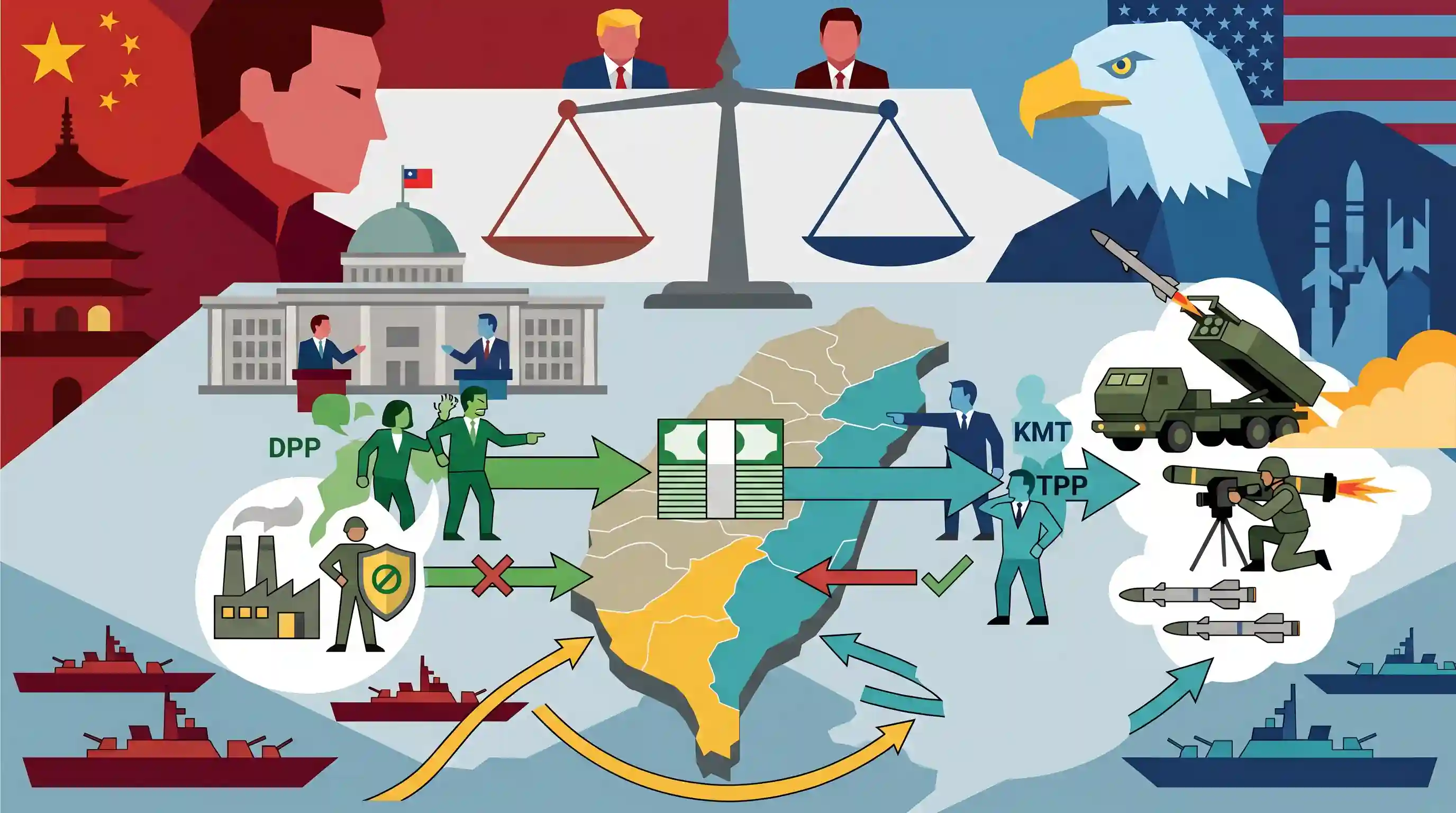
Taiwan's parliament has approved a $25 billion special defense spending bill, falling short of the nearly $40 billion requested by the ruling Democratic Progressive Party (DPP). Pushed through by the opposition Kuomintang (KMT) and Taiwan People's Party (TPP), the budget strictly mandates that funds be used exclusively for U.S. weapons, excluding domestic procurement. The DPP criticized this restriction, arguing it undermines Taiwan's self-reliance and sustainability in the event of a Chinese blockade. The approved budget covers advanced U.S. arms such as HIMARS, Javelin, and TOW missiles. The legislative compromise aims to balance reassuring the U.S. of Taiwan's commitment to defense while attempting not to overly provoke Beijing, especially ahead of a planned summit between U.S. President Donald Trump and Chinese President Xi Jinping.
Key Points
- Taiwan's parliament passed a $25 billion defense spending bill, significantly lower than the nearly $40 billion proposed by President Lai Ching-te's government.
- The opposition KMT and TPP restricted the budget exclusively to U.S. arms purchases, removing provisions for domestic defense procurement like Taiwanese drones.
- The ruling DPP criticized the move, arguing that a lack of investment in domestic defense capacity leaves Taiwan vulnerable in the event of a Chinese blockade.
- The package funds major U.S. weapons systems, including HIMARS, Javelin, and TOW 2B missiles, with potential for Patriot and Hellfire missiles in a second phase.
- The passage reflects a political compromise designed to reassure Washington of Taiwan's defense commitment without overly provoking Beijing ahead of a Trump-Xi summit.
Important Terms
Democratic Progressive Party (DPP)

Taiwan's current ruling party, advocating for Taiwanese sovereignty and a distinct democratic identity. It favors a "deterrence" strategy against China, emphasizing strong defense ties with the U.S. and other democratic nations.
UPSC context
GS Paper II (International Relations); relevant for studying the China-Taiwan conflict and its impact on Indo-Pacific security.
Kuomintang (KMT)
Taiwan's main opposition party, historically known as the Nationalist Party. It generally advocates for the "status quo" and dialogue with Beijing based on the "1992 Consensus," prioritizing regional stability.
UPSC context
GS Paper II; important for understanding cross-strait political dynamics and the historical roots of the Chinese Civil War.
Taiwan People's Party (TPP)
A centrist third party in Taiwan that currently holds the balance of power (kingmaker) in parliament. It focuses on pragmatic governance and often aligns with the opposition to check the ruling party's power.
UPSC context
GS Paper II; tests knowledge of "divided governments" and their impact on foreign and defense policy.
Legislative Yuan
The unicameral parliament of Taiwan responsible for passing laws and approving the national budget. Currently, no single party holds an absolute majority, leading to legislative compromises on defense and spending.
UPSC context
GS Paper II; comparative politics and the role of legislatures in shaping international defense procurement.
Taiwan Strait
A critical 180-km wide maritime passage separating Taiwan from mainland China. It is a major global shipping route and a primary geopolitical flashpoint in the U.S.-China strategic rivalry.
UPSC context
GS Paper II & III; crucial for maritime security, global trade chokepoints, and regional stability.
Indo-Pacific Region
A strategic geopolitical construct spanning the Indian and Pacific Oceans. It is central to India’s "Act East" policy and the vision of a "free, open, and inclusive" maritime order.
UPSC context
GS Paper II; fundamental concept for India’s foreign policy, QUAD, and maritime security strategies.
Prelims Trap
"The US is bound by a mutual defense treaty to militarily defend Taiwan."
The US abrogated its Mutual Defense Treaty with Taiwan in 1979. It now follows the Taiwan Relations Act, maintaining 'strategic ambiguity' and only committing to providing defensive weapons.
Static Concepts Connected
What is the 'Porcupine Strategy' in defense?
- Asymmetric warfare: Focuses on agile, relatively cheap weapons to inflict heavy, disproportionate damage on a superior invading force.
- Denial of dominance: Prioritizes mobile anti-ship and anti-air defense (e.g., HIMARS, Javelins) over large, expensive conventional platforms.
- Deterrence by cost: Aims to make an invasion or blockade so costly and protracted that it deters the adversary.
What is the US policy of 'Strategic Ambiguity'?
- Deliberate uncertainty: The US remains intentionally vague about whether it would militarily intervene to defend Taiwan.
- Dual deterrence: Deters China from unilaterally attacking (fearing US intervention) while deterring Taiwan from formally declaring independence.
- Taiwan Relations Act: A 1979 US domestic law obligating Washington to provide Taiwan with defensive arms without guaranteeing troops.
Cross-Topic Patterns
Defense indigenization vs. Imports
Taiwan's debate over prioritizing domestic drones versus US imports mirrors India's push for Atmanirbhar Bharat in defense to avoid supply-chain shocks during conflicts.
Maritime blockades & semiconductors
A potential Chinese blockade on Taiwan threatens global semiconductor supply chains, directly impacting India's tech sovereignty and economic security strategy.

The 'Porcupine Strategy' and US 'Strategic Ambiguity' are highly likely to feature as Prelims paired-terms or a Mains IR concept in 2026.
Linked PYQs · 5
Linked PYQs · 5
- 2020MainsGS2
What is the significance of Indo-US defence deals over Indo-Russian defence deals? Discuss with reference to stability in the Indo-Pacific region.
- 2021MainsGS2
“The USA is facing an existential threat in the form of a China, that is much more challenging than the erstwhile Soviet Union.” Explain.
- 2021MainsGS2
The newly tri-nation partnership AUKUS is aimed at countering China's ambitions in the Indo-Pacific region. Is it going to supersede the existing partnerships in the region? Discuss the strength and impact of AUKUS in the present scenario.
- 2014MainsGS3
Foreign Direct Investment (FDI) in the defence sector is now set to be liberalized. What influence this is expected to have on Indian defence and economy in the short and long run?
- 2014MainsGS2
With respect to the South China sea, maritime territorial disputes and rising tension affirm the need for safeguarding maritime security to ensure freedom of navigation and over flight throughout the region. In this context, discuss the bilateral issues between India and China.
