Taiwan Affirms US Arms Sales Commitment Amid Strategic Shifts
Source:The Hindu ↗
Why It Matters
The evolving dynamics between the U.S., China, and Taiwan are central to Indo-Pacific geopolitics. Any shifts in U.S. security commitments to Taiwan directly impact regional stability, global supply chains, and broader strategies to counter Chinese hegemony, which are vital for India's strategic calculations in the region.
Summary
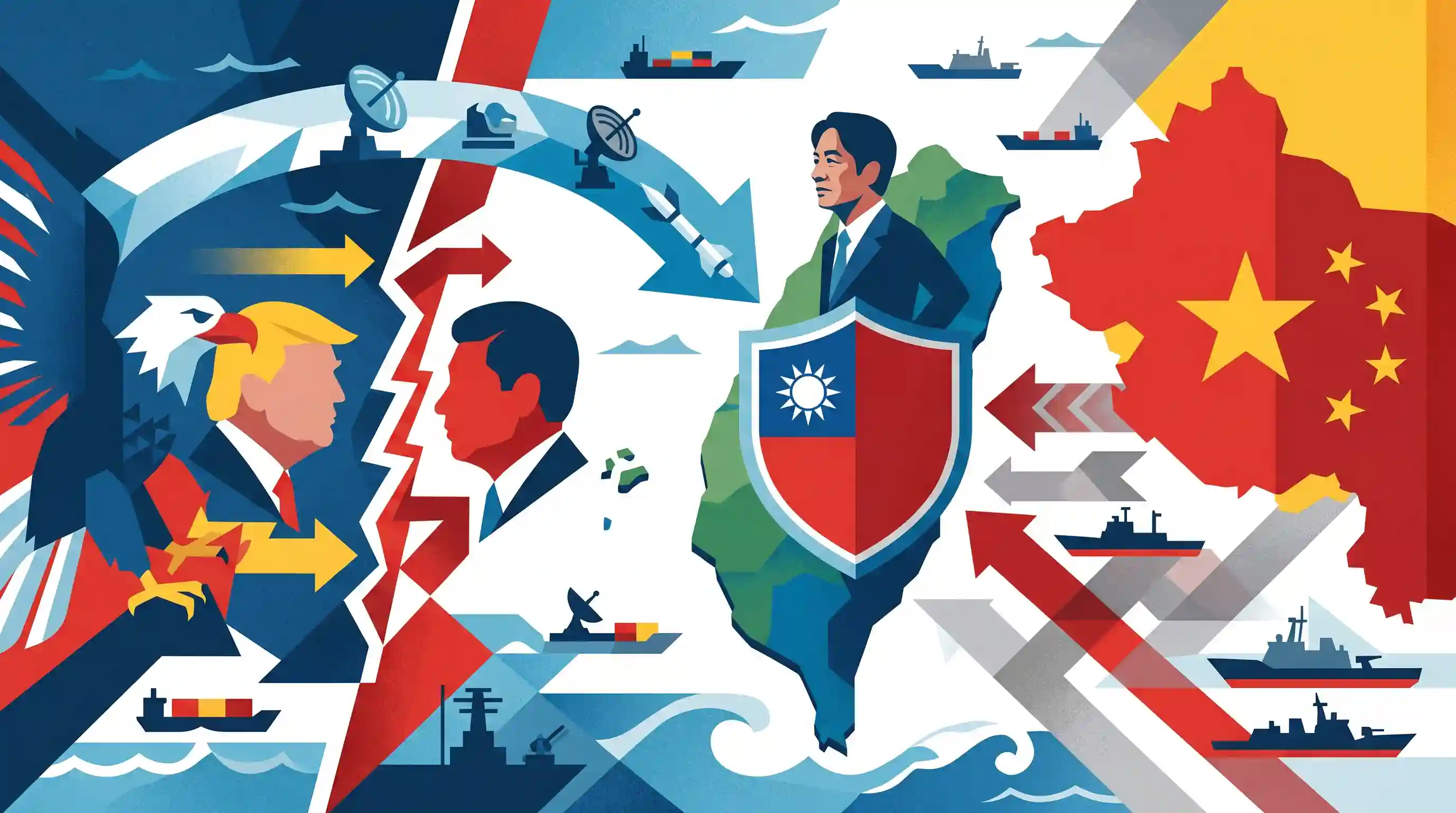
Taiwan's President Lai Ching-te has firmly asserted the island's sovereignty and democratic way of life in response to recent dialogue between U.S. President Donald Trump and Chinese President Xi Jinping. Amidst Trump's hesitation over future arms sales, Lai underscored that U.S. military support is a legally binding commitment under the 1979 Taiwan Relations Act, crucial for maintaining peace in the Taiwan Strait. Lai reiterated that the Republic of China (Taiwan) and the People's Republic of China are not subordinate to one another, firmly rejecting any 'grey-zone' warfare or pressure from Beijing while emphasizing Taiwan's existing status as an independent nation.
Key Points
- Taiwanese President Lai Ching-te stated that Taiwan will not be 'sacrificed or traded' following remarks by U.S. President Donald Trump at a summit with Chinese President Xi Jinping.
- Trump indicated hesitation over new arms sales to Taiwan, citing concerns about encouraging Taiwanese independence.
- Lai emphasized that U.S. arms sales are legally mandated by the 1979 Taiwan Relations Act and serve as a crucial deterrent against regional instability.
- The U.S. recently approved an $11 billion arms sales package to Taiwan, with another $14 billion package pending.
- Taiwan maintains its stance as a sovereign, independent country under the name 'Republic of China', dismissing the need to declare formal independence.
Important Terms
Taiwan Relations Act (1979)

A 1979 US law mandating unofficial relations with Taiwan, requiring the US to provide defensive weapons and treat any non-peaceful change to Taiwan's status as a grave security concern.
UPSC context
GS-II (International Relations); critical for analyzing US-China-Taiwan dynamics and India’s strategic posture in the Indo-Pacific.
Grey-zone Warfare
Coercive actions—like cyberattacks, maritime incursions, or economic pressure—that remain below the threshold of conventional war, used to achieve strategic goals through ambiguity and intimidation.
UPSC context
GS-III (Security); tests understanding of non-conventional threats and maritime security challenges in the South China Sea.
Republic of China (ROC)
The official name of the government in Taiwan. Established in 1912 on the mainland, it relocated to Taiwan in 1949 and now functions as a multi-party democracy.
UPSC context
GS-II (IR); essential for distinguishing between the two entities in the 'One China Policy' framework.
People's Republic of China (PRC)
The sovereign state governing mainland China since 1949 under Communist rule. It claims Taiwan as a breakaway province under its 'One China Principle.'
UPSC context
GS-II (IR); central to global geopolitics, India-China relations, and regional security in East Asia.
Democratic Progressive Party (DPP)
Taiwan's current ruling party, which emphasizes a distinct Taiwanese identity and democratic sovereignty, generally rejecting the '1992 Consensus' that views Taiwan as part of one China.
UPSC context
GS-II (IR); relevant for tracking regional political shifts that influence Indo-Pacific stability and trade.
Prelims Trap
"India and the United States officially endorse China's 'One China Principle'."
India and the US follow the 'One China Policy' (acknowledging the claim), NOT the 'One China Principle' (endorsing the claim). India has stopped explicitly mentioning the policy in statements since 2010.
Static Concepts Connected
What constitutes 'Grey-Zone Warfare' in modern security?
- Threshold limit: Operates in the ambiguous space between peace and war, remaining deliberately below the threshold of conventional armed military conflict.
- Non-kinetic tactics: Employs unconventional and non-kinetic tactics like cyberattacks, economic coercion, disinformation, and maritime militias to achieve strategic objectives incrementally.
What is the strategic significance of the First Island Chain?
- Geographical extent: An archipelagic string spanning from the Kuril Islands in the north, through Japan, Taiwan, and the Philippines, down to Borneo.
- Containment strategy: Acts as a critical maritime barrier utilized by the US and its allies to contain China's naval power projection into the wider Pacific Ocean.
- Taiwan's centrality: Taiwan forms the crucial geographical midpoint of this chain; its capture would give China unhindered deep-water access to the Pacific.
Cross-Topic Patterns
Semiconductor supply chain geopolitics
Taiwan produces over 60% of the world's semiconductors. A crisis in the Taiwan Strait directly threatens India’s electronics manufacturing and digital public infrastructure goals (GS3).
Grey-zone tactics in South China Sea
China's grey-zone strategy against Taiwan perfectly mirrors its maritime militia deployments against the Philippines, directly linking to India’s broader Indo-Pacific maritime security and Act East policy focus.

Expect a Prelims question differentiating 'First/Second Island Chains' or defining 'Grey-zone warfare' within Indo-Pacific security.
Linked PYQs · 3
Linked PYQs · 3
- 2020MainsGS2
What is the significance of Indo-US defence deals over Indo-Russian defence deals? Discuss with reference to stability in the Indo-Pacific region.
- 2021MainsGS2
The newly tri-nation partnership AUKUS is aimed at countering China's ambitions in the Indo-Pacific region. Is it going to supersede the existing partnerships in the region? Discuss the strength and impact of AUKUS in the present scenario.
- 2024MainsGS2
‘The West is fostering India as an alternative to reduce dependence on China's supply chain and as a strategic ally to counter China's political and economic dominance.’ Explain this statement with examples.
