Taiwan seeks US assurances on tariff deals after court ruling
Source:The Hindu ↗
Why It Matters
The article illustrates the shifting dynamics of global trade, where major powers use tariff threats and bilateral pacts to secure strategic investments (e.g., in semiconductors and AI). It is highly relevant for UPSC aspirants studying the waning of globalization, trade wars, supply chain resilience, and the economic diplomacy driving modern international relations.
Summary
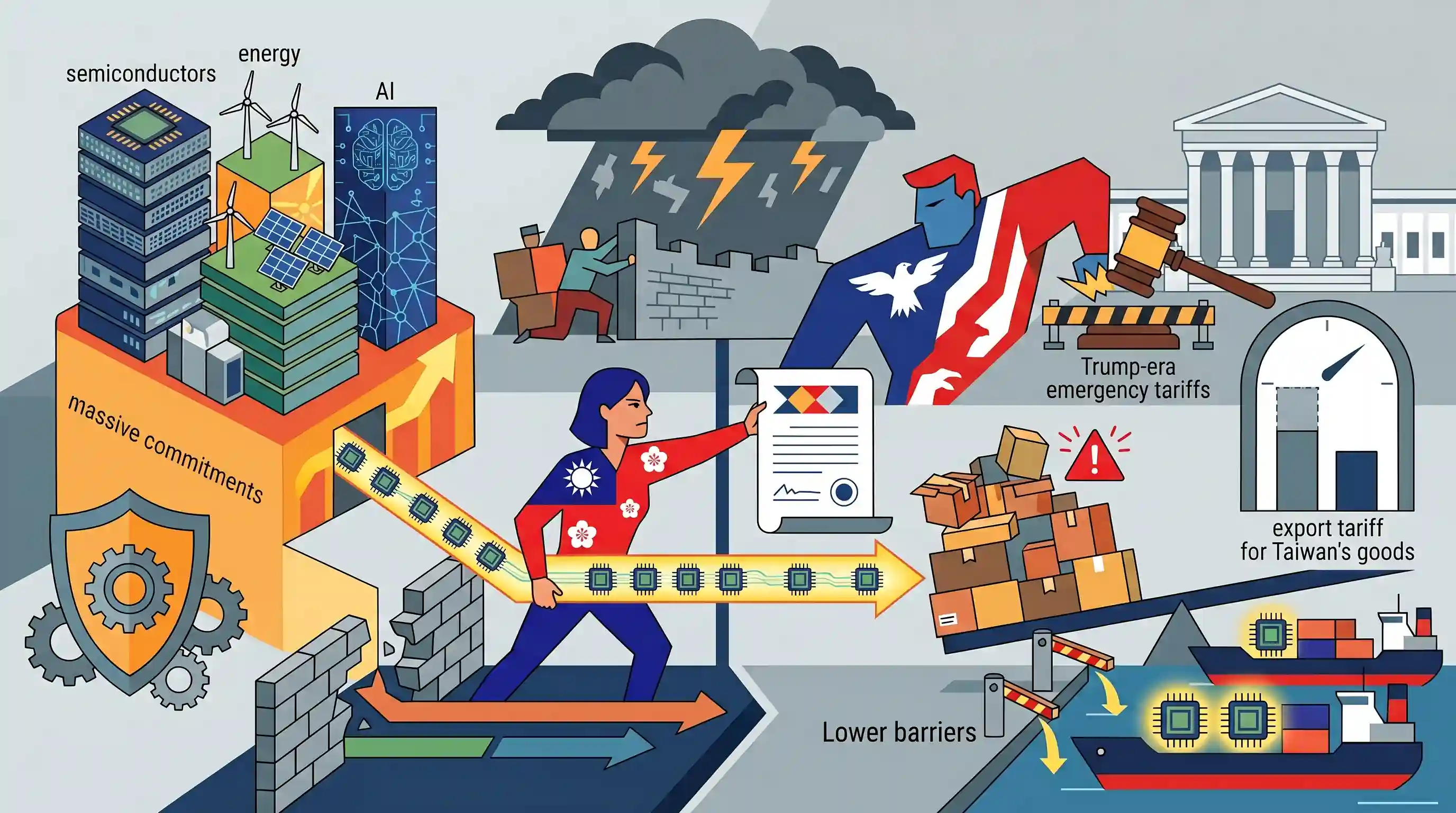
Taiwan is proactively engaging with the United States to ensure that recently negotiated tariff reduction agreements remain intact after the U.S. Supreme Court struck down former President Donald Trump's emergency tariffs. Under these agreements, notably the Agreement on Reciprocal Trade (ART), Taiwan secured a reduction in export tariffs to 15% in exchange for massive commitments: $250 billion in investments in U.S. semiconductor, energy, and AI sectors, a $250 billion credit guarantee, and the elimination of tariffs on nearly all U.S. goods. While Taiwan expects its crucial semiconductor sector to retain preferential treatment, its large trade surplus with the U.S. remains a potential point of friction amid growing protectionist trade policies.
Key Points
- Taiwan is seeking U.S. assurances that previously negotiated tariff reduction deals (lowering tariffs from 20% to 15%) will be honored after the U.S. Supreme Court struck down President Trump's emergency tariffs.
- The U.S. is set to stop collecting the invalidated tariffs by February 24, although Trump has threatened to impose higher duties under alternative trade laws if nations renege on trade agreements.
- Under the Agreement on Reciprocal Trade (ART), Taiwanese firms committed to investing $250 billion in U.S. semiconductor, AI, and energy production, alongside $250 billion in credit guarantees.
- Taiwan also agreed to eliminate or lower tariffs on almost all U.S. goods and significantly increase imports of U.S. products like natural gas.
- Despite expectations that preferential tariffs for Taiwan's vital semiconductor exports will remain unchanged, Taiwan's substantial trade surplus with the U.S. continues to present economic risks.
Important Terms
Agreement on Reciprocal Trade (ART)

A 2026 bilateral deal where Taiwan committed $500 billion in US investments and credit guarantees for semiconductors and AI in exchange for a 15% export tariff cap.
UPSC context
GS-II: Bilateral agreements. Tests understanding of 'investment-for-market-access' deals and their impact on global supply chains.
International Emergency Economic Powers Act (IEEPA)
A 1977 law granting the US President emergency trade powers; restricted by a 2026 Supreme Court ruling (Learning Resources v. Trump) to prevent unilateral tariff imposition.
UPSC context
GS-II: Global legal frameworks. Relevant for analyzing executive vs. legislative powers in international trade.
Section 232 (Trade Expansion Act)
A 1962 law allowing US tariffs for 'national security' reasons. Unlike IEEPA, these duties (e.g., on steel/aluminum) often remain valid despite recent judicial restrictions on emergency powers.
UPSC context
GS-III: Trade barriers. Important for understanding non-WTO compliant protectionist measures affecting Indian exports.
Semiconductor Geopolitics
The strategic manipulation of chip manufacturing and supply chains as leverage in international power dynamics, focusing on 'chokepoint' technologies like advanced logic chips.
UPSC context
GS-II & III: Strategic relations and Industrial Policy. Vital for India’s Semiconductor Mission and supply chain resilience.
Protectionism
Economic policy of shielding domestic industries from foreign competition through tariffs, quotas, or subsidies, often leading to retaliatory trade wars and supply chain decoupling.
UPSC context
GS-III: Liberalization and Trade. Tests ability to critique 'America First' vs 'AtmaNirbhar' policies in global commerce.
U.S. Supreme Court (Trade Ruling)
A 2026 U.S. judicial decision (Learning Resources, Inc. v. Trump) that struck down executive-imposed emergency tariffs, reasserting congressional authority over taxation and international trade duties.
UPSC context
GS-II: International impact of domestic laws. Relevant for understanding shifts in global trade predictability.
Prelims Trap
The U.S.-Taiwan Agreement on Reciprocal Trade (ART) was negotiated under the WTO's dispute settlement mechanism.
The ART is a transactional bilateral deal bypassing the WTO, driven by U.S. domestic tariff threats and Taiwan's strategic leverage in semiconductor supply chains.
Static Concepts Connected
What are the standard WTO-approved Trade Remedy Measures?
- Anti-dumping Duty (ADD): Applied when foreign companies sell goods in an importing country below their fair market value.
- Countervailing Duty (CVD): Imposed to neutralize the negative effects of unfair subsidies provided by foreign governments to their exporters.
- Safeguard Duty: A temporary restriction on imports to protect a specific domestic industry from an unexpected surge in imports.
What is 'Semiconductor Diplomacy' and the 'Silicon Shield'?
- Strategic Leverage: Using dominance in manufacturing critical technologies (like microchips) as a tool for geopolitical leverage and trade concessions.
- Deterrence Mechanism: Global reliance on a nation's tech exports (e.g., Taiwan's TSMC) acts as a 'shield' against military or economic aggression.
- Supply Chain Security: Forces major powers to invest in bilateral guarantees to secure resilient, uninterrupted tech supply chains.
Cross-Topic Patterns
Semiconductors & India's Strategic Autonomy
Taiwan leverages chip dominance for trade concessions. India's Semiconductor Mission (ISM) aims to build similar strategic autonomy to buffer against unilateral trade shocks and supply chain weaponization.
Weaponization of Trade Deficits
A persistent trade surplus is now a geopolitical vulnerability. Deficit nations increasingly use unilateral domestic laws (like U.S. Section 301) rather than multilateral WTO mechanisms to force concessions.

Expect a 2026 GS2 mains question on how 'transactional protectionism' and 'semiconductor diplomacy' are bypassing traditional WTO frameworks.
Linked PYQs · 3
Linked PYQs · 3
- 2018MainsGS2
What are the key areas of reform if the WTO has to survive in the present context of "Trade War', especially keeping in mind the interest of India?
- 2025MainsGS3
India aims to become a semiconductor manufacturing hub. What are the challenges faced by the semiconductor industry in India? Mention the salient features of the India Semiconductor Mission.
- 2025MainsGS2
"With the waning of globalization, post-Cold War world is becoming a site of sovereign nationalism.” Elucidate.
