Taiwan Strait Aviation Routes and Grey Zone Tactics
Source:The Hindu ↗
Why It Matters
The increasing use of 'grey-zone' tactics by China—such as altering civil aviation routes to exert strategic pressure—highlights the volatile security environment in the Indo-Pacific. This is crucial for UPSC aspirants understanding regional stability, maritime security, and the broader implications of US-China-Taiwan dynamics on India's strategic interests in the Indo-Pacific.
Summary
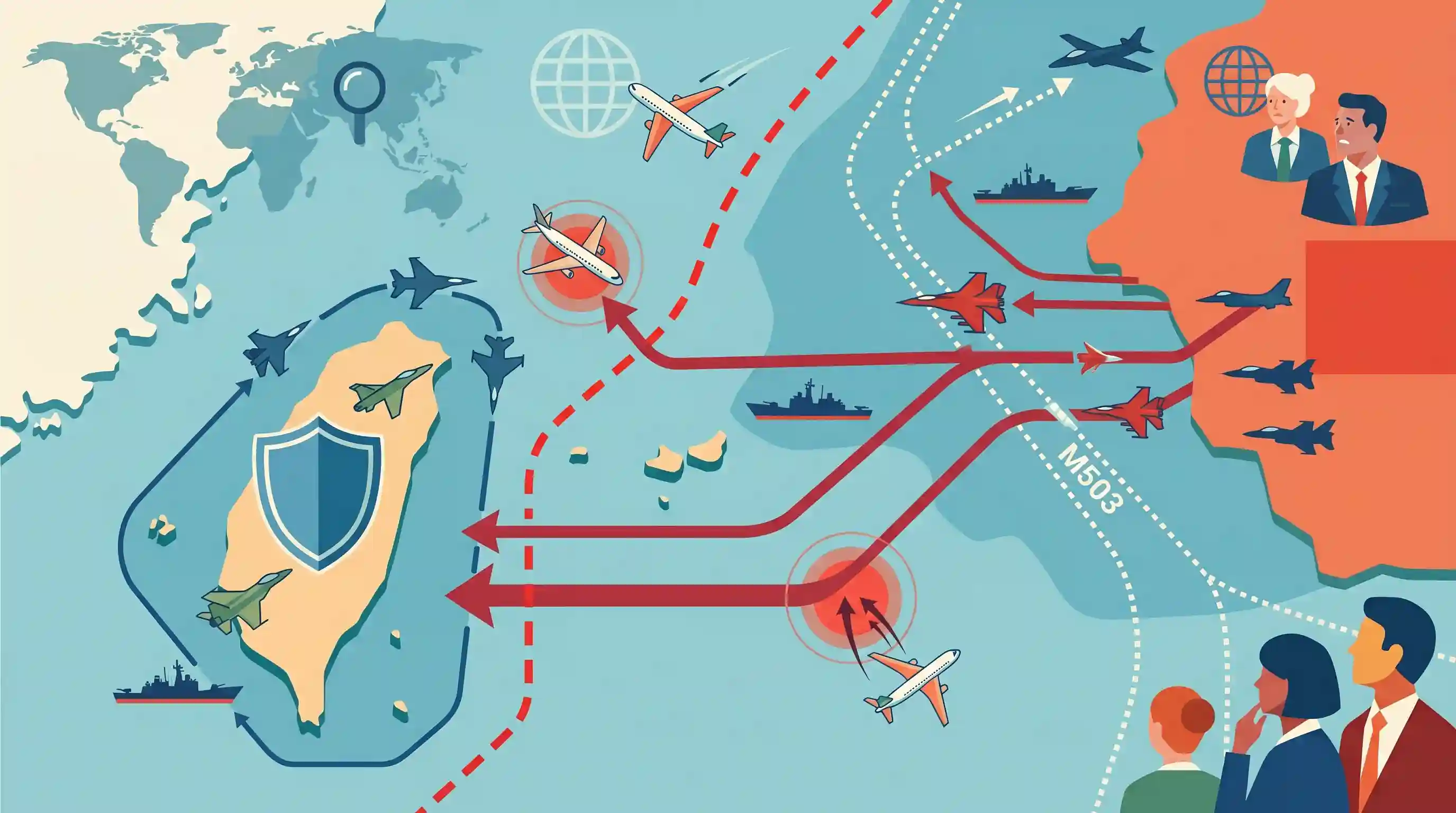
Tensions in the Taiwan Strait have escalated as Taiwan condemned China's unilateral launch of new aviation routes connecting to the M503 flight path. Taiwan argues the move, executed without prior consultation, brings Chinese aircraft dangerously close to the median line and Taiwan-controlled islands, undermining the cross-strait status quo and compromising aviation safety. Taipei views these airspace adjustments as a calculated 'grey-zone' tactic to exert military and political pressure. Conversely, Beijing justifies the new routes as necessary administrative adjustments to relieve airspace congestion and improve flight efficiency in the region.
Key Points
- Taiwan has strongly condemned China for unilaterally opening new flight connecting routes (W122 and W123) off the M503 flight path without prior consultation.
- The new routes bring Chinese flights closer to the median line of the Taiwan Strait and to Taiwan-controlled islands (Matsu and Kinmen), raising security and aviation safety concerns.
- Taiwan views this move as a 'grey-zone' tactic designed to pressure Taipei militarily and politically while altering the status quo in the Taiwan Strait.
- China's Civil Aviation Administration argues the flight path adjustments are routine measures to alleviate airspace congestion and improve flight punctuality.
Important Terms
M503 flight path

A north-south civil aviation corridor in the Taiwan Strait established by China. Its proximity to the de-facto median line makes it a major source of security and sovereignty tension.
UPSC context
GS-II: International Relations; tests knowledge of Indo-Pacific security, territorial sovereignty disputes, and cross-strait regional dynamics.
W122 and W123 routes
East-west flight paths connecting Fuzhou and Xiamen to the M503 corridor. Their eastbound activation brings Chinese aircraft close to Taiwan-controlled islands like Kinmen and Matsu.
UPSC context
GS-II: IR; tests understanding of regional aviation safety, territorial integrity, and civil-military signaling in the First Island Chain.
Grey-zone tactics
Coercive, incremental actions—short of open warfare—used to achieve political or security goals. Examples include unilateral flight path changes, maritime militia activities, and disinformation.
UPSC context
GS-III: National Security & GS-II: IR; critical term for modern hybrid warfare and asymmetric conflict strategies in the Indo-Pacific.
Median line
An unofficial de-facto maritime and air boundary in the middle of the Taiwan Strait separating mainland China and Taiwan, long respected to prevent military accidents.
UPSC context
GS-II: International Relations; essential for questions on maritime disputes, the One China policy, and cross-strait status quo.
Civil Aviation Administration of China (CAAC)
China's state aviation regulator which manages the Shanghai Flight Information Region (FIR). It implemented the M503 adjustments, citing the need to reduce airspace congestion.
UPSC context
GS-II: IR; relevant to the role of administrative bodies in executing state-led geopolitical strategies.
Civil Aeronautics Administration (Taiwan)
Taiwan's aviation authority responsible for managing the Taipei Flight Information Region (FIR). It opposes China's unilateral route changes due to safety and security risks.
UPSC context
GS-II: IR; tests administrative responses to international pressure and management of contested airspace.
Prelims Trap
The Median Line in the Taiwan Strait is an officially recognized maritime boundary under UNCLOS.
The Median Line (Davis Line) is strictly an unofficial, historical buffer created during the Cold War. It is not recognized by Beijing and holds no legal standing under UNCLOS.
Static Concepts Connected
What is 'Grey-Zone Warfare' in international security?
- Below threshold: Coercive state actions that fall below the threshold of conventional armed conflict or formal war.
- Salami slicing: Gradual, incremental actions designed to alter the strategic status quo without triggering a direct military response.
- Civilian masking: Using civilian infrastructure, like commercial aviation routes or fishing militias, to achieve strategic and political goals.
What is the geographic and economic significance of the Taiwan Strait?
- Connecting seas: It is a strategic, 180-kilometer-wide waterway linking the East China Sea to the South China Sea.
- Trade artery: A critical global maritime chokepoint handling nearly half of the world's container shipping fleet.
- Geopolitical buffer: Houses the unofficial 'Median Line' and heavily fortified Taiwan-controlled archipelagos like Kinmen and Matsu off China's coast.
Cross-Topic Patterns
Grey-zone tactics & LAC salami slicing
China's use of civil aviation to pressure Taiwan mirrors its strategy along the LAC, where it builds dual-use border villages to slowly alter the status quo without triggering outright war.
Freedom of Navigation & UNCLOS
Unilateral adjustments of airspace and maritime buffers by China repeatedly test UNCLOS norms, connecting Taiwan Strait tensions to broader South China Sea and Indo-Pacific freedom of navigation disputes.

Mapping pairs of East Asian flashpoints (Kinmen, Matsu, Senkaku) with their controlling nations is a highly probable 2026 Prelims format.
Linked PYQs · 3
Linked PYQs · 3
- 2014MainsGS2
With respect to the South China sea, maritime territorial disputes and rising tension affirm the need for safeguarding maritime security to ensure freedom of navigation and over flight throughout the region. In this context, discuss the bilateral issues between India and China.
- 2022PrelimsGS1
Which one of the following statements best reflects the issue with Senkaku Islands, sometimes mentioned in the news?
- 2021MainsGS2
The newly tri-nation partnership AUKUS is aimed at countering China's ambitions in the Indo-Pacific region. Is it going to supersede the existing partnerships in the region? Discuss the strength and impact of AUKUS in the present scenario.
