Taiwan Defense Modernization and Asymmetric Warfare Strategy
Source:The Hindu ↗
Why It Matters
The geopolitical dynamics between Taiwan, China, and the U.S. directly impact peace and stability in the Indo-Pacific region. For UPSC aspirants, Taiwan's strategic shift towards asymmetric warfare and drone technology highlights key trends in modern defense preparedness and international security alliances.
Summary
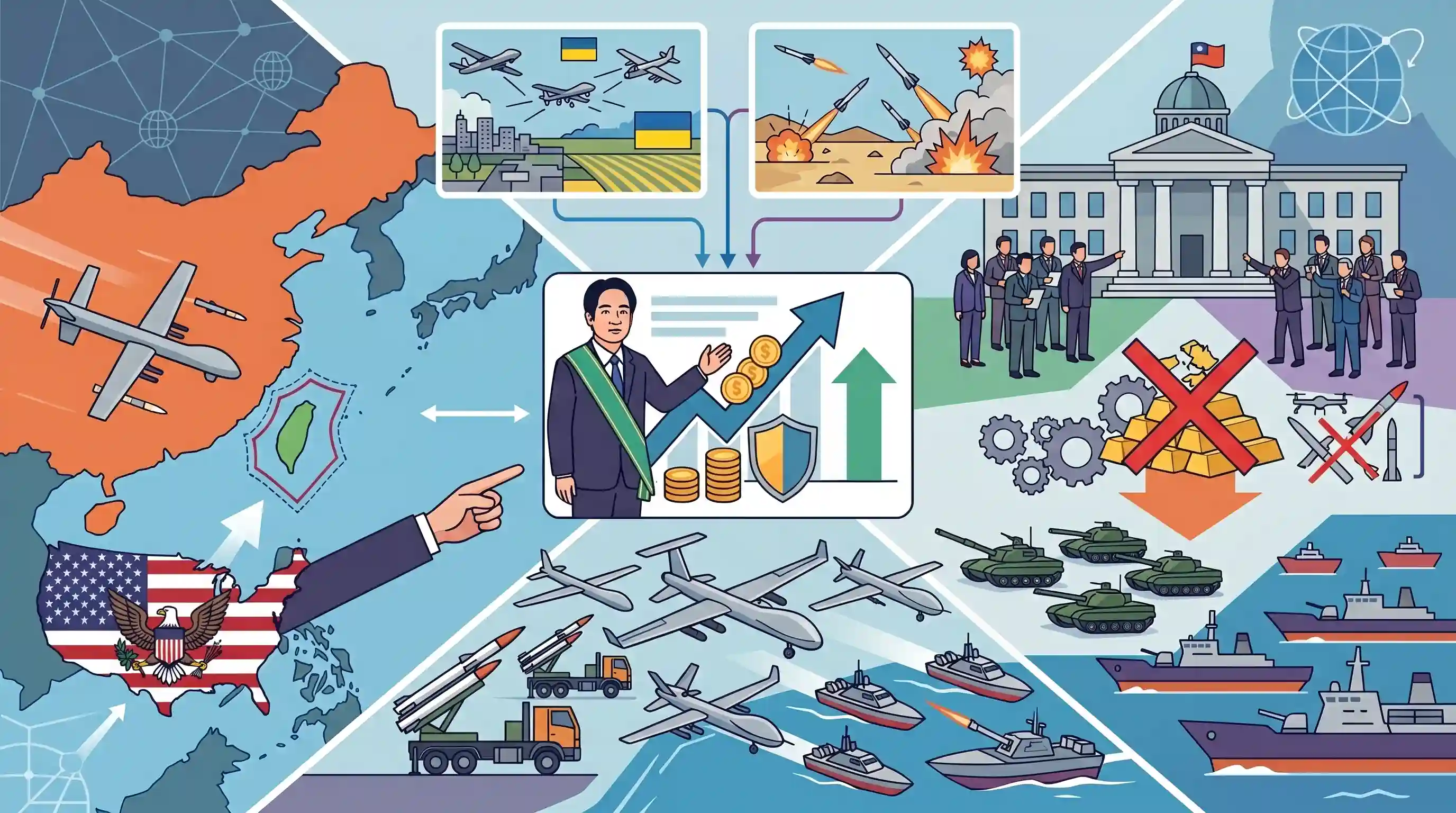
Taiwan's President Lai Ching-te has affirmed his commitment to increasing defense spending to 5% of GDP by 2030 and modernizing the military through asymmetric warfare systems, despite the Opposition-led Parliament cutting funds for domestic drones and missiles from a recent $40 billion supplementary budget. The strategic shift emphasizes unmanned technologies, learning from recent conflicts in Ukraine and West Asia. Additionally, the move to boost defense expenditure aligns with calls from the United States for allies to increase their defense burden-sharing amidst rising regional tensions in the Indo-Pacific.
Key Points
- Taiwan's Opposition-controlled Parliament passed a reduced supplementary budget, funding U.S. weapons but vetoing domestically made drones and missiles.
- President Lai Ching-te reiterated his commitment to increasing the defense budget to 5% of GDP by 2030 to bolster deterrence against China.
- Taiwan's defense strategy is increasingly focusing on 'asymmetric warfare' and unmanned systems, drawing strategic lessons from the wars in Ukraine and West Asia.
- The push for higher defense spending aligns with expectations from the U.S., Taiwan's major ally, for partners to take on greater defense burden-sharing.
Important Terms
Asymmetric Warfare

A military strategy where a weaker power uses unconventional tactics—like drones, cyberattacks, or guerrilla warfare—to exploit the vulnerabilities of a significantly more powerful adversary.
UPSC context
Relevant for GS Paper III (Internal Security) and GS Paper II (International Relations); focuses on modern defense strategies against superior conventional forces.
Indo-Pacific
A geopolitical region encompassing the Indian and Pacific Oceans, treated as a single strategic space focusing on maritime security, trade routes, and a rules-based order.
UPSC context
Crucial for GS Paper II (International Relations); tests knowledge of regional security architectures like QUAD and India's 'Act East' policy.
Cross-Strait Relations
The complex political, economic, and military relationship between mainland China (PRC) and Taiwan (ROC), centered on sovereignty disputes and the 'One China' policy.
UPSC context
Significant for GS Paper II (IR); involves global flashpoints, semiconductor supply chains, and the balance of power in East Asia.
Defense Burden-sharing
The expectation that allies (e.g., in NATO or the Indo-Pacific) contribute a 'fair share' to collective security costs, typically measured as a percentage of GDP.
UPSC context
Relevant for GS Paper II (International Relations); tests understanding of US-led security alliances and evolving global security commitments.
Legislative Yuan
The unicameral parliament of Taiwan (Republic of China), holding supreme authority to pass laws, approve budgets, and oversee the executive branch.
UPSC context
Relevant for GS Paper II (International Relations); tests knowledge of foreign political institutions and their impact on regional stability and defense.
Prelims Trap
"The 'Porcupine Strategy' is India's military doctrine for defending the Line of Actual Control against China."
The Porcupine Strategy is specifically Taiwan's asymmetric warfare doctrine using cost-effective, agile technologies to deter a conventionally superior Chinese invasion, not an Indian doctrine.
Static Concepts Connected
What constitutes the "First Island Chain" in Indo-Pacific geopolitics?
- Geographic extent: A chain of archipelagos encompassing the Kuril Islands, Japan, the Ryukyu Islands, Taiwan, and the northern Philippines.
- Strategic value: Serves as the primary maritime barrier restricting China's People's Liberation Army Navy (PLAN) from unrestricted deep-water access to the broader Pacific Ocean.
What are the core tenets of Asymmetric Warfare?
- Power disparity: Involves conflict between nations or non-state actors whose relative military power, resources, or strategies differ drastically.
- Unconventional tools: Employs low-cost, decentralized technologies like swarming drones, anti-ship missiles, and cyber-attacks to neutralize high-value, traditional military platforms.
Cross-Topic Patterns
Drone revolution in asymmetric warfare
Taiwan's shift to domestic unmanned aerial vehicles directly mirrors Ukraine's tactical reliance on FPV drones, marking a global security transition towards cheap, decentralized platforms as strategic equalizers.
Geopolitical burden-sharing architecture
US expectations for Taiwan to reach 5% GDP in defense spending parallels its demands for NATO's 2% benchmark, signaling a shift from blanket security guarantees to capacity-building alliances.

Expect a 2026 Prelims pair-matching question linking geographic/strategic terms (First Island Chain, Porcupine Strategy) to their regions.
Linked PYQs · 4
Linked PYQs · 4
- 2021MainsGS2
The newly tri-nation partnership AUKUS is aimed at countering China's ambitions in the Indo-Pacific region. Is it going to supersede the existing partnerships in the region? Discuss the strength and impact of AUKUS in the present scenario.
- 2020MainsGS2
What is the significance of Indo-US defence deals over Indo-Russian defence deals? Discuss with reference to stability in the Indo-Pacific region.
- 2014MainsGS2
With respect to the South China sea, maritime territorial disputes and rising tension affirm the need for safeguarding maritime security to ensure freedom of navigation and over flight throughout the region. In this context, discuss the bilateral issues between India and China.
- 2023MainsGS3
The use of unmanned aerial vehicles (UAVs) by our adversaries across the borders to ferry arms/ammunitions, drugs, etc., is a serious threat to the internal security. Comment on the measures being taken to tackle this threat.
