Taiwan Military Drone Bill and Asymmetric Warfare Strategy
Source:The Hindu ↗
આ શા માટે મહત્વનું છે
For UPSC aspirants, Taiwan's defense strategies and its focus on drone technology are highly relevant for GS Paper 2 (International Relations) and GS Paper 3 (Internal Security and Defence). Understanding the shift towards asymmetric warfare using UAVs provides crucial context for analyzing regional security dynamics in the Indo-Pacific, border security challenges, and the evolving nature of modern conflicts.
સારાંશ
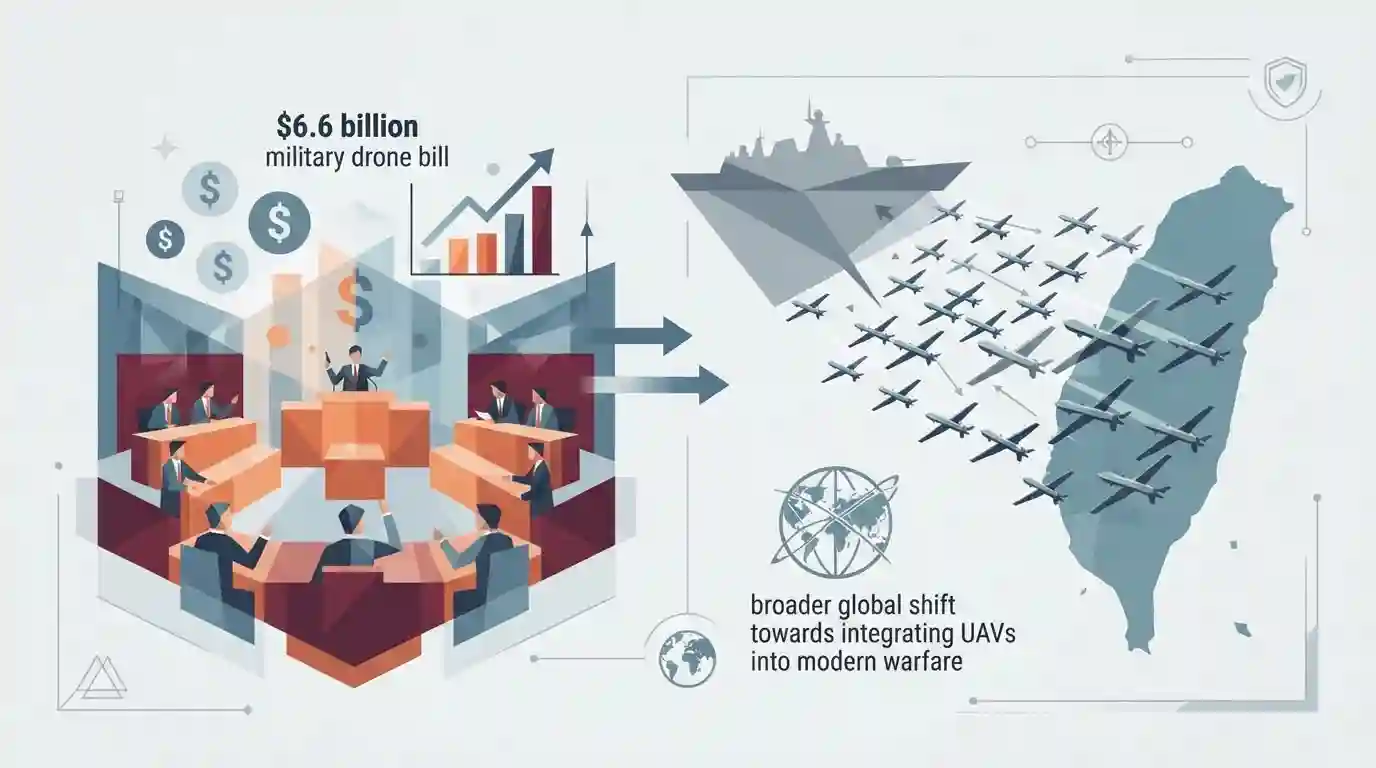
Taiwan's leadership is pushing for a substantial $6.6 billion military drone bill ahead of a critical legislative vote, signaling a major investment in asymmetric defense capabilities. This move is largely a strategic response to increasing military assertiveness from China and reflects a broader global shift towards integrating unmanned aerial vehicles (UAVs) into modern warfare. The bill's success will depend on navigating domestic political dynamics, while its implementation could have significant implications for security and deterrence in the Indo-Pacific region.
મુખ્ય મુદ્દા
- The Taiwanese President is advocating for the passage of a $6.6 billion military drone bill ahead of a crucial legislative vote.
- This significant investment in unmanned aerial vehicles (UAVs) highlights Taiwan's strategy to bolster its asymmetric warfare capabilities amid rising military pressure from China.
- The focus on drone technology reflects broader global trends where UAVs have become central to modern defense strategies, drawing lessons from contemporary conflicts.
- The passage of the bill is contingent on domestic political consensus, underscoring the internal legislative dynamics shaping Taiwan's national security posture.
મહત્વપૂર્ણ શબ્દો
Asymmetric Warfare

A conflict where opposing forces have unequal military capabilities. The weaker actor uses unconventional tactics—like drones, guerrilla combat, or cyberattacks—to exploit a stronger adversary's vulnerabilities and erode their will to fight.
UPSC context
GS Paper 3 (Security). Tests understanding of modern warfare evolution, hybrid threats, and defense modernization strategies.
Indo-Pacific Security
A geostrategic framework viewing the Indian and Pacific Oceans as a single, interconnected theater. It emphasizes a free, open, and rules-based maritime order, focusing on freedom of navigation and managing regional power dynamics.
UPSC context
GS Paper 2 (International Relations). Crucial for questions on QUAD, India's maritime strategy, and regional deterrence.
Unmanned Aerial Vehicles (UAVs)
Remotely piloted or autonomous aircraft used for surveillance, target acquisition, and strikes. They are increasingly central to modern defense for their cost-effectiveness and ability to execute high-risk operations without risking human pilots.
UPSC context
GS Paper 3 (Science & Tech, Security). Assesses knowledge of emerging defense technologies, border surveillance, and combat.
$6.6 billion military drone bill
A proposed T$210 billion ($6.6 billion) special budget by Taiwan to procure approximately 210,000 military drones over six years. The initiative aims to rapidly build asymmetric combat capabilities against potential Chinese military aggression.
UPSC context
GS Paper 2 (International Relations). Relevant as a contemporary case study for East Asian geopolitics and cross-strait tensions.
પ્રિલિમ્સ ટ્રેપ
The 'Porcupine Strategy' is a multilateral naval alliance of Quad countries to deter Chinese expansion.
It is actually a unilateral Taiwanese defense doctrine focused on asymmetric, low-cost defensive systems to resist a large-scale invasion, not a multilateral alliance.
સંલગ્ન સ્થિર ખ્યાલો
What is the 'Porcupine Strategy' in modern military doctrine?
- Core Philosophy: A defensive doctrine focused on making an invasion unacceptably costly, rather than matching the adversary's conventional military size.
- Weaponry Type: Prioritizes small, agile, and cost-effective weapons like UAVs, smart mines, and man-portable missiles over large legacy platforms.
- Strategic Objective: Deters a larger power by targeting vulnerabilities during amphibious transit, ensuring high survival rates of defensive assets.
What is the concept of 'Cost Asymmetry' in drone warfare?
- Economic Imbalance: Refers to the massive cost difference where inexpensive, mass-produced UAVs require highly expensive defensive missiles to shoot down.
- Swarm Intelligence: Utilizes decentralized, AI-driven drone networks that communicate to overwhelm legacy air defense systems through sheer numbers.
- Security Implications: Democratizes precision deterrence, allowing smaller nations to neutralize multi-million-dollar conventional military assets.
આંતર-વિષય પેટર્ન
Asymmetric warfare & India's border challenges
The rise of low-cost drone swarms highlights India's urgent need for counter-UAV technology to secure its borders against asymmetrical, state-sponsored gray-zone tactics.
Silicon Shield & maritime choke points
Taiwan's defense directly impacts global semiconductor security, linking electronic supply chain resilience directly with Indo-Pacific naval deterrence strategies.

Expect conceptual questions on asymmetric warfare ('Porcupine Strategy') and the cost-asymmetry of swarm drone tech under GS3 Security.
સંલગ્ન PYQ · 2
સંલગ્ન PYQ · 2
- 2023MainsGS3
The use of unmanned aerial vehicles (UAVs) by our adversaries across the borders to ferry arms/ammunitions, drugs, etc., is a serious threat to the internal security. Comment on the measures being taken to tackle this threat.
- 2021MainsGS2
The newly tri-nation partnership AUKUS is aimed at countering China's ambitions in the Indo-Pacific region. Is it going to supersede the existing partnerships in the region? Discuss the strength and impact of AUKUS in the present scenario.
