China Deploys Military Assets Near Taiwan Amid Strait Tensions
Source:The Hindu ↗
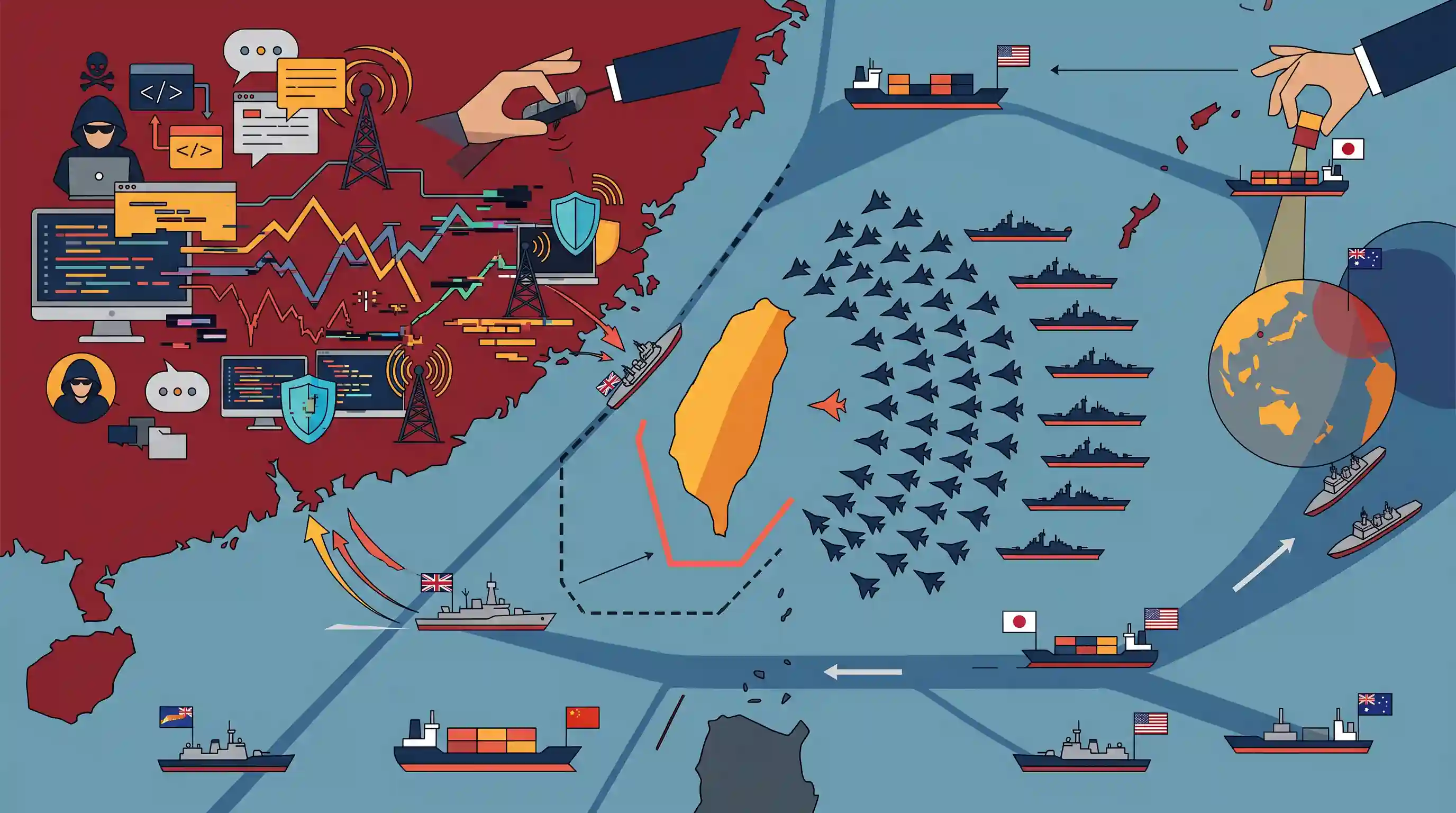
Why It Matters
The militarization of the Taiwan Strait and China's assertive posturing affect regional stability in the Indo-Pacific. For India and global stakeholders, upholding freedom of navigation in international waters is critical for securing vital supply chains. The use of cyberattacks and disinformation also underscores the growing threat of hybrid warfare globally.
Summary
Following the transit of a British naval vessel through the Taiwan Strait, Taiwan detected a massive incursion of 50 Chinese military aircraft and six naval vessels around its territory. This development highlights escalating geopolitical tensions in the Indo-Pacific, as China asserts sovereignty over the strait, while the US and its allies maintain it is an international waterway essential for global trade and freedom of navigation. Concurrently, tensions are exacerbated by cyber warfare and disinformation, with Taiwan accusing Beijing of using non-kinetic measures to undermine its sovereignty.
Key Points
- Taiwan detected 50 Chinese military aircraft and six naval vessels around its territory following the transit of the British naval vessel HMS Spey through the Taiwan Strait.
- The 180-kilometre-wide Taiwan Strait is a major geopolitical flashpoint; the US and allies consider it international waters ensuring freedom of navigation, while China claims sovereignty and jurisdiction over it.
- Diplomatic friction recently escalated after Taiwanese President Lai Ching-te labeled China a "foreign hostile force," prompting Beijing to issue warrants for alleged Taiwanese hackers.
- Taiwan frequently accuses China of engaging in hybrid warfare tactics, including espionage, cyberattacks, and disinformation campaigns aimed at destabilizing the island.
Important Terms
UNCLOS

A 1982 international treaty establishing a legal framework for all marine and maritime activities, defining zones like Territorial Sea and Exclusive Economic Zone (EEZ).
UPSC context
GS2 International Relations. Tests knowledge of maritime laws, ocean governance, and India's position on sea-lane security.
Taiwan Strait
A 180-km wide waterway separating mainland China from Taiwan, connecting the South China Sea and East China Sea; it is a vital global trade artery.
UPSC context
GS1 Geography/GS2 IR. A critical geopolitical flashpoint; significant for global trade, semiconductor supply chains, and Indo-Pacific security.
Freedom of Navigation (FON)
A principle of international law, codified in UNCLOS, ensuring ships of any nation can traverse international waters without interference from coastal states.
UPSC context
GS2 IR. Essential for a "Free and Open Indo-Pacific"; tested via South China Sea disputes and FONOPs.
Indo-Pacific
A strategic geopolitical region encompassing the Indian and Pacific Oceans, characterized by interconnected trade, maritime security challenges, and great-power competition.
UPSC context
GS2 IR. Central to India’s "Act East" policy and regional security partnerships like QUAD.
Cross-Strait Relations
The complex political, economic, and military interactions between the People's Republic of China (Mainland) and the Republic of China (Taiwan).
UPSC context
GS2 IR. Impact on East Asian stability, "One China" policy, and regional trade flows.
Non-Kinetic Warfare
Conflict strategies achieving objectives without physical force, using tools like cyber warfare, disinformation, and economic coercion to destabilize an adversary.
UPSC context
GS3 Internal Security. Tests preparedness against hybrid threats and evolving security challenges in the digital age.
Prelims Trap
"Under UNCLOS, the entire Taiwan Strait is classified as international waters."
The 180km strait has territorial waters on both sides. Under UNCLOS, only the central corridor is an EEZ where high-seas freedom of navigation applies.
Static Concepts Connected
How does UNCLOS categorize maritime zones and navigation rights in straits?
- Territorial Sea: Extends up to 12 nautical miles from the baseline where coastal states claim sovereignty, but foreign ships enjoy the right of 'innocent passage'.
- Transit Passage: Applies to straits used for international navigation, allowing continuous and expeditious transit of vessels and aircraft without suspension.
- Central Corridor: If the strait is wider than intersecting territorial seas (like the Taiwan Strait), the middle remains an EEZ/High Sea area ensuring full freedom of navigation.
What defines 'Grey Zone' tactics and hybrid warfare in security?
- Sub-threshold threshold: Coercive statecraft actions that remain deliberately below the threshold of conventional armed conflict to avoid triggering direct military responses or treaty obligations.
- Asymmetric tools: Blends kinetic and non-kinetic tools including cyberattacks, disinformation campaigns, economic coercion, and the deployment of proxy civilian maritime militias.
Cross-Topic Patterns
Taiwan Strait + Global semiconductor supply
Escalations in the strait threaten global microchip logistics, directly linking Indo-Pacific maritime security to India's push for semiconductor self-reliance and its domestic PLI schemes.
Taiwan hybrid warfare + LAC Salami Slicing
China's use of non-kinetic measures, cyber incursions, and incremental pressure against Taiwan closely mirrors its 'salami slicing' and psychological warfare strategies along the Line of Actual Control (LAC).

Expect a Prelims question mapping UNCLOS maritime zones (EEZ vs Transit passage) directly to contested Indo-Pacific choke points by 2026.
Linked PYQs · 4
Linked PYQs · 4
- 2014MainsGS2
With respect to the South China sea, maritime territorial disputes and rising tension affirm the need for safeguarding maritime security to ensure freedom of navigation and over flight throughout the region. In this context, discuss the bilateral issues between India and China.
- 2021MainsGS2
The newly tri-nation partnership AUKUS is aimed at countering China's ambitions in the Indo-Pacific region. Is it going to supersede the existing partnerships in the region? Discuss the strength and impact of AUKUS in the present scenario.
- 2024MainsGS2
‘The West is fostering India as an alternative to reduce dependence on China's supply chain and as a strategic ally to counter China's political and economic dominance.’ Explain this statement with examples.
- 2016MainsGS3
Use of Internet and social media by non-state actors for subversive activities is a major security concern. How have these been misused in the recent past? Suggest effective guidelines to curb the above threat.
