अनुकूल कृषि अनुसंधान और प्रौद्योगिकी हस्तांतरण
स्रोत:द हिंदू ↗
क्यों मायने रखता है
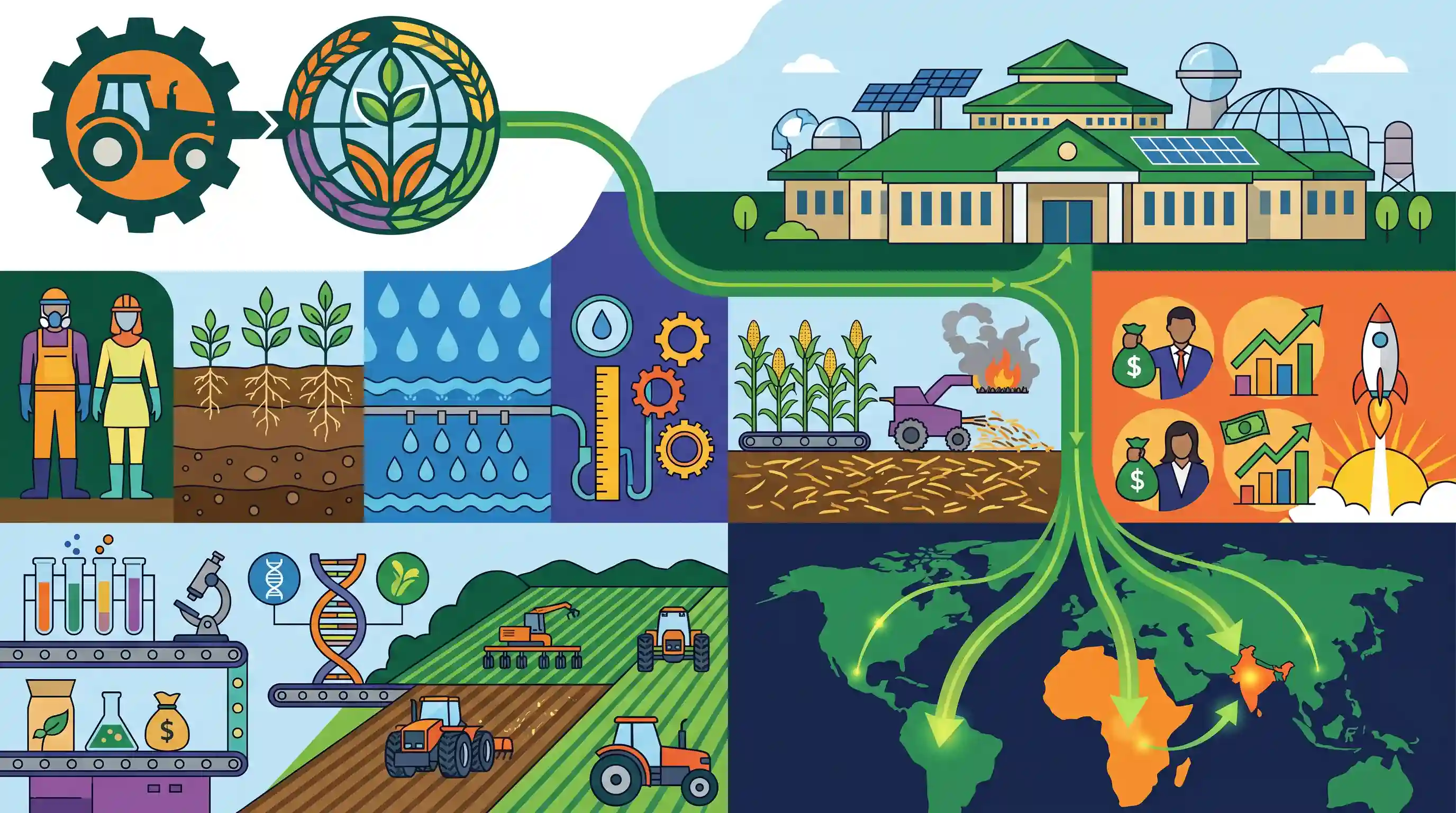
The lab-to-land transfer of technology and adaptive agricultural practices are critical for Indian farmers facing climate change. Corporate-institutional partnerships like this boost technology dissemination, sustainable practices (like water conservation and crop residue management), and scale-appropriate mechanisation for smallholder farmers.
सारांश
Tractors and Farm Equipment Ltd. (TAFE) and the International Crops Research Institute for the Semi-Arid Tropics (ICRISAT) have signed an MoU to establish an adaptive agriculture research and extension centre in Hyderabad. Focusing on sustainable and precision farming, the centre will educate farmers on soil conservation, efficient water use, and scale-appropriate mechanisation, notably in crop-residue management. Key goals include facilitating the lab-to-land transfer of agricultural technologies and promoting agricultural entrepreneurship. Ultimately, the partnership aims to lower the environmental impacts of farming and scale these agricultural innovations across India and Africa.
मुख्य बिंदु
- TAFE and ICRISAT have partnered to set up the 'JFarm Adaptive Agriculture Research & Extension Centre' at the ICRISAT campus in Hyderabad.
- The centre focuses on sustainable agriculture, soil conservation, efficient water use, and scale-appropriate mechanisation, particularly for crop-residue processing.
- The initiative aims to foster lab-to-land transfer of agro-technologies and promote agricultural entrepreneurship and service models.
- The research emphasizes reducing chemical inputs, labor dependency, and environmental impact, with a vision to scale these innovations across Africa.
महत्वपूर्ण शब्द
ICRISAT

An international non-profit organization (HQ: Hyderabad) conducting agricultural research for dryland regions in Asia and sub-Saharan Africa. It focuses on resilient crops like millets and pulses.
UPSC context
GS Paper II/III: International organizations and agricultural research; critical for food security and climate-resilient farming.
Precision Farming
A site-specific farm management strategy using technology (GPS, IoT, sensors) to ensure crops and soil receive precise inputs, maximizing yield while minimizing waste.
UPSC context
GS पेपर III: किसानों की सहायता में ई-तकनीक; आधुनिक कृषि दक्षता की समझ का परीक्षण करता है।
Lab-to-Land Transfer
The process of transferring scientific innovations and research from laboratories directly to farmers' fields through extension services to ensure practical application and productivity gains.
UPSC context
GS Paper III: Agricultural extension and technology dissemination; essential for bridging the gap between research and practice.
Crop-residue Management
The efficient handling of materials (like stalks and stubble) left after harvest, focusing on in-situ or ex-situ utilization to prevent environmentally harmful practices like stubble burning.
UPSC context
GS Paper III: Environment and Agriculture; crucial for addressing air pollution (stubble burning) and soil health.
Scale-appropriate Mechanisation
The implementation of farm machinery and tools specifically designed to match the economic, technical, and landholding constraints of small and marginal farmers.
UPSC context
GS Paper III: Farm mechanization; vital for increasing productivity among India's predominantly smallholder farming population.
Semi-Arid Tropics (SAT)
Global regions characterized by unpredictable, low-to-medium rainfall and high temperatures, making them highly vulnerable to drought and food insecurity.
UPSC context
GS Paper I/III: Geography and Agriculture; relevant to dryland farming and climate change adaptation strategies.
प्रारंभिक ट्रैप
ICRISAT is an autonomous research institute functioning under the Indian Council of Agricultural Research (ICAR).
ICRISAT is an international non-profit organization operating under the global CGIAR consortium. It is not an Indian government body or ICAR institute, despite being headquartered in Hyderabad.
संबंधित अवधारणाएँ
What is the core mandate of ICRISAT?
- वैश्विक फोकस: Conducts agricultural research to improve rural livelihoods in the semi-arid tropics of Asia and sub-Saharan Africa.
- CGIAR consortium: It is an international non-profit and one of the 15 research centers supported by the global CGIAR network.
- Mandate crops: Focuses heavily on climate-smart, highly nutritious dryland crops like sorghum, pearl millet, chickpea, pigeonpea, and groundnut.
What are the primary methods of crop residue management in India?
- In-situ management: Incorporating crop residue back into the soil using machinery like Happy Seeders or Super SMS to boost soil organic carbon.
- Ex-situ management: Baling and removing the residue from fields for use as cattle fodder, biomass power generation, or bio-ethanol production.
- Bio-decomposition: Using microbial consortia (like the Pusa Decomposer) sprayed on fields to accelerate the rotting of stubble.
अंतर-विषय पैटर्न
India-Africa agricultural diplomacy
Transferring dryland and precision farming technologies to Africa strengthens India's soft power and Global South leadership, echoing themes of South-South cooperation from recent G20 summits.
Custom Hiring Centres (CHCs) & air pollution
Scale-appropriate machinery developed by research labs must reach small and marginal farmers via Custom Hiring Centres (CHCs) to effectively tackle in-situ crop residue management and winter stubble burning.

Look for a 2026 prelims question pairing ICRISAT's global mandate under CGIAR with dryland farming traits or 'Smart Food' (millets).
संबद्ध PYQ · 4
संबद्ध PYQ · 4
- 2021PrelimsGS1
In the context of India's preparation for Climate-Smart Agriculture, consider the following statements : 1. The 'Climate-Smart Village' approach in India is a part of a project led by the Climate Change, Agriculture and Food Security (CCAFS), an international research programme. 2. The project of CCAFS is carried out under Consultative Group on International Agricultural Research (CGIAR) headquartered in France. 3. The International Crops Research Institute for the Semi-Arid Tropics (ICRISAT) in India is one of the CGIAR's research centres. Which of the statements given above are correct?
- 2020MainsGS3
Suggest measures to improve water storage and irrigation system to make its judicious use under depleting scenario.
- 2023MainsGS3
How does e-Technology help farmers in production and marketing of agricultural produce? Explain it.
- 2021MainsGS3
What are the present challenges before crop diversification? How do emerging technologies provide an opportunity for crop diversification?
