TAFE Farm Mechanization Meeting With Rajasthan Chief Minister
Source:khetigaadi ↗
Why It Matters
Farm mechanization and modern agricultural technology adoption are critical for improving resource-use efficiency and crop yields in dryland regions like Rajasthan. Partnerships between state governments and leading industrial players like TAFE play a major role in regional capital formation, technology transfer, and rural skill enhancement, which are core themes of both RPSC RAS and UPSC CSE examinations.
Summary
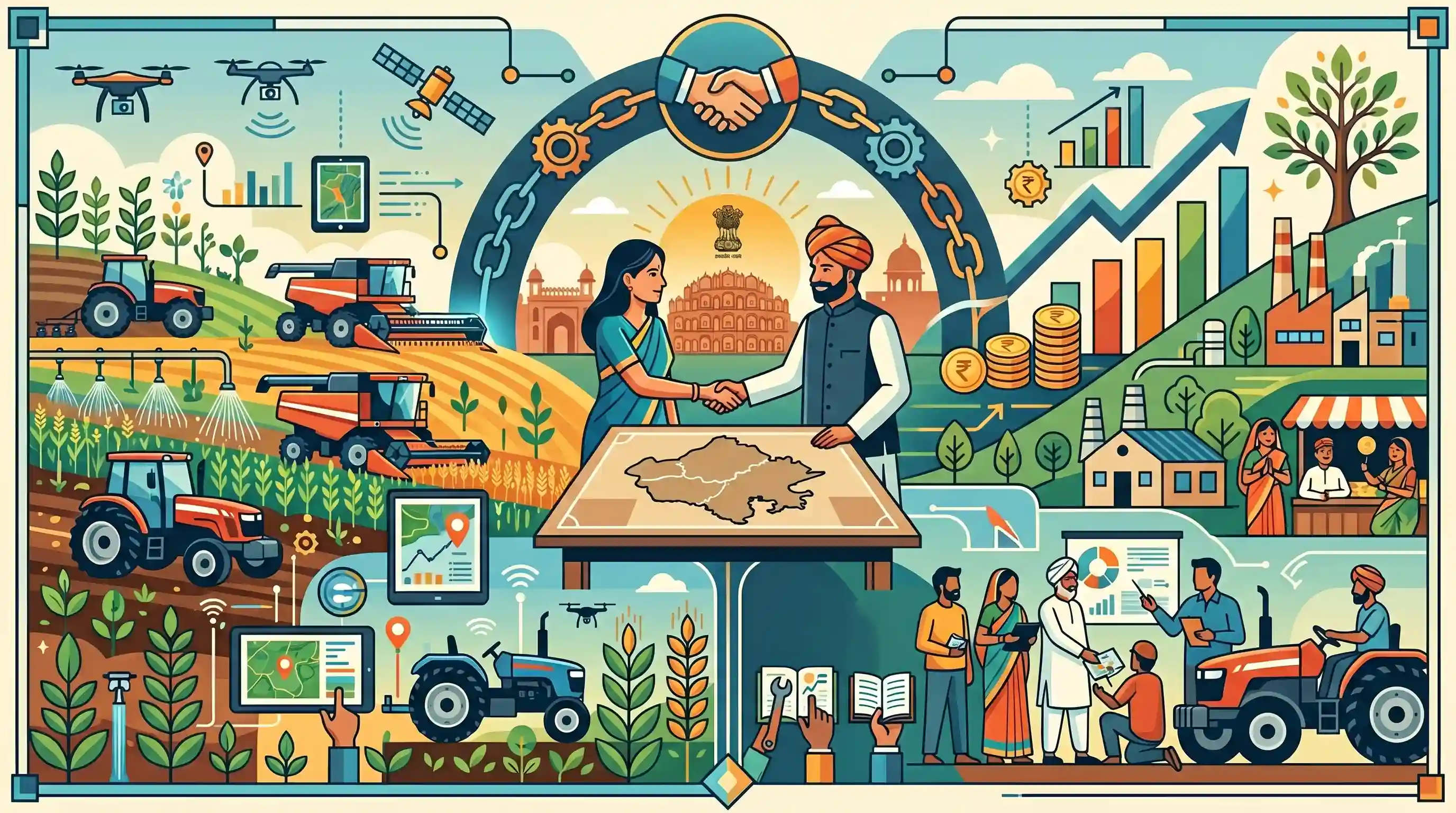
TAFE Chairperson Mallika Srinivasan met with Rajasthan Chief Minister Bhajan Lal Sharma in Jaipur to deliberate on accelerating agricultural growth, advancing farm mechanization, and adopting modern technologies. The meeting highlighted potential collaborations in farmer training, skill-building, and agricultural machinery integration (including TAFE's Massey Ferguson and Eicher brands) to enhance productivity, optimize resources, and bolster Rajasthan's rural economy.
Key Points
- TAFE Chairperson Mallika Srinivasan met Rajasthan Chief Minister Bhajan Lal Sharma in Jaipur to discuss agricultural growth and farm mechanization.
- The discussion focused on adopting modern farming technologies, advanced agricultural machinery, and innovative mechanization solutions to enhance farmer welfare and crop productivity.
- Both sides explored opportunities for joint cooperation in farmer training, skill development, and awareness programs to encourage the adoption of modern agricultural tools.
- The partnership aims to address labor shortages, reduce operational costs, and boost Rajasthan's rural economy by leveraging advanced machinery like TAFE's Massey Ferguson and Eicher tractor ranges.
Important Terms
Tractors and Farm Equipment Limited (TAFE)

An Indian multinational agricultural machinery manufacturer established in 1960. It is the world's third-largest tractor manufacturer by volume, playing a critical role in agricultural mechanization across India.
UPSC context
GS Paper III: Agriculture. Relevant for examining private sector partnership models in enhancing agricultural productivity and rural technology adoption.
Farm Mechanization
The adoption of mechanical technologies, machinery, and precision tools in farming operations to optimize inputs, decrease labor dependencies, and boost overall agricultural yields.
UPSC context
GS Paper III: Agricultural Technology. Tests knowledge of farm productivity, structural barriers of smallholders, and economic modernization in rural India.
Public-Private Partnership (PPP) in Agriculture
Collaborative frameworks combining government oversight and private sector investments to build agricultural infrastructure, expand technology access, and implement skill-development programs for farmers.
UPSC context
GS Paper III: Infrastructure & Mobilization of Resources. Evaluates hybrid development models to address public infrastructure gaps in rural sectors.
Custom Hiring Centers (CHCs)
Specialized hubs that rent out expensive high-tech agricultural machinery to small and marginal farmers, mitigating high individual ownership costs and overcoming land-fragmentation constraints.
UPSC context
GS Paper III: E-technology in Aid of Farmers. Tests understanding of low-cost machinery access and economic viability for smallholder farming.
Sub-Mission on Agricultural Mechanization (SMAM)
A centrally sponsored scheme launched in 2014-15 by the Ministry of Agriculture to extend the reach of mechanization to small, marginal farmers and low farm-power regions.
UPSC context
GS Paper III: Government Schemes & Agriculture. Tests policy awareness on farm equipment subsidies, regional disparities, and agricultural capacity building.
Prelims Trap
Agriculture contributes the highest share to Rajasthan's Gross Fixed Capital Formation (GFCF), followed by Manufacturing.
In Rajasthan, Construction and Manufacturing (Machinery & Equipment) both contribute more to Gross Fixed Capital Formation (GFCF) than Agriculture, despite the state's heavy agrarian base.
Static Concepts Connected
What are Custom Hiring Centres (CHCs) under the Sub-Mission on Agricultural Mechanization (SMAM)?
- Core Objective: CHCs are localized hubs that lease out high-tech agricultural machinery to small and marginal farmers who cannot afford outright ownership.
- Economic Utility: They combat low farm power availability, reduce manual labor dependencies, and lower the overall cost of production per hectare.
- Institutional Support: Supported by central/state subsidies (often up to 40-50%) allocated to cooperative societies, SHGs, and rural entrepreneurs.
What is Gross Fixed Capital Formation (GFCF) in Agriculture?
- Definition: GFCF represents the net addition to physical assets (like tractors, irrigation systems, and land reclamation) that boost long-term productive capacity.
- Public vs Private: Private sector investment (primarily by farmers themselves in machinery) dominates agricultural capital formation, contributing over 80% compared to public investment.
- Trend and Challenge: Stagnating agricultural GFCF relative to agricultural GDP is a major structural bottleneck for crop diversification and sustainable yields.
Cross-Topic Patterns
State planning bodies + Rural PPPs
The transformation of state-level planning bodies (such as RITI replacing CMRETAC) mirrors the national shift toward NITI Aayog's cooperative federalism and structured PPPs in rural infrastructure.
Corporate extension + Agri-tech transfer
Private initiatives like JFarm act as corporate agricultural extension services, complementing public Krishi Vigyan Kendras (KVKs) in high-tech machinery and skill dissemination.

State-level GFCF trends in agriculture and the cooperative model of Custom Hiring Centres (CHCs) are highly probable for GS-3 2026.
Linked PYQs · 2
Linked PYQs · 2
- 2025RPSC_PRELIMSGS1
The correct order of decreasing contribution of different sectors in Rajasthan’s Gross Fixed Capital Formation is
- 2023RPSC_PRELIMSGS1
Compared to the previous year, in the year 2022-23, in which sector is the estimated highest increase in the Gross State Value Added (GSVA) (at constant 2011-12 base values) of Rajasthan?
