India US strategic ties and Indo Pacific energy security dialogue
Source:The Hindu ↗
Why It Matters
This development is crucial for UPSC aspirants as it covers key GS-II and GS-III themes: the evolution of the India-US strategic partnership, the geopolitical vulnerability of global energy chokepoints (like the Strait of Hormuz), and the importance of secure supply chains and maritime commerce in the Indo-Pacific region.
Summary
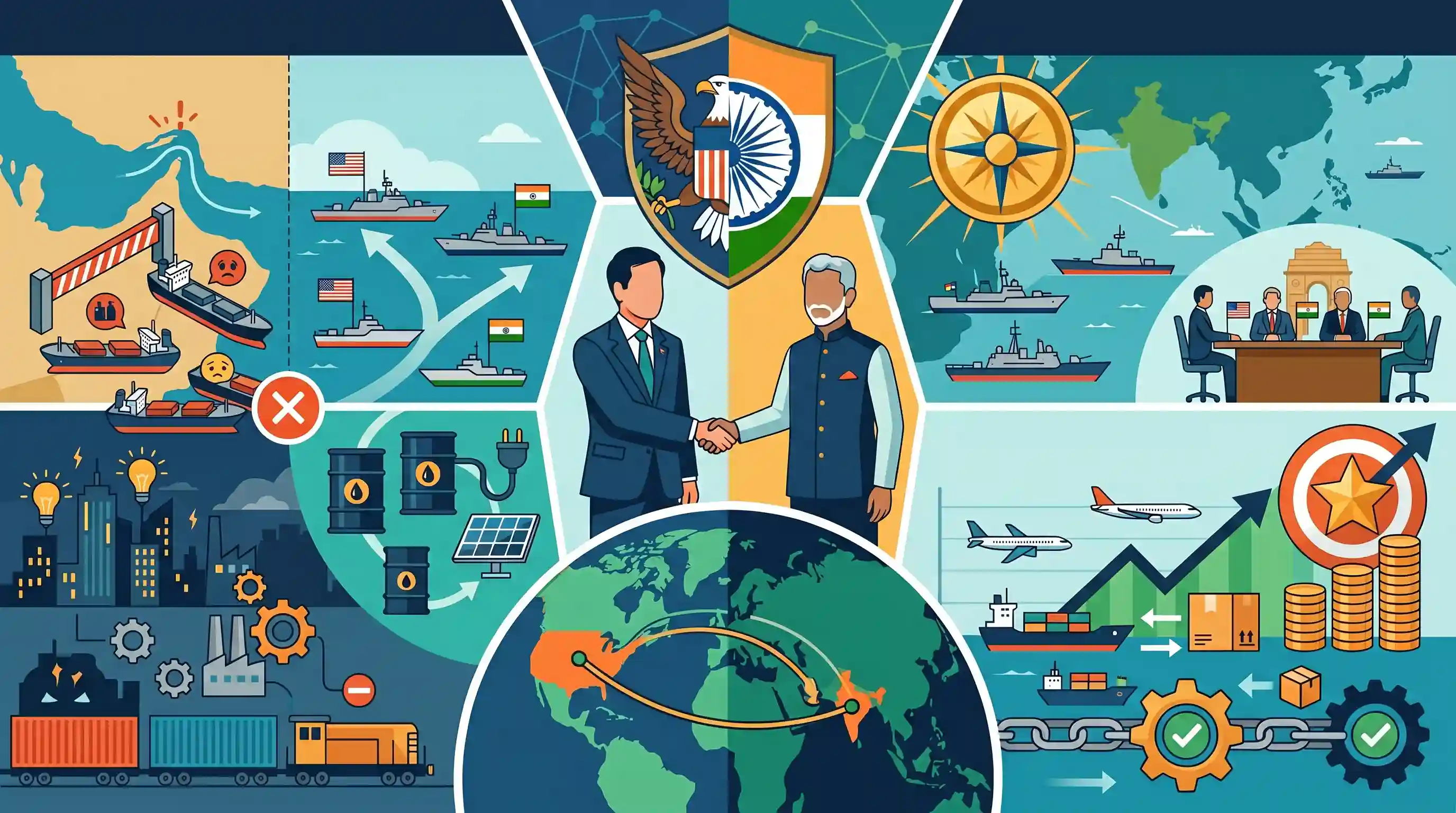
During his visit to India, US Secretary of State Marco Rubio emphasized that the US-India relationship is 'highly strategic' and will not be compromised by America's 'tactical' engagements with other countries. A key focus of the discussions was global energy security, with External Affairs Minister S. Jaishankar warning that Iran's potential blockade of the Strait of Hormuz could trigger a severe global energy crisis and disrupt supply chains. The leaders also reaffirmed their commitment to a free and open Indo-Pacific, discussed expanding bilateral trade towards a $500 billion target, and announced an upcoming Quad Ministerial meeting in India.
Key Points
- US Secretary of State Marco Rubio assured that US tactical relationships with other nations will not undermine its 'highly strategic' partnership with India.
- External Affairs Minister S. Jaishankar identified Iran's potential chokehold on the Strait of Hormuz as the 'number one global crisis in the making', threatening global energy security.
- Both leaders emphasized the necessity of a free and open Indo-Pacific, securing maritime commerce, and de-risking global supply chains.
- The dialogue highlighted economic ambitions, including a bilateral trade target of $500 billion and preparations for an upcoming Quad Ministerial meeting to be hosted by India.
Important Terms
Quad

A strategic forum comprising India, USA, Japan, and Australia focused on a "free and open" Indo-Pacific. It cooperates on maritime security, climate, and health rather than acting as a formal military alliance.
UPSC context
GS Paper 2: International Relations; tests knowledge of regional security architecture and India's multilateral diplomacy.
Indo-Pacific
A geopolitical region connecting the Indian and Pacific Oceans. For India, it spans from the African coast to the Americas, serving as a hub for 60% of global GDP and maritime trade.
UPSC context
GS Paper 2: Bilateral/Multilateral relations; crucial for understanding India's "Act East" policy and strategic autonomy.
Strait of Hormuz
A vital maritime chokepoint between Iran and Oman connecting the Persian Gulf to the open ocean. It facilitates approximately 20% of global oil and 35% of LNG shipments.
UPSC context
GS Paper 3: Energy Security; relevant for maritime trade vulnerability and its impact on India's economy.
Ministry of External Affairs (MEA)
The central government agency responsible for India's foreign relations. It formulates and executes foreign policy, manages diplomatic missions, and represents India at international forums like the United Nations.
UPSC context
GS Paper 2: Institutions/Governance; tests understanding of the executive machinery managing India’s global engagement.
Strategic Partnership
A long-term bilateral relationship covering multiple areas like defense, technology, and trade. It signals high-priority cooperation without the rigid, legally binding mutual-defense commitments of a traditional military alliance.
UPSC context
GS Paper 2: International Relations; tests the ability to distinguish between different levels of diplomatic cooperation.
US Department of State
The United States executive department responsible for foreign policy and international relations. Led by the Secretary of State, it manages diplomacy and foreign assistance programs globally.
UPSC context
GS Paper 2: Foreign Policy; relevant for comparative analysis of executive agencies and US-India bilateral mechanisms.
Prelims Trap
"The Supply Chain Resilience Initiative (SCRI) is a joint initiative launched by the Quad nations to de-risk global supply chains."
SCRI was launched trilaterally by India, Japan, and Australia in 2021. While the US supports supply chain de-risking, it is not a founding member of this specific initiative.
Static Concepts Connected
What is the geographical and strategic significance of the Strait of Hormuz?
- Connecting Waters: It connects the Persian Gulf in the west to the Gulf of Oman and the Arabian Sea in the east.
- Bordering Nations: It is flanked by Iran to the north and the United Arab Emirates and Oman (Musandam Peninsula) to the south.
- Energy Chokepoint: It is one of the world's most vulnerable maritime chokepoints, handling roughly 20% of global oil shipments daily.
What are the foundational defense agreements defining the India-US strategic partnership?
- GSOMIA: General Security of Military Information Agreement (2002) allows sharing of classified military information.
- LEMOA: Logistics Exchange Memorandum of Agreement (2016) permits access to each other's military facilities for supplies and repairs.
- COMCASA: Communications Compatibility and Security Agreement (2018) facilitates secure military communications and interoperability.
- BECA: Basic Exchange and Cooperation Agreement (2020) enables real-time sharing of geospatial intelligence and maps.
Cross-Topic Patterns
Maritime Chokepoints + Energy Security
Iran's threat to the Strait of Hormuz directly tests India's energy diplomacy, forcing an accelerated reliance on strategic petroleum reserves and import diversification from non-Middle Eastern sources.
Quad's Geo-economic Pivot
The India-US 'Mission 500' trade target aligns with the Quad's broader evolution from a maritime security framework into a robust platform for critical technologies and supply chain de-risking.

Expect a 2026 Prelims map question linking West Asian chokepoints (Hormuz, Bab-el-Mandeb) to supply chain disruptions and energy security.
Linked PYQs · 5
Linked PYQs · 5
- 2020MainsGS2
What is the significance of Indo-US defence deals over Indo-Russian defence deals? Discuss with reference to stability in the Indo-Pacific region.
- 2020MainsGS2
Quadrilateral Security Dialogue (Quad)' is transforming itself into a trade bloc from a military alliance, in present times - Discuss.
- 2025MainsGS2
"Energy security constitutes the dominant kingpin of India's foreign policy, and is linked with India's overarching influence in Middle Eastern countries.” How would you integrate energy security with India's foreign policy trajectories in the coming years?
- 2017MainsGS2
The question of India's Energy Security constitutes the most important part of India's economic progress. Analyze India's energy policy cooperation with West Asian countries.
- 2025MainsGS3
Why is maritime security vital to protect India's sea trade? Discuss maritime and coastal security challenges and the way forward.
