Kerala Public Health Strategy for Addressing Mental Health Burden
Source:The Hindu ↗
Why It Matters
Mental health remains an under-addressed aspect of public health in India. Kerala's experience highlights how demographic shifts (ageing population) and changing societal structures impact mental well-being, serving as a case study for India's future healthcare and social policy formulation.
Summary
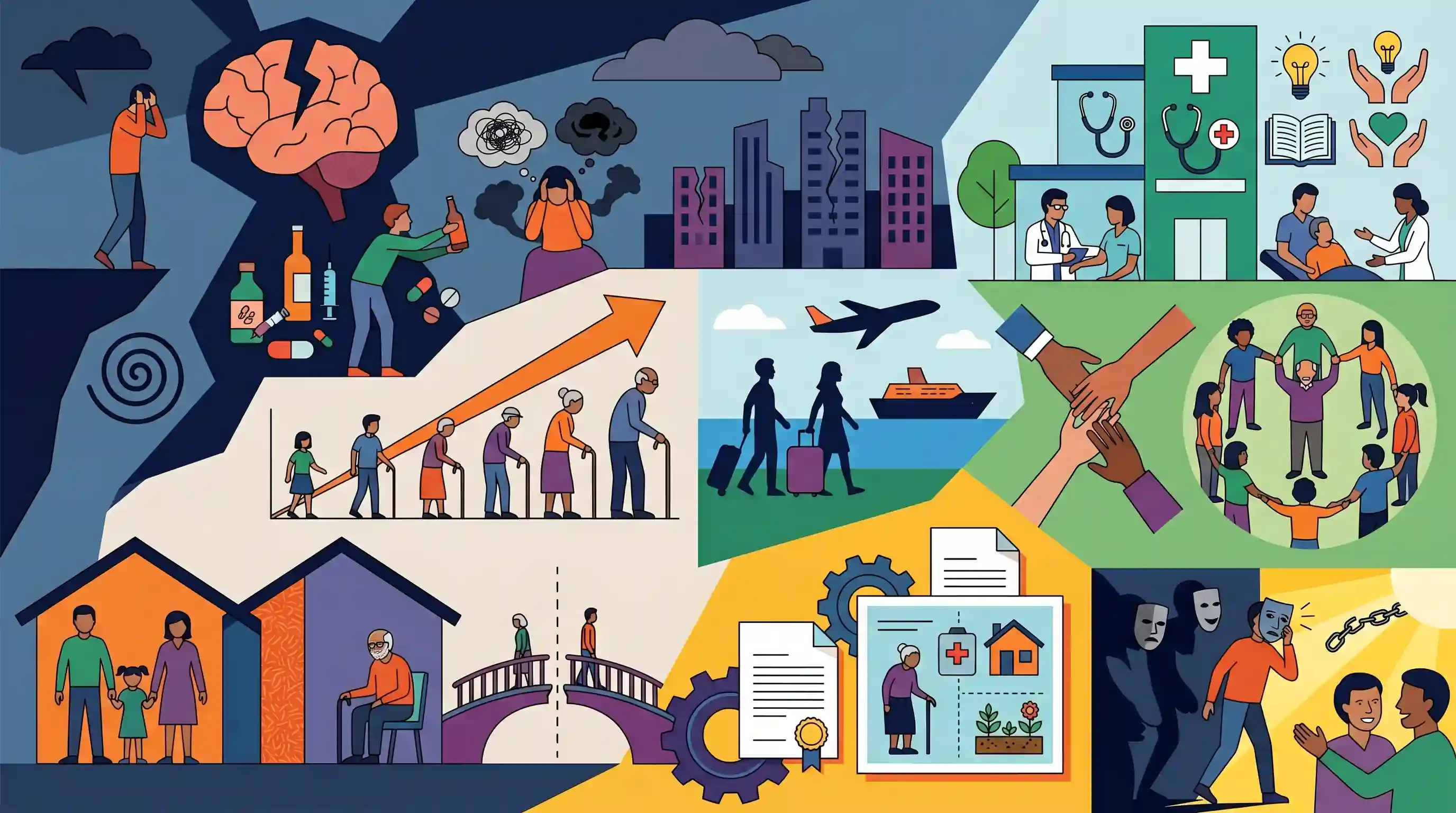
Despite achieving high indices of human development, Kerala is grappling with a severe mental health crisis characterized by high suicide rates, substance abuse, and psychological distress. The state's unique demographic profile, notably a rapidly ageing population, alongside changing social structures like youth out-migration and nuclearization of families, exacerbates social isolation. Addressing this challenge necessitates integrating mental health services into the primary healthcare infrastructure, focusing on community-driven care, and formulating robust policies for geriatric well-being while actively combating the stigma associated with mental illness.
Key Points
- Kerala faces a paradox of possessing high human development indicators while concurrently struggling with a significant mental health burden, including high suicide rates.
- The state's demographic transition towards a rapidly ageing population increases the prevalence of mental health challenges such as dementia and depression among the elderly.
- Changing social dynamics, including the rise of nuclear families, youth out-migration, and educated unemployment, have led to increased isolation and stress.
- Tackling this challenge requires decentralizing mental healthcare by integrating it with grassroots public health systems like Primary Health Centres (PHCs) and involving community health workers.
- Addressing the social stigma attached to psychiatric conditions through community awareness is critical to improving mental health outcomes.
Important Terms
National Mental Health Programme (NMHP)

A flagship central scheme launched in 1982 to ensure availability of minimum mental healthcare for all, focusing on early detection, treatment, and rehabilitation through general health services.
UPSC context
GS Paper II (Social Justice/Health); tests knowledge of national health policies and their integration into public infrastructure.
District Mental Health Programme (DMHP)
A decentralised component of NMHP (launched 1996) based on the 'Bellary Model,' aimed at providing mental health services at the community level via district hospitals.
UPSC context
GS Paper II (Government Policies); relevant for discussing decentralisation and grassroots healthcare delivery in India.
Primary Health Centres (PHCs)
The fundamental structural unit of India's public health system, providing basic curative and preventive services. Kerala has upgraded many into 'Family Health Centres' (FHCs) for better reach.
UPSC context
GS Paper II (Health); essential for understanding the three-tier healthcare structure and community-level interventions.
Geriatric Care
Specialised healthcare for the elderly, addressing chronic diseases and mental health. Kerala has India's highest proportion of elderly residents, making this a critical social and health priority.
UPSC context
GS Paper I (Social Issues/Population) and GS II (Health); tests understanding of demographic shifts and social security.
Mental Healthcare Act, 2017
A landmark law ensuring the right to access mental healthcare, protecting the dignity of patients, and decriminalising suicide attempts by presuming severe stress.
UPSC context
GS Paper II (Social Justice/Laws); critical for questions on rights-based frameworks and legislative reforms in healthcare.
Tele-MANAS
A 24x7 toll-free mental health helpline (14416) launched in 2022 to provide counselling and clinical referrals across India, leveraging technology for mental health access.
UPSC context
GS Paper II (Health/IT); relevant for digital health initiatives and bridging the treatment gap in remote areas.
Demographic Transition
The process of moving from high to low birth and death rates. Kerala is in an advanced stage, leading to a rapidly ageing population.
UPSC context
GS Paper I (Population/Geography); tests knowledge of population dynamics and their socio-economic implications.
Prelims Trap
"States with the highest Human Development Index (HDI) consistently report the lowest suicide and mental health morbidity rates in India."
Aspirants often conflate HDI's health parameters (life expectancy) with total well-being. The "Kerala Paradox" proves high physical health/HDI can coexist with severe mental health crises.
Static Concepts Connected
What characterizes the advanced demographic transition in states like Kerala?
- Sub-replacement fertility: Total Fertility Rate (TFR) falling below the replacement level of 2.1, leading to a shrinking base of young population.
- High life expectancy: Advanced healthcare increases longevity, creating a top-heavy population pyramid.
- Geriatric burden: A rising share of the elderly (projected over 22% by 2036) rapidly shifts policy focus toward dementia, depression, and palliative care.
How is mental healthcare legally and administratively decentralized in India?
- Mental Healthcare Act (2017): Guarantees every person the right to access mental healthcare and treatment from state-funded public health services.
- District Mental Health Programme: Operationalizes community-based psychiatric services by shifting care from tertiary asylums to district hospitals and local clinics.
- Ayushman Arogya Mandirs: Upgraded primary centers now integrate Mental, Neurological, and Substance Use (MNS) disorders into Comprehensive Primary Health Care.
Cross-Topic Patterns
Emigration and the Care Economy
Youth out-migration to the Gulf and West directly inflates the demand for a formal "care economy" and institutional geriatric support for the socially isolated elderly left behind in Kerala.
Economic Survey on Social Connectedness
The Economic Survey 2025-26 explicitly linked rising suicides in Southern states to the breakdown of "intra-district social connectedness," elevating a sociological phenomenon to a macroeconomic policy concern.

The 'Kerala Paradox' and the Economic Survey's focus on social connectedness will likely trigger a Mains GS1 question on urban isolation.
Linked PYQs · 4
Linked PYQs · 4
- 2023MainsGS1
Explain why suicide among young women is increasing in Indian society.
- 2021MainsGS2
“Besides being a moral imperative of a Welfare State, primary health structure is a necessary precondition for sustainable development.” Analyze.
- 2024MainsGS2
In a crucial domain like the public healthcare system the Indian State should play a vital role to contain the adverse impact of marketisation of the system. Suggest some measures through which the State can enhance the reach of public healthcare at the grassroots level.
- 2020MainsGS2
In order to enhance the prospects of social development, sound and adequate health care policies are needed particularly in the fields of geriatric and maternal health care. Discuss.
