Food Loss Reduction and Supply Chain Management in India
Source:The Hindu ↗
ఇది ఎందుకు ముఖ్యం
Food loss and waste directly impact India's agricultural economy, food security, and environmental goals. Understanding supply chain inefficiencies and infrastructure gaps is vital for answering questions on agricultural marketing and food processing in GS Paper 3.
సారాంశం
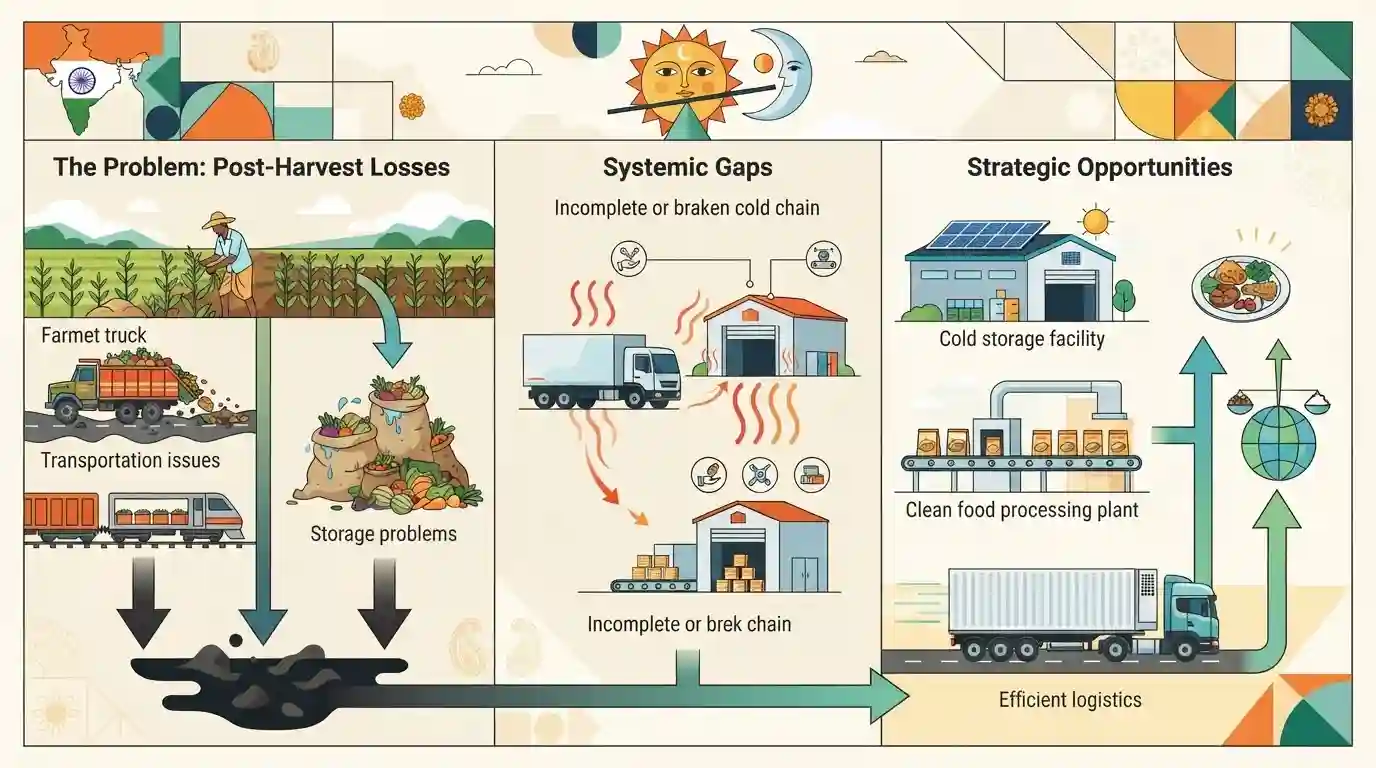
The article discusses the challenge of food loss and waste in India, highlighting its implications for food security, economic efficiency, and environmental sustainability. It explores how systemic gaps in agricultural supply chains, storage, and cold chains contribute to massive post-harvest losses, and emphasizes the strategic opportunities for India in modernizing infrastructure, scaling up food processing, and improving resource use efficiency.
ముఖ్య అంశాలు
- Food loss and waste represent a critical developmental, economic, and environmental challenge for India, impacting food security and resource efficiency.
- Inadequate supply chain management, cold chain infrastructure deficits, and post-harvest management gaps are major drivers of food loss.
- Tackling food loss offers a dual opportunity: enhancing national food availability and mitigating greenhouse gas emissions associated with discarded food.
- Policy interventions require strengthening agricultural supply chains, promoting food processing, and fostering behavioral change regarding food consumption and waste management.
అనుసంధానమైన స్థిర భావనలు
What are the key government schemes and institutional frameworks addressing agricultural post-harvest losses and food processing in India?
- PM Kisan SAMPADA Yojana: PMKSY: Centrally sponsored scheme providing capital subsidies for mega food parks, cold chain infrastructure, and agro-processing clusters.
- Operation Greens Expansion: Operation Greens: Initially aimed at TOP (Tomato, Onion, Potato) crops, expanded to cover all perishables to stabilize prices and build supply chains.
- Agriculture Infrastructure Fund: AIF & PACS: Financing facility (₹1 lakh crore) for farm-gate infrastructure, paired with the world's largest grain storage plan at Primary Agricultural Credit Societies.
అంతర-అంశ నమూనాలు
Food Waste Mitigation + Climate NDCs
Food loss reduction directly lowers agricultural GHG emissions, supporting India's enhanced Nationally Determined Contributions (NDCs) under the Paris Agreement.
Resource Efficiency + Agricultural Subsidies
Post-harvest losses squander critical natural resources like groundwater and synthetic fertilizers, aggravating water scarcity and fiscal burdens through unutilised agricultural subsidies.

Post-harvest loss infrastructure (PMKSY, PACS storage) will likely be tested via a multi-statement match with food security & climate goals.
అనుసంధాన PYQలు · 3
అనుసంధాన PYQలు · 3
- 2025MainsGS3
Elaborate the scope and significance of supply chain management of agricultural commodities in India.
- 2025MainsGS3
Examine the scope of the food processing industries in India. Elaborate the measures taken by the government in the food processing industries for generating employment opportunities.
- 2020PrelimsGS1
In India, which of the following can be considered as public investment in agriculture? 1. Fixing Minimum Support Price for agricultural produce of all crops 2. Computerization of Primary Agricultural Credit Societies 3. Social Capital development 4. Free electricity supply to farmers 5. Waiver of agricultural loans by the banking system 6. Setting up of cold storage facilities by the governments Select the correct answer using the code given below:
