Institutional Inefficiencies Hinder Indigenisation in Defence Sector
Source:The Hindu ↗
Why It Matters
This article provides a critical analysis of India's defense acquisition and manufacturing landscape. In the context of a challenging security environment on India's borders, understanding the structural and bureaucratic bottlenecks in achieving defense self-reliance is highly relevant for both GS Paper III (Security & Technology) and GS Paper II (Governance & Institutional Reforms).
Summary
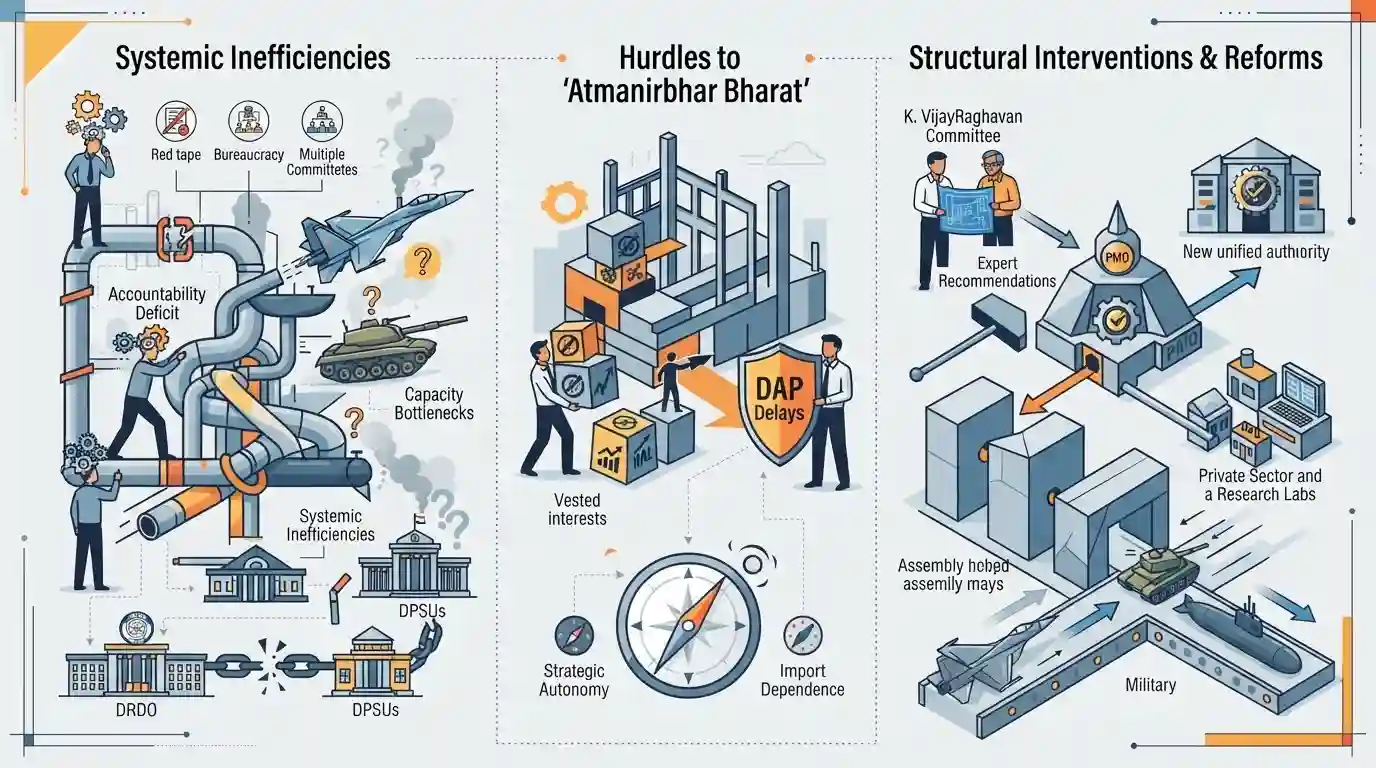
The article examines the systemic and institutional inefficiencies within India's defence research, development, and manufacturing ecosystem that hamper the timely roll-out of critical military assets. It highlights how the policy of 'Atmanirbhar Bharat' (self-reliance in defence) faces serious hurdles due to the accountability deficit in DRDO, capacity bottlenecks within Defence Public Sector Undertakings (DPSUs) like HAL, and bureaucratic delays in the Defence Acquisition Procedure (DAP). The author argues that achieving strategic autonomy requires urgent structural interventions, such as implementing the K. VijayRaghavan Committee's recommendations, breaking public-sector monopolies, and establishing a high-powered, PMO-led Defence Technology Commission to streamline acquisition and R&D.
Key Points
- Despite a robust policy push for 'Atmanirbhar Bharat' in defense, India remains one of the world's largest arms importers due to chronic delays in domestic military development programs (e.g., LCA Tejas, naval submarines, jet engines).
- The Defence Research and Development Organisation (DRDO) faces an accountability deficit and a diluted focus, as it attempts to manage both high-tech futuristic research and routine equipment manufacturing, leading to cost and time overruns.
- Defence Public Sector Undertakings (DPSUs) like HAL hold a near-monopoly on major contracts but suffer from severe production capacity bottlenecks, while the domestic private defense sector remains underutilized due to rigid procurement rules and institutional bias.
- The Defence Acquisition Procedure (DAP) continues to be plagued by bureaucratic red tape, cumbersome trial evaluation processes, and a persistent preference for the lowest-bidder (L1) criteria rather than life-cycle quality.
- Addressing these systemic dysfunctions requires immediate structural reforms, including restructuring the DRDO based on the K. VijayRaghavan Committee recommendations, establishing a PMO-led Defence Technology Commission, and integrating the private sector as equal development partners.
Important Terms
Defence Acquisition Procedure (DAP)

India's official procurement framework (replacing DPP in 2020) governing capital acquisition of defence hardware. It prioritizes indigenous manufacturing, aligns with Atmanirbhar Bharat, and streamlines buying processes for the armed forces.
UPSC context
GS Paper III (Defence Procurement & Indigenisation); tests comprehension of policies, procurement categories, and procedural bottlenecks in military modernization.
Defence Acquisition Council (DAC)
The highest decision-making body for capital defence procurement within India's Ministry of Defence. Chaired by the Defence Minister, it approves acquisition policies and grants "Acceptance of Necessity" (AoN) to initiate procurement.
UPSC context
GS Paper II/III (Governance & Internal Security); tests comprehension of institutional frameworks, acquisition decision-making, and structural reforms in national security.
Defence Research and Development Organisation (DRDO)
India’s premier military research and development agency under the Ministry of Defence. Established in 1958, it designs, develops, and facilitates the domestic manufacturing of advanced weapon systems, military technologies, and strategic platforms.
UPSC context
GS Paper III (Science & Technology/Indigenisation); tests understanding of domestic R&D performance, structural reforms, and strategic technology development.
Strategic Partnership Model
A procurement framework under the DAP that pairs designated domestic private firms with foreign aerospace/defence OEMs. It aims to build local manufacturing capacity for big-ticket platforms, reducing reliance on foreign imports.
UPSC context
GS Paper III (Indigenisation of Technology & Security); tests initiatives facilitating public-private partnerships, technology transfer, and breaking public-sector defence monopolies.
Department of Defence Production (DDP)
A department under India's Ministry of Defence that promotes self-reliance in military manufacturing. It oversees Defence Public Sector Undertakings (DPSUs), regulates private defence industries, and facilitates streamlined defence production and exports.
UPSC context
GS Paper II/III (Government Policies/Security); tests comprehension of administrative institutions overseeing public-sector shipyards, aircraft manufacturers, and private-sector ease-of-doing-business reforms.
Atmanirbhar Bharat
A flagship national vision aimed at making India self-sufficient. In defence, it focuses on maximizing indigenous procurement, implementing positive indigenisation (import ban) lists, and fostering a strong domestic military-industrial complex.
UPSC context
GS Paper III (Economy/Security); tests understanding of policy instruments for strategic autonomy, import substitution, and scaling up domestic manufacturing.
Prelims Trap
The Defence Acquisition Council (DAC) is chaired by the Prime Minister of India to ensure swift procurement decisions.
The DAC is chaired by the Union Defence Minister. It is the proposed Defence Technology Council (DTC) under the VijayRaghavan panel that is envisioned to be chaired by the Prime Minister.
Static Concepts Connected
What is the Defence Acquisition Procedure (DAP) 2020 procurement hierarchy?
- Highest Priority: Buy (Indian-IDDM) (Indigenously Designed, Developed, and Manufactured) holds topmost priority, requiring at least 50% indigenous content with an indigenous design.
- Subsequent Categories: Followed by 'Buy (Indian)' (min 50-60% indigenous content depending on design source), 'Buy and Make (Indian)', and 'Buy (Global - Manufacture in India)'.
- Lowest Priority: Direct import via 'Buy (Global)' is placed at the absolute bottom of the procurement hierarchy, allowed only when domestic options are completely exhausted.
What is the Strategic Partnership (SP) Model in Indian defence procurement?
- Core Objective: Aims to revitalize the private sector by encouraging long-term partnerships with global Original Equipment Manufacturers (OEMs) to transfer technology.
- Key Segments: Focuses on four critical segments: Fighter Aircraft, Helicopters, Submarines, and Armoured Fighting Vehicles/Main Battle Tanks.
- Private Sector Integration: Indian private firms act as prime system integrators, building complex platforms domestically using foreign technology transfers.
Cross-Topic Patterns
Defence indigenisation + Fiscal deficit management
Reducing the defense import bill directly conserves foreign exchange reserves and alleviates current account deficit (CAD) pressures, aligning fiscal health with strategic autonomy.
Dual-use technology + IP regime roadblocks
Modernizing DRDO's spin-off technologies for civilian use requires robust intellectual property sharing frameworks to incentivize private commercialization without compromising national security.

Analytical question likely on why indigenous designs (IDDM) face production bottlenecks despite high-priority placement in DAP 2020.
Linked PYQs · 3
Linked PYQs · 3
- 2024PrelimsGS1
Consider the following aircraft : 1. Rafael 2. MiG-29 3. Tejas MK-1 How many of the above are considered fifth generation fighter aircraft?
- 2026PrelimsGS1
Which of the following items of defence hardware is/are manufactured in India ? 1. Su-30 MKI Fighter Jets 2. T-90 MK-III Tanks 3. Akula Class Submarine Select the answer using the code given below :
- 2014MainsGS3
Foreign Direct Investment (FDI) in the defence sector is now set to be liberalized. What influence this is expected to have on Indian defence and economy in the short and long run?
