India adopts recalibrated diplomatic strategy in multipolar world
Source:Indian Express ↗
Why It Matters
The concept of 'recalibrated diplomacy' provides a contemporary framework for analyzing India's foreign policy shifts. It is highly relevant for GS Paper 2 questions evaluating India's strategic autonomy, its evolving role in the multipolar world, and its leadership aspirations within the Global South.
Summary
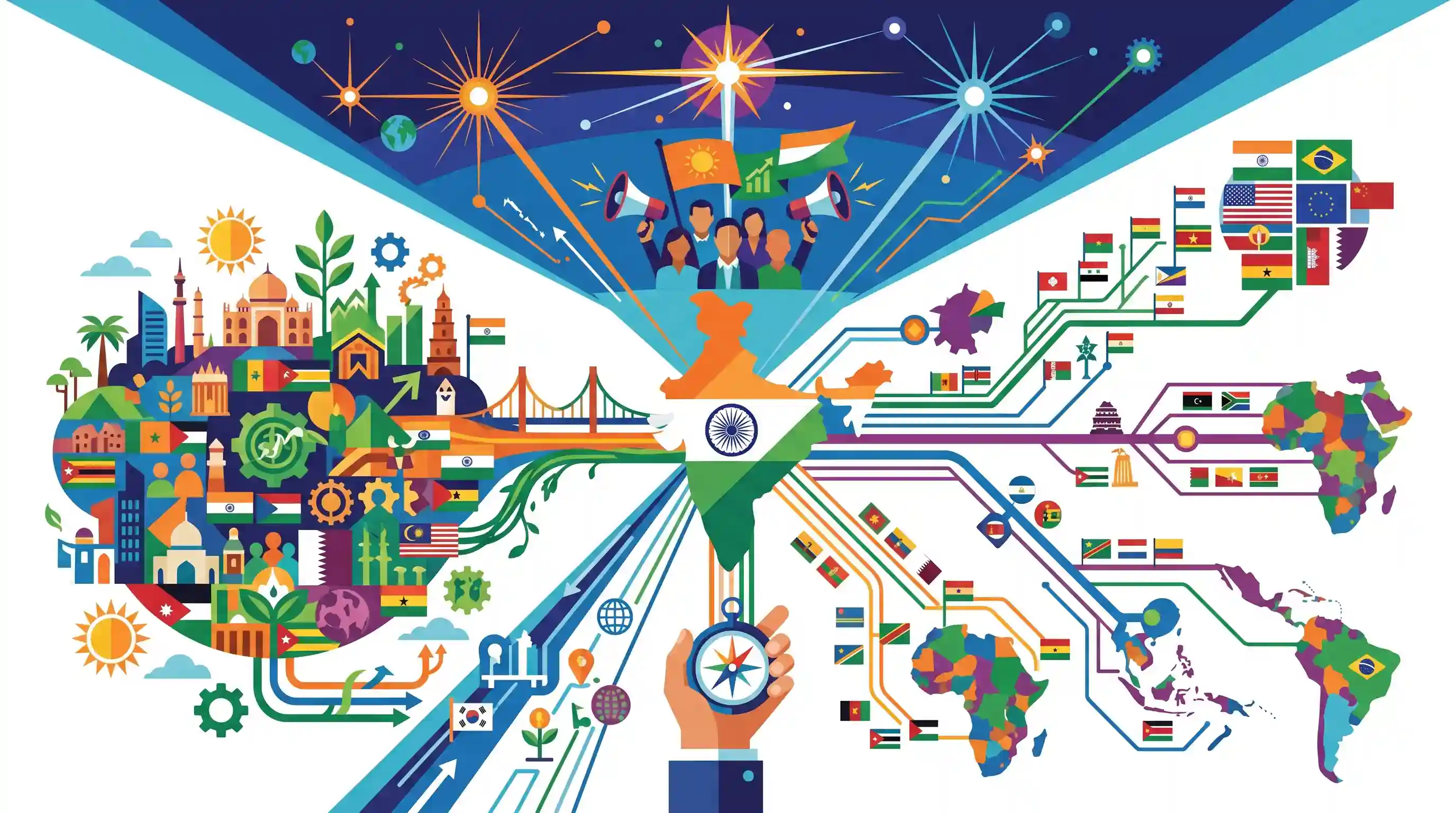
In this piece, Syed Akbaruddin highlights a paradigm shift in India's foreign policy, characterizing it as a "recalibrated diplomacy." The article focuses on India's expanding diplomatic footprint and its targeted outreach to a wider array of nations beyond the traditional major powers. This strategic evolution emphasizes multi-alignment, strategic autonomy, and a deeper engagement with the Global South, reflecting India's growing ambition to shape the emerging multipolar world order actively and advocate for developing nations on the global stage.
Key Points
- India is transitioning from traditional non-alignment to a more dynamic, "recalibrated diplomacy" defined by strategic autonomy and multi-alignment.
- The evolving diplomatic strategy focuses on an expanded outreach, moving beyond traditional major powers to actively engage with a broader set of nations, particularly in the Global South.
- This recalibration reflects India's ambition to position itself as an active shaper of the emerging multipolar global order rather than a passive observer.
- India's shifting foreign policy balances complex geopolitical rivalries while simultaneously championing the interests of developing and marginalized nations.
Prelims Trap
India's multi-alignment strategy involves formally abandoning the Non-Aligned Movement (NAM) and joining formal military alliances.
India has never formally abandoned NAM. Multi-alignment focuses on issue-based coalitions (like Quad and SCO) while maintaining strategic autonomy, avoiding binding military treaties.
Static Concepts Connected
How does 'Multi-alignment' differ from traditional 'Non-Alignment'?
- Non-Alignment: A Cold War doctrine focused on maintaining equidistant neutrality and avoiding superpower blocs.
- Multi-alignment: Active, simultaneous engagement with multiple rival powers (e.g., USA and Russia) through issue-based coalitions.
- Strategic Autonomy: The core driver allowing independent foreign policy decisions to maximize national interest without military treaty constraints.
What recent initiatives highlight India's 'Global South' leadership?
- G20 Presidency: Successfully secured permanent G20 membership for the African Union during the New Delhi summit in 2023.
- Voice of Global South: Instituted summit-level meetings to aggregate developing world concerns on debt, climate finance, and food security.
- Vishwa Bandhu: Positioning India as a global friend, acting as a diplomatic bridge between the Global North and South.
Cross-Topic Patterns
Global South leadership and UNSC Reforms
By institutionalizing the voice of developing nations, India strategically strengthens its voting bloc (like the L.69 grouping) to bolster its claim for a permanent UNSC seat.
Multi-alignment in Economic Security
Geopolitical multi-alignment mirrors India's geoeconomic strategy, driving non-traditional coalitions like the IPEF and Supply Chain Resilience Initiative to reduce single-source dependencies.

A 2026 GS2 Mains question will likely contrast India's 'Vishwa Bandhu' multi-alignment strategy with its traditional Non-Alignment doctrine.
Linked PYQs · 2
Linked PYQs · 2
- 2019MainsGS2
‘The long-sustained image of India as a leader of the oppressed and marginalised nations has disappeared on account of its new found role in the emerging global order.’ Elaborate.
- 2024MainsGS2
Critically analyse India's evolving diplomatic, economic and strategic relations with the Central Asian Republics (CARs) highlighting their increasing significance in regional and global geopolitics.
