Supreme Court reviews compliance gaps in solid waste management
Source:Indian Express ↗
কেন এটি গুরুত্বপূর্ণ
Solid waste management is a critical component of urban governance and environmental sustainability in India, making judicial directives and policy enforcement vital for civil services aspirants.
সারসংক্ষেপ
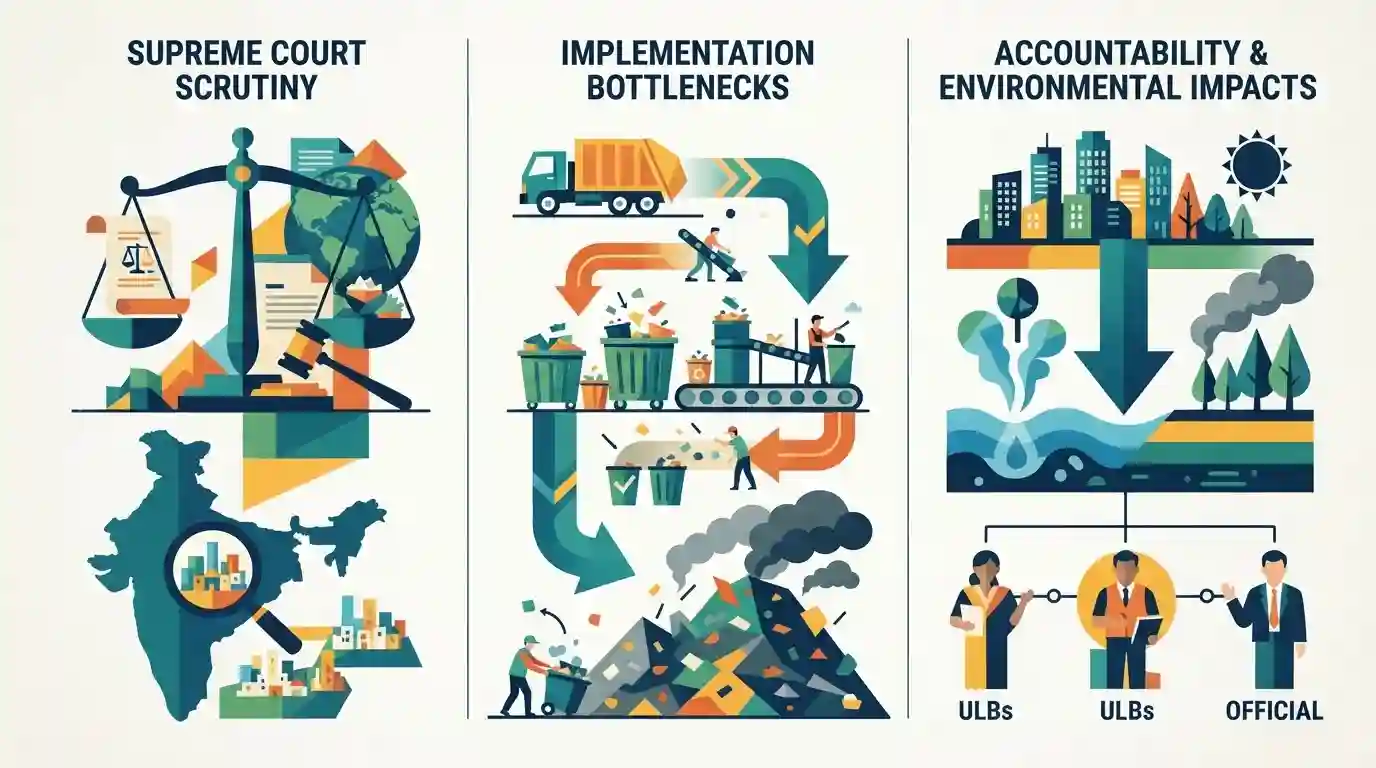
An overview of the Supreme Court's scrutiny regarding Solid Waste Management (SWM) Rules and municipal waste handling in India, highlighting implementation bottlenecks, accountability of urban local bodies, and environmental impacts.
মূল বিষয়
- The Supreme Court of India has been examining issues related to municipal solid waste management, compliance gaps by states, and enforcement of the Solid Waste Management Rules.
- Urban local bodies face persistent challenges in segregation, processing, and scientific disposal of municipal solid waste, leading to massive legacy waste dumps.
- Judicial intervention highlights systemic failures in implementing environmental laws and emphasizes accountability for local governance bodies.
গুরুত্বপূর্ণ শব্দ
Solid Waste Management Rules

National rules governing municipal solid waste handling, segregation, and processing in India, focusing on source segregation, accountability of local bodies, and stringent enforcement mechanisms.
UPSC context
GS Paper III (Environmental Pollution and Degradation, Waste Management). Tests understanding of regulatory frameworks and municipal governance challenges.
Supreme Court of India
The apex judicial body in India that exercises constitutional oversight over environmental governance, enforcing statutory mandates and holding urban local bodies accountable for waste management lapses.
UPSC context
GS Paper II (Judicial Review, Constitutional Bodies) and GS Paper III (Environmental Governance). Tests the judiciary's role in enforcing environmental laws.
Ministry of Environment, Forest and Climate Change
The central nodal ministry responsible for formulating environmental and forestry policies, framing waste management rules, and establishing guidelines for environmental compensation and monitoring.
UPSC context
GS Paper II (Government Policies & Interventions) and GS Paper III (Environment). Essential for questions on institutional mechanisms for pollution control.
প্রিলিমস ফাঁদ
Solid Waste Management Rules are solely administrative guidelines enforced by state pollution control boards without constitutional backing.
Aspirants often assume Solid Waste Management Rules are exclusively enforced by the Ministry of Environment through Pollution Control Boards, overlooking the direct constitutional mandate tied to Article 21 and the judicial empowerment of District Collectors.
সংযুক্ত স্থির ধারণা
What are the key provisions and implementation framework of the Solid Waste Management Rules in India?
- Source Segregation: Mandates source segregation of waste into biodegradable, non-biodegradable, and domestic hazardous wastes by all generators.
- EPR Framework: Places the responsibility on brand owners, manufacturers, and producers for collecting back plastic waste through Extended Producer Responsibility (EPR).
- ULB Powers: Empowers Urban Local Bodies (ULBs) to collect user fees from waste generators and levy spot fines for littering.
- Disposal Norms: Prohibits setting up open dumpsites and mandates sanitary landfills for processing non-recyclable inert waste.
আন্তঃবিষয় প্যাটার্ন
Urban Waste Governance & Article 21 Enforcement
Judicial enforcement of SWM Rules mirrors the strict monitoring seen in the Graded Response Action Plan (GRAP) for air pollution, linking local executive non-compliance directly to Article 21.
District Administration & Environmental Coercive Powers
Empowering District Collectors with coercive utility-cutoff powers bridges environmental governance with district administration and cooperative federalism challenges.

SC mandates on solid waste management (Article 21 link, Polluter Pays, District Collector powers) are prime for a multi-statement Prelims item.
সংযুক্ত PYQ · 2
সংযুক্ত PYQ · 2
- 2019MainsGS3
Define the concept of carrying capacity of an ecosystem as relevant to an environment. Explain how understanding this concept is vital while planning for sustainable development of a region.
- 2026PrelimsGS1
In a multi-ethnic district where both economic competition and historical grievances frequently led to community tensions, a flashpoint has arisen with a Government decision to allocate land for a waste management facility near a tribal hamlet, sparking protests by the tribal community, which claimed that the land was sacred and critical to their cultural identity. At the same time, urban residents and local industries supported the project, citing severe solid waste challenges and health concerns due to lack of a proper disposal site. The conflict has escalated with road blockades, social media campaigns, and allegations of police excesses. As a responsible Government official, you are tasked with resolving the situation through mediation, ensuring a sustainable outcome that balances environmental needs, tribal rights, and urban public health. Consider the following statements with reference to the above : 1. A successful conflict resolution process must begin with acknowledging the cultural concerns of the protesting tribal community before discussing technical alternatives. 2. The Government should move ahead with the project without delay to address urban health concerns, which outweigh the sentiments of a small group. 3. Creating a multi-stakeholder dialogue platform — including tribal leaders, environmental experts, and municipal representatives — to build mutual understanding and help de-escalate tensions. 4. Conducting an independent Environmental and Social Impact Assessment (ESIA) and sharing findings transparently with both sides to facilitate evidence-based decision-making. Which of the statements given above would contribute to the resolution process ?
