Karnataka Cabinet Urges State Election Panel to Use Ballot Papers
Source:Indian Express ↗
Why It Matters
It serves as a prime case study for GS2 answers on two fronts: the ongoing debate surrounding EVM trustworthiness/electoral reforms, and the constitutional autonomy of the State Election Commission (SEC) in the face of state government recommendations.
Summary
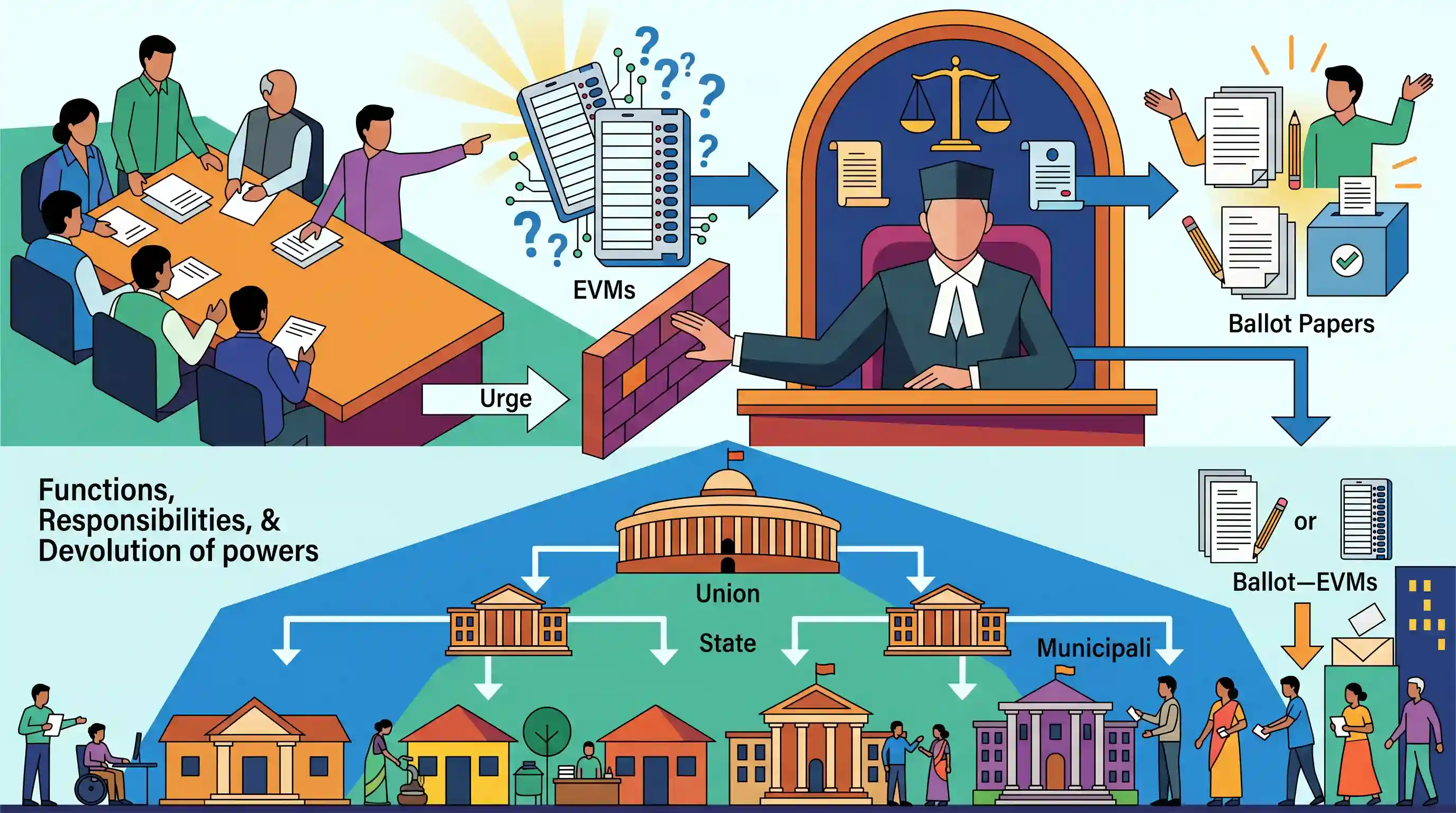
The Karnataka Cabinet has urged the State Election Commission (SEC) to replace Electronic Voting Machines (EVMs) with ballot papers for upcoming local body elections, citing concerns over EVM transparency and public trust. This move highlights ongoing debates surrounding electoral reforms and technology. Crucially, it brings into focus the constitutional autonomy of the SEC under Articles 243K and 243ZA, as the final decision on election modalities rests with the Commission rather than the state government.
Key Points
- The Karnataka State Cabinet has formally requested the State Election Commission (SEC) to switch from Electronic Voting Machines (EVMs) back to traditional ballot papers for upcoming local body elections.
- Under Articles 243K and 243ZA of the Constitution, the SEC is an independent body entrusted with the superintendence, direction, and control of elections to Panchayats and Municipalities.
- While the state cabinet can make recommendations or amend municipal laws, the ultimate authority on the modalities of election conduct (EVM vs. Ballot) rests with the autonomous SEC.
- The development reignites the national debate regarding the trustworthiness, transparency, and verifiability of EVMs versus the logistical challenges of using ballot papers.
Important Terms
State Election Commission (SEC)

An autonomous constitutional body responsible for the superintendence, direction, and control of electoral rolls and elections for Panchayats and Municipalities within a State.
UPSC context
GS Paper II (Constitutional Bodies); tests the functional and constitutional distinction from the Election Commission of India.
Article 243K
A constitutional provision empowering the State Election Commission to manage elections for Panchayati Raj Institutions, ensuring periodic and fair polls for rural local bodies.
UPSC context
GS Paper II (Indian Constitution); central to the devolution of powers and rural grassroots democracy.
Article 243ZA
A constitutional provision that vests the power of conducting elections for Municipalities (urban local bodies) in the State Election Commission, paralleling Article 243K.
UPSC context
GS Paper II (Indian Constitution); essential for understanding urban local governance and electoral autonomy.
73rd Constitutional Amendment Act
The 1992 landmark legislation that granted constitutional status to Panchayati Raj Institutions by adding Part IX and the Eleventh Schedule to the Constitution.
UPSC context
GS Paper II (Decentralization); foundational for questions on local self-government and democratic decentralization.
74th Constitutional Amendment Act
The 1992 legislation that institutionalized urban local bodies (Municipalities) by adding Part IXA and the Twelfth Schedule, mandating regular elections and functional devolution.
UPSC context
GS Paper II (Urban Governance); critical for topics regarding the structure and management of urban administration.
Election Commission of India (ECI)
A permanent constitutional body (Article 324) responsible for administering elections to Parliament, State Legislatures, and the offices of the President and Vice-President.
UPSC context
GS Paper II (Constitutional Bodies); tests the jurisdictional boundary between federal and local electoral management.
Prelims Trap
"State Election Commissions use EVMs provided by the Election Commission of India for local body elections."
SECs are independent constitutional bodies. They procure their own EVMs directly from manufacturers for local polls; the ECI does not supply or maintain them.
Static Concepts Connected
How is the independence of the State Election Commission constitutionally protected?
- Appointment: The State Election Commissioner is appointed by the Governor under Article 243K (Panchayats) and 243ZA (Municipalities).
- Security of Tenure: They can be removed only in the same manner and on the same grounds as a Judge of a High Court.
- Service Conditions: Conditions of service cannot be varied to the Commissioner's disadvantage after their appointment.
How do ECI and SEC constitutional mandates fundamentally differ?
- ECI Domain: Conducts elections for Parliament, State Legislatures, President, and Vice-President under Article 324.
- SEC Domain: Exclusively responsible for the superintendence, direction, and control of Panchayat and Municipality elections.
- No Subordination: The SEC is an entirely independent constitutional authority and is not subordinate to the ECI.
Cross-Topic Patterns
Local Devolution vs. State Encroachment
Friction over poll modalities mirrors broader GS2 themes where state legislatures attempt to infringe upon the constitutionally mandated operational autonomy of decentralised local bodies.
Electoral Trust vs. Technological Efficiency
The EVM-to-ballot debate connects GS2 (Electoral Reforms) with GS4 (Probity), evaluating whether administrative efficiency outweighs the imperative of verifiable democratic trust and transparency.

A 2026 Prelims multi-statement question contrasting SEC and ECI jurisdictions, specifically targeting EVM procurement and SEC removal, is highly probable.
Linked PYQs · 5
Linked PYQs · 5
- 2018MainsGS2
In the light of recent controversy regarding the use of Electronic Voting Machines (EVM), what are the challenges before the Election Commission of India to ensure the trustworthiness of elections in India?
- 2024MainsGS2
Examine the need for electoral reforms as suggested by various committees with particular reference to "one nation one election" principle.
- 2024MainsGS2
Analyse the role of local bodies in providing good governance at local level and bring out the pros and cons merging the rural local bodies with the urban local bodies.
- 2017PrelimsGS1
Consider the following statements: 1. The Election Commission of India is a five-member body. 2. Union Ministry of Home Affairs decides the election schedule for the conduct of both general elections and bye-elections. 3. Election Commission resolves the disputes relating to splits/mergers of recognised political parties. Which of the statements given above is/are correct?
- 2009PrelimsGS1
If a Panchayat is dissolved, elections are to be held within
