Swiss Neutrality and Its Diplomatic Role in Global Conflict Mediation
Source:Indian Express ↗
Why It Matters
Understanding the evolution and nuances of neutrality offers crucial context for geopolitical dynamics, the shifting nature of international mediation, and the impact of economic sanctions in global conflicts.
Summary
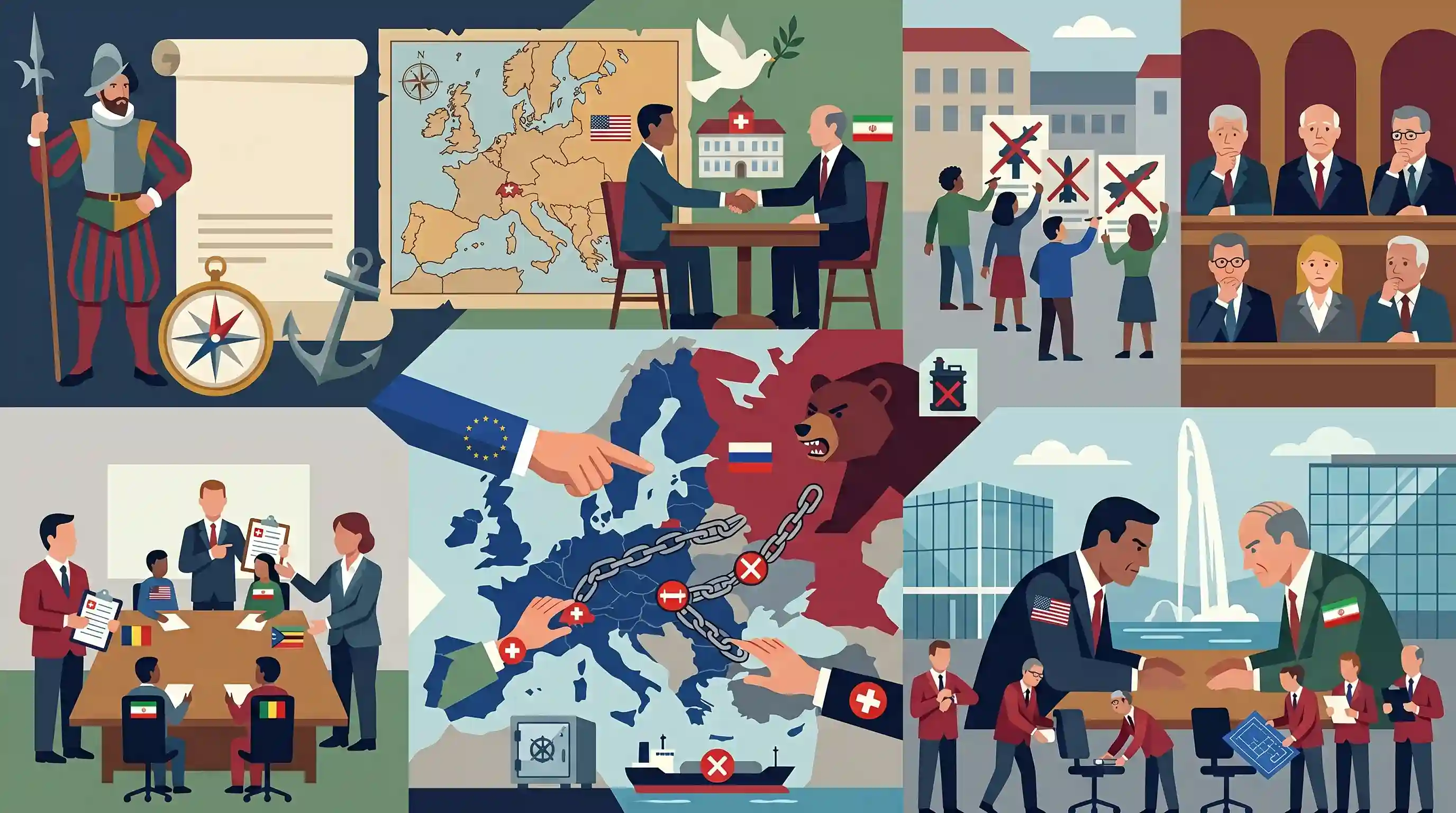
The concept of Swiss neutrality, rooted in the 16th century and codified in the 1907 Hague Conventions, is undergoing contemporary recalibration. Historically, Switzerland leveraged its neutral status to offer "Good Offices," serving as a diplomatic mediator. However, modern interpretations have seen Switzerland engage in "elastic neutrality," such as implementing UN Security Council sanctions and, more recently, adopting EU economic sanctions against Russia. This has sparked domestic debate, culminating in a proposed "Neutrality Initiative" to ban non-UN sanctions. While Geneva currently hosts high-stakes US-Iran talks, Switzerland's role is shifting towards logistical facilitation as regional actors take the lead in active mediation.
Key Points
- Swiss neutrality originated after the Battle of Marignano (1515) and received formal international recognition at the Congress of Vienna and the Act of Paris in 1815.
- The 1907 Hague Conventions codified neutral status, prohibiting engagement in military conflicts or supplying state weapons, but allowing the provision of "Good Offices" for mediation.
- Switzerland has practiced "elastic neutrality," adopting differential neutrality to join the League of Nations and determining that UN Security Council Chapter VII sanctions do not violate its neutral status.
- Following Russia's invasion of Ukraine, Switzerland adopted EU economic sanctions, sparking a domestic "Neutrality Initiative" aimed at constitutionally banning non-UN economic sanctions.
- In the ongoing US-Iran talks, Switzerland is primarily providing logistical support in Geneva, while active political mediation is being handled by countries like Pakistan and Qatar.
Important Terms
Hague Conventions (1907)

A series of international treaties that codified the laws of war, establishing specific rights and duties for neutral powers, such as the inviolability of their territory and non-participation in conflicts.
UPSC context
GS Paper 2 (International Treaties); tests knowledge of International Humanitarian Law and legal frameworks governing global conflict and state neutrality.
Neutrality Initiative
A 2024 Swiss popular initiative seeking to enshrine strict neutrality in the constitution, specifically aiming to ban the adoption of non-UN sanctions, such as those imposed against Russia.
UPSC context
GS Paper 2 (Effect of Policies of Developed Countries); relevant for contemporary debates on international sanctions and evolving interpretations of traditional neutrality.
Bindschedler Doctrine
A 1954 Swiss guideline defining a strict, 'abstentionist' neutrality—advocating against joining military alliances, political organizations like the UN, or participating in international economic sanctions.
UPSC context
GS Paper 2 (International Relations); important for analyzing historical foreign policy doctrines and the transition from strict to active neutrality.
Congress of Vienna (1815)
A grand diplomatic assembly of European powers after Napoleon's defeat that established a new political order and first recognized Switzerland’s perpetual neutrality to ensure regional stability.
UPSC context
GS Paper 1 (World History); tests understanding of the Concert of Europe and the 19th-century foundations of modern international diplomacy.
Act of Paris (1815)
The formal declaration by European Great Powers following the Congress of Vienna that provided the specific international legal guarantee for Switzerland’s permanent and perpetual neutrality.
UPSC context
GS Paper 1 (World History); relevant for studying the legal formalization of sovereign status and neutrality in 19th-century Europe.
UN Security Council
The primary UN organ responsible for global peace; its mandated sanctions are the only type Switzerland’s strict neutrality traditionally permits it to follow without compromising its impartial status.
UPSC context
GS Paper 2 (International Organizations); crucial for understanding global governance, collective security mechanisms, and the legitimacy of international sanctions.
Prelims Trap
"Switzerland's permanent neutral status strictly prohibits it from imposing or participating in any economic sanctions against other nations."
False. Under "elastic neutrality," Switzerland routinely implements binding UN Security Council (Chapter VII) sanctions and recently even adopted unilateral EU economic sanctions against Russia.
Static Concepts Connected
How do 'Good Offices' differ from 'Mediation' in international dispute settlement?
- Good Offices: A neutral third party provides logistical support, communication channels, and a venue for dialogue, without directly participating in the negotiations.
- Mediation: The third party actively participates in the negotiations, guiding discussions and proposing substantive compromises or solutions to resolve the conflict.
What is the historical significance of the Congress of Vienna (1815)?
- Post-Napoleonic Order: It reorganized the European political landscape following the defeat of Napoleon, establishing a balance of power to prevent future major conflicts.
- Swiss Neutrality Guarantee: It provided formal international recognition and guarantee of Switzerland's permanent neutrality, shaping its modern diplomatic identity.
Cross-Topic Patterns
Rise of Middle Powers in Mediation
The shift from Switzerland to actors like Qatar, Oman, and Pakistan in active US-Iran mediation highlights the growing diplomatic clout and agency of Global South middle powers in dispute resolution.
UNSC Chapter VII vs. Unilateral Sanctions
Switzerland's internal debate over adopting EU sanctions mirrors India's traditional stance: strictly recognizing UN Security Council (Chapter VII) sanctions as legally binding under international law, while rejecting unilateral Western sanctions.

Expect a Prelims matching-pair question linking diplomatic terms (Good Offices, Mediation) or historic treaties (Hague, Vienna) to meanings.
Linked PYQs · 3
Linked PYQs · 3
- 2018MainsGS2
In what ways would the ongoing US-Iran Nuclear Pact Controversy affect the national interest of India? How should India respond to this situation?
- 2025MainsGS2
"The reform process in the United Nations remains unresolved, because of the delicate imbalance of East and West and entanglement of the USA vs. Russo-Chinese alliance.” Examine and critically evaluate the East-West policy confrontations in this regard.
- 2021MainsGS1
"There arose a serious challenge to the Democratic State System between the two World Wars.” Evaluate the statement.
