Digital Divide and Exclusion Risks in Financial Inclusion
Source:Indian Express ↗
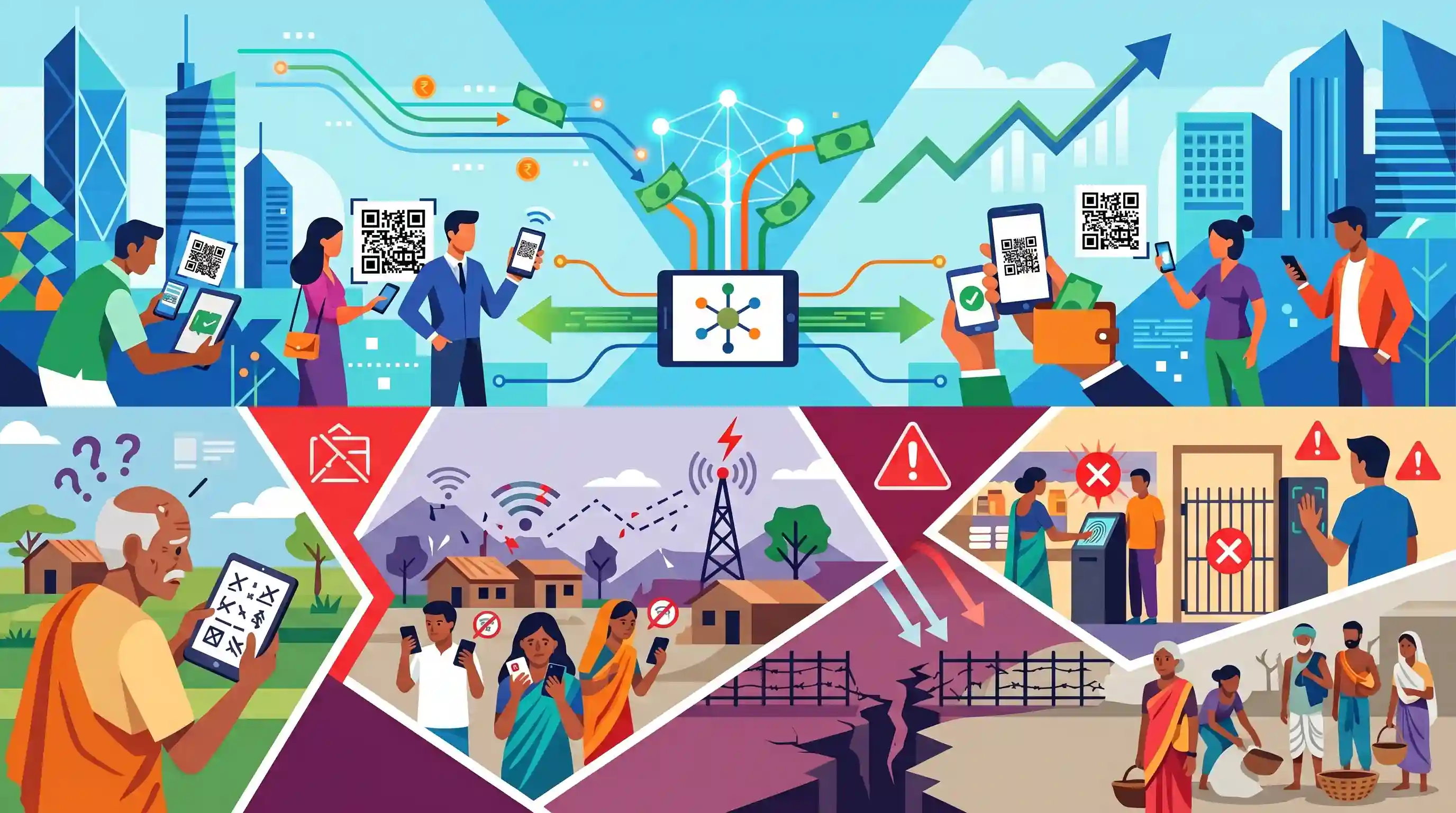
Why It Matters
UPSC often tests the critical evaluation of government schemes. This article provides crucial counter-arguments to the success narrative of India's digital payment revolution (UPI, JAM trinity), highlighting the ground realities of the digital divide and tech-induced exclusion—essential for writing balanced Mains answers in GS2 (Social Justice/E-governance) and GS3 (Inclusive Growth).
Summary
The article highlights the paradox of India's rapid digital financial inclusion drive, noting that the aggressive push towards technologies like UPI, digital payments, and Aadhaar-enabled services often excludes marginalized populations. While the 'swipe and tap' culture has modernized the economy, structural barriers such as the digital divide, poor internet connectivity, digital illiteracy, and technical glitches in biometric authentication lead to the financial and social exclusion of the vulnerable. The piece argues that true financial inclusion requires addressing these systemic gaps and adopting user-centric policies rather than relying on technology as a panacea.
Key Points
- India's rapid transition towards a digital economy through tools like UPI and Aadhaar-enabled payments poses a significant risk of systemic exclusion for marginalized communities.
- The persistent digital divide, characterized by a lack of smartphone ownership, poor internet connectivity, and digital illiteracy in rural areas, hinders true financial inclusion.
- Over-reliance on biometric authentication and technological back-ends in welfare delivery (DBT) often leads to denial of essential services due to technical glitches or fingerprint mismatches.
- A user-centric approach, rather than a purely technology-centric bias, is necessary to ensure that the drive for financial digitalization does not deepen existing socio-economic inequalities.
Important Terms
Pradhan Mantri Jan-Dhan Yojana (PMJDY)

National mission providing universal banking access, including zero-balance savings accounts, credit, insurance, and pensions to the unbanked.
UPSC context
GS Paper III (Inclusive Growth); tests knowledge of foundational infrastructure for financial inclusion and the JAM trinity.
Unified Payments Interface (UPI)
Real-time, mobile-based payment system that enables instant inter-bank fund transfers using a unique identifier (Virtual Payment Address).
UPSC context
GS Paper III (Economy); essential for understanding Digital Public Infrastructure (DPI) and the formalization of the economy.
Aadhaar
A 12-digit unique identity number linked to biometric data, used as proof of identity to access various government and financial services.
UPSC context
GS Paper II (Governance); relevant for analyzing welfare delivery, biometric authentication challenges, and digital exclusion risks.
Direct Benefit Transfer (DBT)
Mechanism to transfer government subsidies and welfare benefits directly into beneficiaries' bank accounts to reduce leakages and eliminate intermediaries.
UPSC context
GS Paper II (Welfare Schemes); key for evaluating transparency and efficiency in the last-mile delivery of public services.
National Payments Corporation of India (NPCI)
An umbrella organization established by the RBI and IBA to operate and manage retail payment and settlement systems in India.
UPSC context
GS Paper III (Economy); tests knowledge of the institutional architect behind India's digital payment innovations like UPI.
Reserve Bank of India (RBI)
India's central bank and regulatory body responsible for monetary policy, banking supervision, and formulating national strategies for financial inclusion.
UPSC context
GS Paper III (Economy); fundamental for understanding the structural framework of India's financial system and monetary stability.
Prelims Trap
"The RBI's Financial Inclusion Index (FI-Index) uses 2017-18 as the base year to measure the progress of financial inclusion."
The FI-Index does NOT have a base year. It is a cumulative score from 0 to 100 reflecting the current level of financial inclusion.
Static Concepts Connected
What are the components of RBI's Financial Inclusion Index (FI-Index)?
- Access (35%): Measures physical and digital infrastructure availability, including banking outlets and digital access points.
- Usage (45%): Captures the active utilization of financial services, savings, and credit, moving beyond mere account ownership.
- Quality (20%): Evaluates financial literacy, consumer protection, inequalities, and grievance redressal mechanisms.
How do 'Type I' and 'Type II' errors apply to Direct Benefit Transfers?
- Exclusion Error (Type I): When eligible beneficiaries are denied their rightful entitlements (e.g., due to fingerprint mismatch or network failure).
- Inclusion Error (Type II): When ineligible individuals or "ghost beneficiaries" wrongfully receive welfare benefits.
- Governance Impact: While the JAM trinity significantly reduces Inclusion Errors (leakages), critics argue it has unintentionally increased Exclusion Errors among marginalized groups.
Cross-Topic Patterns
DPI vs Right to Life (Article 21)
Denial of PDS rations due to Aadhaar biometric glitches connects e-governance infrastructure directly to the Right to Food, a component of Article 21 (underscored by the Puttaswamy judgment caveats).
CBDC offline capabilities and financial inclusion
Financial exclusion due to poor internet infrastructure in rural areas strengthens the case for developing offline functionalities in India's Central Bank Digital Currency (e-Rupee).

Expect a Mains GS2 question analyzing whether India's Digital Public Infrastructure (DPI) simply replaces welfare 'inclusion errors' with systemic 'exclusion errors'.
Linked PYQs · 5
Linked PYQs · 5
- 2021MainsGS2
Has digital illiteracy, particularly in rural areas, coupled with lack of Information and Communication Technology (ICT) accessibility hindered socio-economic development? Examine with justification.
- 2025MainsGS2
e-governance projects have a built-in bias towards technology and back-end integration than user-centric designs. Examine.
- 2023MainsGS3
What is the status of digitalization in the Indian economy? Examine the problems faced in this regard and suggest improvements.
- 2016MainsGS3
Pradhan Mantri Jan-Dhan Yojana (PMJDY) is necessary for bringing unbanked to the institutional finance fold. Do you agree with this for financial inclusion of the poorer section of the Indian society? Give arguments to justify your opinion.
- 2017PrelimsGS1
Which of the following is a most likely consequence of implementing the 'Unified Payments Interface (UPI)'?
