Rajasthan reports surge in swine flu cases prompting health review
Source:ommcomnews ↗
Why It Matters
Questions concerning infectious diseases (like H1N1 and H5N1), their pathogens, and seasonal health management in Rajasthan frequently appear in RPSC Prelims under Science & Technology and State-specific current affairs. Understanding the disease mechanisms and public health surveillance systems (such as the Nidan software) is important for the exam.
Summary
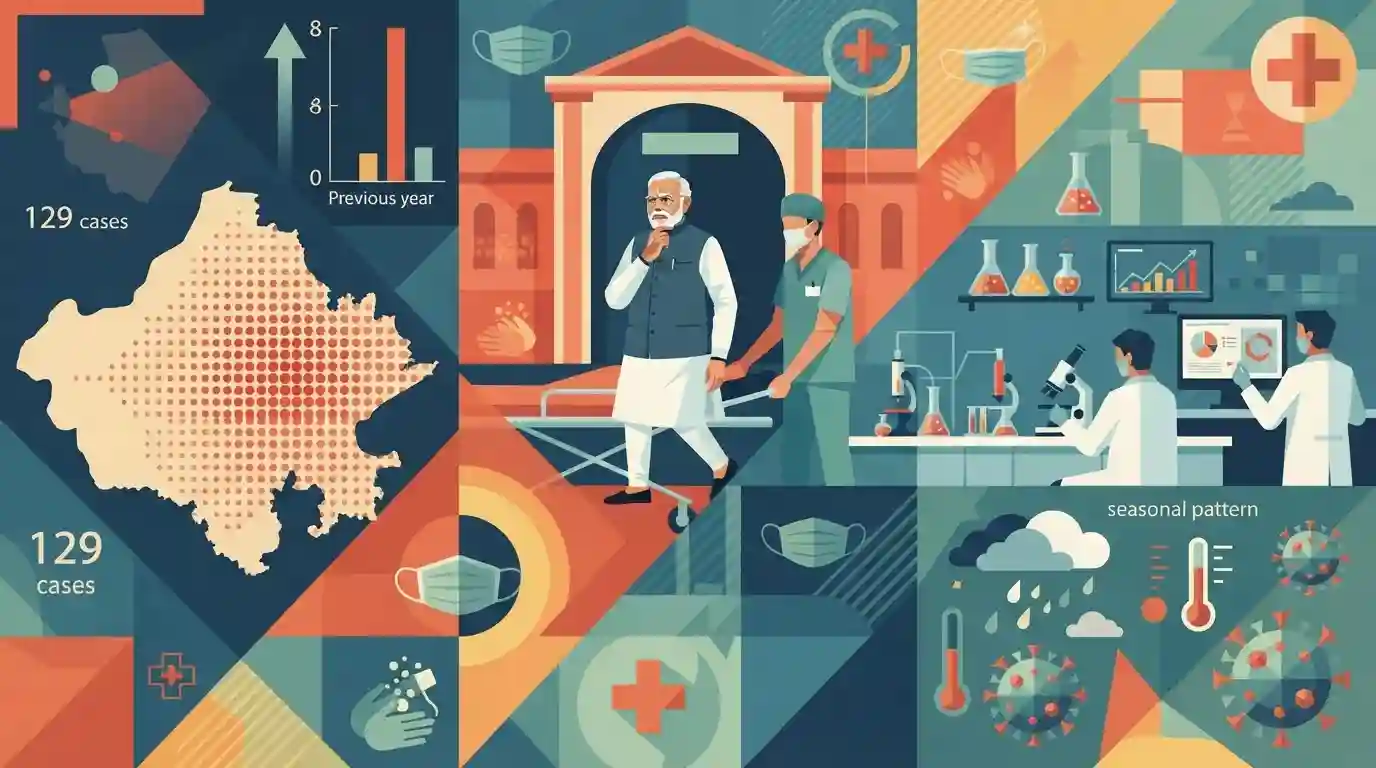
Rajasthan is experiencing a significant surge in Swine Flu (H1N1) cases, recording 129 infections in the first half of August—an eight-fold increase over the previous year. The outbreak gained prominence after State Agriculture Minister Dr. Kirodi Lal Meena tested positive and was admitted to SMS Hospital's ICU in Jaipur. Health authorities note that the virus follows a known seasonal pattern and have intensified surveillance to manage the spike in cases.
Key Points
- Rajasthan reported 129 cases of Swine Flu (H1N1) in the first 15 days of August, an eight-fold increase compared to the same period last year.
- State Agriculture Minister Dr. Kirodi Lal Meena was admitted to the ICU at SMS Hospital in Jaipur after testing positive for the H1N1 virus.
- Health authorities clarified that the H1N1 virus is exhibiting its typical seasonal pattern and is not a novel strain.
- The sudden spike in cases has prompted the Rajasthan Health Department to intensify disease surveillance and monitoring measures across the state.
Important Terms
Swine Flu (H1N1)

A highly contagious respiratory disease caused by the H1N1 influenza virus. It typically exhibits seasonal spikes, spreading through droplets and causing symptoms like fever, cough, and severe fatigue.
UPSC context
Relevant for RAS General Science (Paper II) and Public Health, testing awareness of viral diseases, epidemiology, and seasonal health threats.
Kirodi Lal Meena
A prominent politician and currently the Agriculture Minister of Rajasthan, whose recent intensive care hospitalisation for Swine Flu brought significant administrative attention to the state's outbreak.
UPSC context
Important for State Administration and Prelims, testing awareness of key state cabinet ministers, public figures, and state political events.
Sawai Man Singh (SMS) Hospital
Located in Jaipur, it is a premier tertiary care public hospital and the largest government-run health facility in Rajasthan, acting as a primary nodal centre for severe disease outbreaks.
UPSC context
Relevant for Rajasthan Geography and Administration, testing knowledge of the state's vital medical infrastructure and primary healthcare institutions.
Rajasthan Health Department
The nodal state government authority responsible for public health administration, disease surveillance, and managing medical infrastructure—such as ICU beds and isolation wards—during viral outbreaks.
UPSC context
Crucial for RAS Public Administration (Paper III), testing understanding of state health governance, public health preparedness, and disaster management mechanisms.
Prelims Trap
H1N1 Swine Flu currently requires direct contact with infected pigs to transmit.
While originally zoonotic (derived from pigs), current seasonal H1N1 strains transmit primarily human-to-human via respiratory droplets. Direct contact with pigs is no longer required.
Static Concepts Connected
How are Influenza A viruses classified into subtypes like H1N1?
- Hemagglutinin (H): A surface viral protein (18 known subtypes) that allows the influenza virus to bind to and enter host cells.
- Neuraminidase (N): An enzyme on the virus surface (11 known subtypes) that enables the release of newly formed viruses from infected cells.
- Antigenic Shift: The swapping of genetic material when different flu strains infect the same cell, often causing pandemics.
What is the 'Nidaan' software used by the Rajasthan Government?
- Core Function: A digital platform launched for the presumptive diagnosis and real-time monitoring of seasonal and non-communicable diseases.
- Epidemiological Surveillance: Enables the state Health Department to track localized disease spikes (like Swine Flu or Dengue) and deploy rapid interventions.
Cross-Topic Patterns
Viral surveillance + State e-Governance
State outbreaks directly test digital health infrastructure like the 'Nidaan' software, bridging Public Health administration and State e-Governance topics in the syllabus.
H1N1 vs H5N1 transmission vectors
RPSC exams frequently ask aspirants to distinguish between H1N1 (currently human-to-human spread) and H5N1 (Avian flu, heavily reliant on direct bird contact).

Expect a 'Match-the-Following' question linking viral strains (H1N1, H5N1, Nipah) to their primary vectors or modes of transmission.
Linked PYQs · 2
Linked PYQs · 2
- 2010RPSC_PRELIMSGS1
The H5N1 influenza is known as
- 2018RPSC_PRELIMSGS1
The Rajasthan government has released a new software to monitor trends in seasonal and non-communicable diseases, as well as diseases found in specific areas. What is the name of this software?
