Swami Vivekananda's Philosophy and National Youth Day
Source:Indian Express ↗
Why It Matters
Swami Vivekananda is a foundational figure in both Modern Indian History (GS1) and Ethics (GS4). Understanding his philosophy of Neo-Vedanta, universal brotherhood, and 'service as worship' is critical for answering quotation-based questions in the Ethics paper and tracing the evolution of socio-religious reform movements in the History syllabus.
Summary
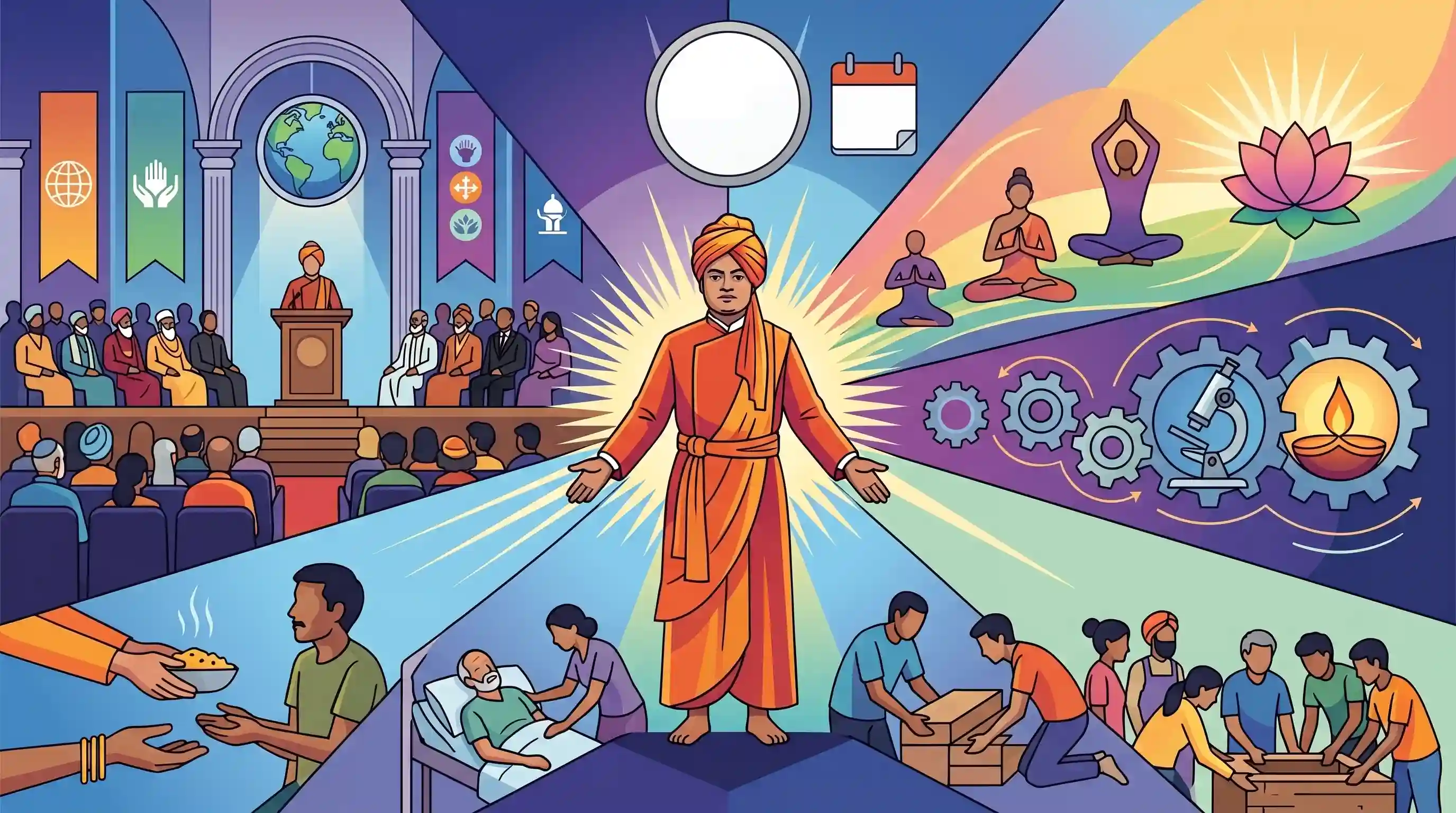
The article commemorates National Youth Day, celebrated annually on January 12 to mark Swami Vivekananda's birth anniversary. It explores his enduring legacy, focusing on his pivotal role in introducing Hindu philosophies—particularly Vedanta and Yoga—to the West. The piece highlights his iconic 1893 speech at the World's Parliament of Religions in Chicago, which established Indian spiritual heritage on the global stage. It details his formulation of Neo-Vedanta, his efforts to synthesize science and religion, and his foundational ethical tenet that "service to mankind is service to God" (Daridra Narayan), which continues to drive the philanthropic mission of the Ramakrishna Order he founded.
Key Points
- National Youth Day is observed in India on January 12 to honor the birth anniversary of Swami Vivekananda and inspire the youth with his ideals.
- He gained global acclaim after his seminal address at the World's Parliament of Religions in Chicago in 1893, which introduced Indian spiritual heritage to the Western world.
- Vivekananda propagated 'Neo-Vedanta', a modern interpretation of ancient Hindu philosophy that reconciled Western science and humanism with traditional Indian spirituality.
- Influenced by his guru Ramakrishna Paramahamsa, he emphasized the concept of 'Daridra Narayan', teaching that service to the poor and marginalized is equivalent to the worship of God.
- He established the Ramakrishna Math and Ramakrishna Mission to institutionalize his spiritual teachings and undertake extensive philanthropic, educational, and medical work.
Important Terms
National Youth Day

Celebrated annually on January 12 since 1985 to mark Swami Vivekananda's birth anniversary. It aims to inspire Indian youth through his ideals of character-building, nation-building, and selfless service.
UPSC context
GS Paper I (Modern Indian History) and Prelims; highlights the state’s role in promoting cultural values.
Neo-Vedanta
A reinterpretation of traditional Advaita Vedanta by Swami Vivekananda, shifting the focus from individual renunciation to social responsibility and active service as the highest form of spiritual practice.
UPSC context
GS Paper I (Socio-religious Reform) and GS Paper IV (Ethics); tests the evolution of Hindu philosophy.
Ramakrishna Mission
A humanitarian organization founded by Swami Vivekananda in 1897. It operates on the principle of "Practical Vedanta," providing social services like education and healthcare as a form of spiritual worship.
UPSC context
GS Paper I (Modern History); a major socio-religious reform organization critical for personality-based questions.
World's Parliament of Religions
A landmark 1893 event in Chicago where Swami Vivekananda introduced Hindu philosophies—Vedanta and Yoga—to the West, advocating for universal tolerance and the end of religious fanaticism.
UPSC context
GS Paper I (Modern History); marks India's early cultural outreach and the globalization of Indian thought.
Daridra Narayan
An axiom coined by Swami Vivekananda meaning "God in the poor." It teaches that serving the downtrodden is equivalent to serving the Divine (Narayana), emphasizing social justice and compassion.
UPSC context
GS Paper IV (Ethics and Human Values); essential for discussing empathy and public service.
Ramakrishna Math
The monastic order and spiritual core of the Ramakrishna movement, focused on the inner spiritual life of its members and the preservation of Vedantic teachings.
UPSC context
GS Paper I (Modern History); distinguishes the monastic lineage from the humanitarian mission (RKM).
Prelims Trap
"Ramakrishna Paramahamsa founded the Ramakrishna Mission to institutionalize his spiritual teachings."
The Mission was founded by Swami Vivekananda in 1897 in Belur. Ramakrishna Paramahamsa was his guru and the inspiration, but never established the formal organization.
Static Concepts Connected
What are the core tenets of Swami Vivekananda's Neo-Vedanta philosophy?
- Practical Spirituality: Emphasizes applying non-dualism to everyday life through social service, rejecting mere ascetic renunciation for active societal participation.
- Daridra Narayan: Views selfless service to the poor and marginalized as the highest form of worship, equating mankind with God.
- Universal Religion: Asserts that all religions are equally valid paths to the same divine reality, promoting spiritual harmony and universalism over mere tolerance.
How did Ramakrishna Mission differ from earlier 19th-century reform movements?
- Image Worship: Unlike the Brahmo Samaj and Arya Samaj, the Mission did not condemn idol worship, recognizing it as a valid, helpful stepping stone for spiritual realization.
- Global Footprint: It actively exported Indian spiritual philosophy, taking Vedanta and Yoga to the West, establishing a global synthesis rather than just inward-looking reform.
Cross-Topic Patterns
Daridra Narayan and GS4 Ethics
Vivekananda’s tenet that 'service to mankind is service to God' is a foundational example for GS4 answers on compassion, altruism, and the moral basis of civil service.
Cultural Diplomacy and Soft Power
The 1893 Chicago address marks the historical genesis of India's 'soft power' diplomacy, laying the groundwork for modern geopolitical tools like the International Day of Yoga.

Expect a 2026 Prelims statement comparing the Ramakrishna Mission's stance on idol worship with that of the Brahmo and Arya Samaj.
Linked PYQs · 3
Linked PYQs · 3
- 2021MainsGS1
Trace the rise and growth of socio-religious reform movements with special reference to Young Bengal and Brahmo Samaj.
- 2023MainsGS4
Given below are three quotations of great thinkers. What do each of these quotations convey to you in the present context ? "Do not hate anybody, because that hatred that comes out from you must, in the long run, come back to you. If you love, that love will come back to you, completing the circle." – Swami Vivekananda
- 2024MainsGS4
Given below are three quotations of great thinkers. What do each of these quotations convey to you in the present context? (a) “Learn everything that is good from others, but bring it in, and in your own way absorb it, do not become others.” — Swami Vivekananda
