Kolkata Ranks as Most Polluted City in Bengal in Clean Air Survey
Source:etvbharat ↗
Why It Matters
Important for state-level environmental governance and current affairs related to West Bengal's urban pollution indices and rankings.
Summary
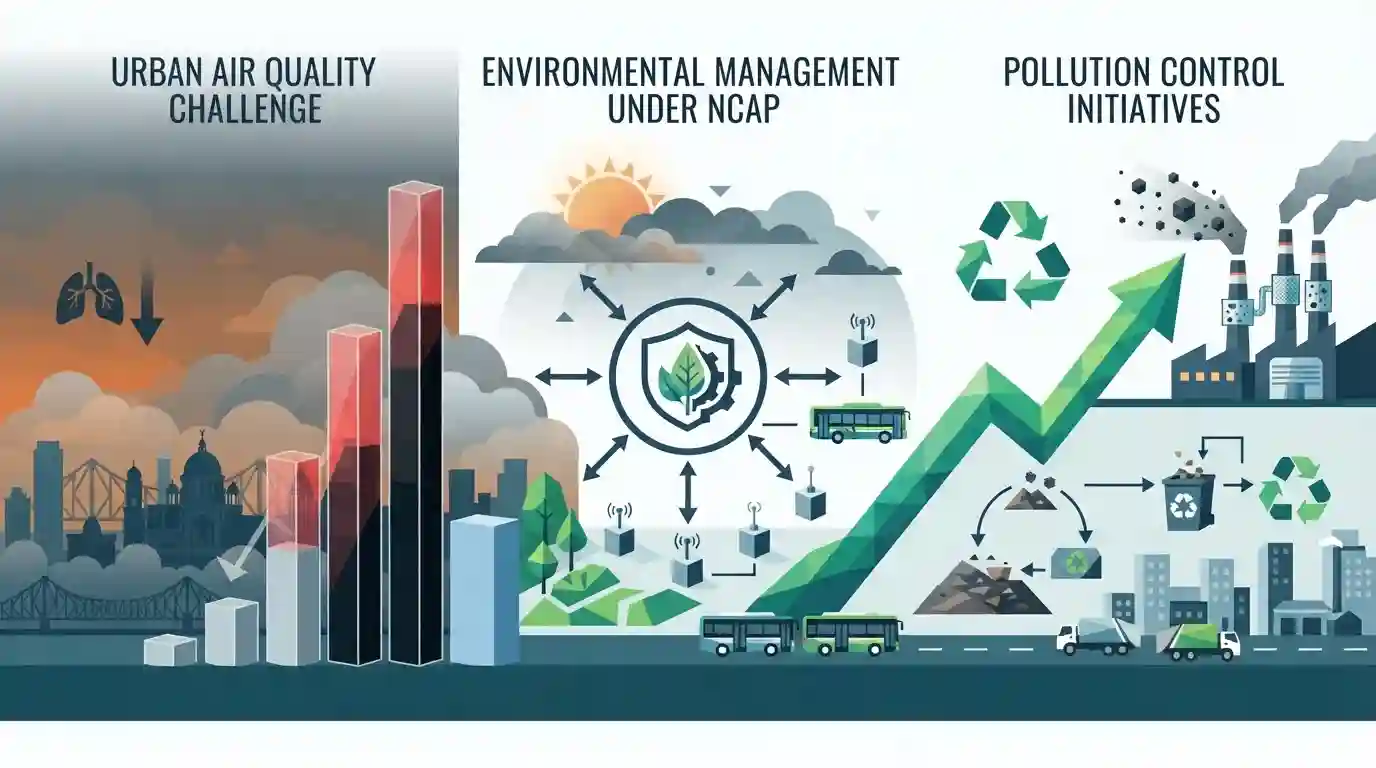
According to the Swachh Vayu Survekshan 2026 rankings, Kolkata has emerged as the most polluted city in West Bengal, bringing urban air quality, environmental management under the National Clean Air Programme, and pollution control initiatives into sharp focus.
Key Points
- Kolkata has been ranked as the most polluted city in West Bengal under the Swachh Vayu Survekshan 2026 rankings.
- Swachh Vayu Survekshan is an initiative by the Ministry of Environment, Forest and Climate Change (MoEFCC) to rank cities based on air quality implementation and targets under the National Clean Air Programme (NCAP).
- Urban air pollution in West Bengal's capital highlights challenges related to vehicular emissions, construction dust, and industrial factors.
Important Terms
Swachh Vayu Survekshan

An evaluation scheme introduced by the MoEFCC under the National Clean Air Programme to rank cities on air quality improvement, municipal implementation, and pollution control measures across various population categories.
UPSC context
WBCS Paper III (Environment & Sustainable Development): Important for urban air pollution rankings, government policy interventions, and local governance.
Central Pollution Control Board
A statutory apex body established under the Water (Prevention and Control of Pollution) Act, 1974, tasked with promoting cleanliness of streams and wells and preventing, controlling, and abating air and water pollution.
UPSC context
WBCS Paper III (Environment): Important for institutional frameworks, environmental statutory bodies, and national pollution monitoring guidelines.
Prelims Trap
Swachh Vayu Survekshan is implemented by the Ministry of Housing and Urban Affairs (MoHUA).
Aspirants often confuse Swachh Vayu Survekshan (administered by MoEFCC for air quality under NCAP) with Swachh Survekshan (administered by the Ministry of Housing and Urban Affairs for solid waste and sanitation).
Static Concepts Connected
What are the primary goals and institutional mechanisms of the National Clean Air Programme (NCAP) in India?
- Target Reductions: Target reduction of 20-30% in PM2.5 and PM10 concentrations by 2024 (baseline 2017), later revised up to 40% reduction by 2026.
- Nodal Agency: Implemented by the Central Pollution Control Board (CPCB) under the Ministry of Environment, Forest and Climate Change (MoEFCC).
- Non-Attainment Cities: Covers over 130 non-attainment cities that fail to meet national ambient air quality standards across India.
Cross-Topic Patterns
NCAP + Municipal Finance Devolution
NCAP targets link urban air quality management with fiscal devolution and municipal governance reforms under the 15th Finance Commission grants for million-plus cities.
Urban Air Pollution + NGT Mandates
West Bengal industrial clusters and Kolkata transport corridors highlight the policy trade-off between rapid urbanization and statutory environmental compliance under the NGT.

Expect statement-based questions on Swachh Vayu Survekshan implementing ministry (MoEFCC) versus Swachh Survekshan (MoHUA).
Linked PYQs · 1
Linked PYQs · 1
- 2018WBCS_PRELIMSGS1
The largest Arsenic de-contamination/purification plant in West Bengal is located at
