West Bengal Border Fencing and Due Process Governance Measures
Source:Indian Express ↗
Why It Matters
These developments are highly relevant for Civil Services aspirants as they intersect multiple syllabus areas: GS2 (Rule of Law, executive overreach, state policies) and GS3 (Border management along the porous India-Bangladesh border). The 'bulldozer' tactic particularly highlights the friction between swift executive action and constitutional natural justice.
Summary
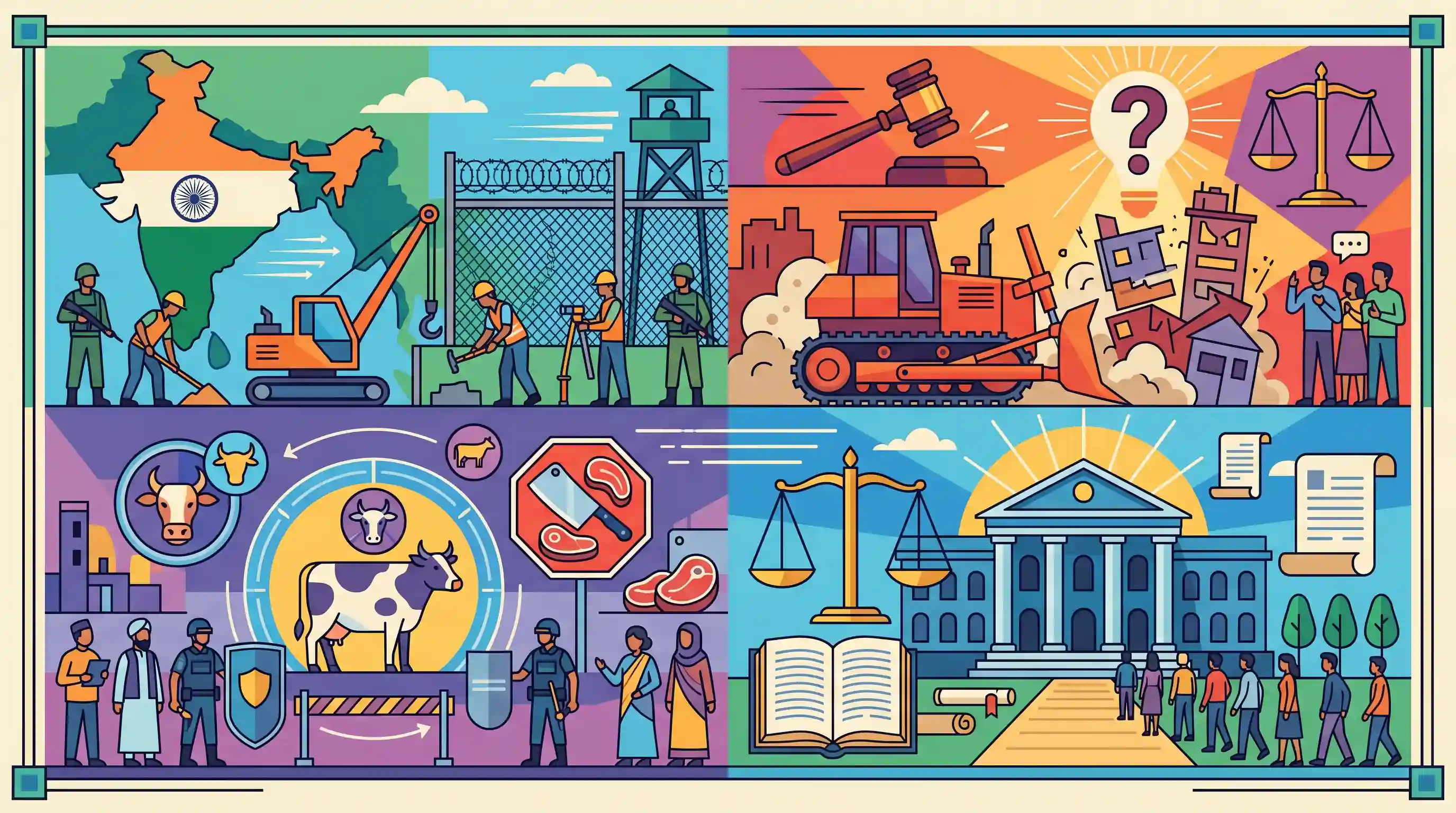
The article highlights the rapid policy shifts introduced by the newly formed Suvendu Adhikari government in West Bengal. In its initial days, the administration has prioritized national security by expediting border fencing along the India-Bangladesh border. Simultaneously, it has embraced aggressive law enforcement tactics, notably the use of 'bulldozers' against illegal properties, which sparks debates regarding executive overreach and adherence to judicial due process. Furthermore, directives to curb animal slaughter indicate a significant realignment of state policies concerning public order, cultural practices, and regulatory enforcement.
Key Points
- The new Suvendu Adhikari-led government in West Bengal has initiated swift administrative and policy measures immediately after assuming office.
- Key security priorities include accelerating border fencing along the India-Bangladesh border to curb illegal infiltration and smuggling.
- The administration has adopted 'bulldozer' tactics for demolishing illegal structures, a contentious executive action that raises debates on constitutional due process and the rule of law.
- Stringent measures to curb animal slaughter have been introduced, reflecting a shift in the state's public order and cultural enforcement policies.
Important Terms
Border Security Force (BSF)

A Central Armed Police Force (CAPF) under the Ministry of Home Affairs, serving as India's "First Line of Defence." It primarily guards the borders with Pakistan and Bangladesh to prevent infiltration, smuggling, and trans-border crimes.
UPSC context
GS-III (Internal Security): Mandates of various security forces and agencies. Tests understanding of border guarding vs. internal security duties.
Border Management
A multi-layered strategy involving infrastructure (fencing, roads), technology (CIBMS), and human resources to secure frontiers. It aims to regulate legal immigration and prevent cross-border crimes like human trafficking and narcotics smuggling.
UPSC context
GS-III (Security challenges in border areas): Focuses on the "One Border, One Guarding Force" principle and infrastructure challenges like riverine gaps.
Due Process of Law
A judicial doctrine (read into Article 21) ensuring that laws depriving a person of life or liberty must be "fair, just, and reasonable." It protects against both arbitrary executive and legislative actions.
UPSC context
GS-II (Polity/Constitution): Significant provisions and judicial review. Tests the evolution of personal liberty from the Maneka Gandhi case onwards.
Article 48 (DPSP)
A Directive Principle (Part IV) instructing the State to organize agriculture and animal husbandry on modern lines and to take steps for preserving breeds and prohibiting the slaughter of cows and calves.
UPSC context
GS-II (Polity): Directive Principles of State Policy. Tests knowledge of non-justiciable guidelines and their impact on state legislation and cultural practices.
Executive Overreach
Occurs when the executive branch exceeds its constitutional authority or infringes upon judicial or legislative domains. It is often debated in the context of summary demolitions or bypass of judicial due process.
UPSC context
GS-II (Governance/Constitution): Separation of powers and the system of checks and balances. Tests the limits of administrative discretion in law enforcement.
Rule of Law
The foundational principle that all persons and the government are subject to law. It mandates that no one is punished except for a specific breach of law established in an ordinary legal manner.
UPSC context
GS-II (Polity): Basic structure of the Constitution. Tests understanding of A.V. Dicey’s concept vs. arbitrary power in governance.
Prelims Trap
"Laws regulating or prohibiting cow and animal slaughter fall under the Concurrent List."
This is a common trap. The preservation, protection, and improvement of livestock falls exclusively under Entry 15 of the State List, not the Concurrent List.
Static Concepts Connected
How does the Constitution view 'bulldozer justice' and executive demolitions?
- Article 21 Violation: Punitive property demolition without notice or fair hearing bypasses due process, violating the right to life, shelter, and personal liberty.
- Separation of Powers: The executive acts unconstitutionally when it usurps judicial functions by pronouncing guilt and punishing accused individuals directly without trial.
- Article 142 Directives: The Supreme Court invoked its extraordinary powers to issue pan-India guidelines requiring 15-day prior notice, appellate opportunities, and videography of proceedings.
What makes securing the India-Bangladesh border difficult?
- Riverine Topography: Large stretches feature shifting river channels, dense forests, and marshy lands, making physical fencing technically challenging and maintenance-heavy.
- Porous Boundaries: Dense human settlements extend right up to the zero line, complicating surveillance and facilitating illegal immigration and cattle smuggling.
Cross-Topic Patterns
Separation of Powers & Admin Ethics
'Bulldozer justice' spans GS2 (Fundamental Rights, Article 142) and GS4 (administrative ethics), pitting rapid executive enforcement against procedural fairness, rule of law, and constitutionalism.
DPSP and State List overlap
State curbs on animal slaughter operationalize Article 48 of the DPSPs (prohibiting cow slaughter) utilizing the exclusive legislative powers granted under Entry 15 of the State List.

Expect a 2026 GS2 mains question evaluating 'bulldozer justice' against the doctrine of Separation of Powers and Article 142 rules.
Linked PYQs · 4
Linked PYQs · 4
- 2020MainsGS3
Analyze internal security threats and transborder crimes along Myanmar, Bangladesh and Pakistan borders including Line of Control (LoC). Also discuss the role played by various security forces in this regard.
- 2024MainsGS2
What changes has the Union Government recently introduced in the domain of Centre-State relations ? Suggest measures to be adopted to build the trust between the Centre and the States and for strengthening federalism.
- 2020MainsGS3
For effective border area management, discuss the steps required to be taken to deny local support to militants and also suggest ways to manage favourable perception among locals.
- 2023MainsGS2
“Constitutionally guaranteed judicial independence is a prerequisite of democracy.” Comment.
