West Bengal Renames State Award to Vidyasagar Teacher Honour
Source:theprint ↗
Why It Matters
The renaming of a state award is highly relevant for WBCS Prelims current affairs, while Ishwar Chandra Vidyasagar's role in education links directly to the Bengal Renaissance. Additionally, disaster management and the geography of West Bengal's flood-prone river systems are core regional syllabus components.
Summary
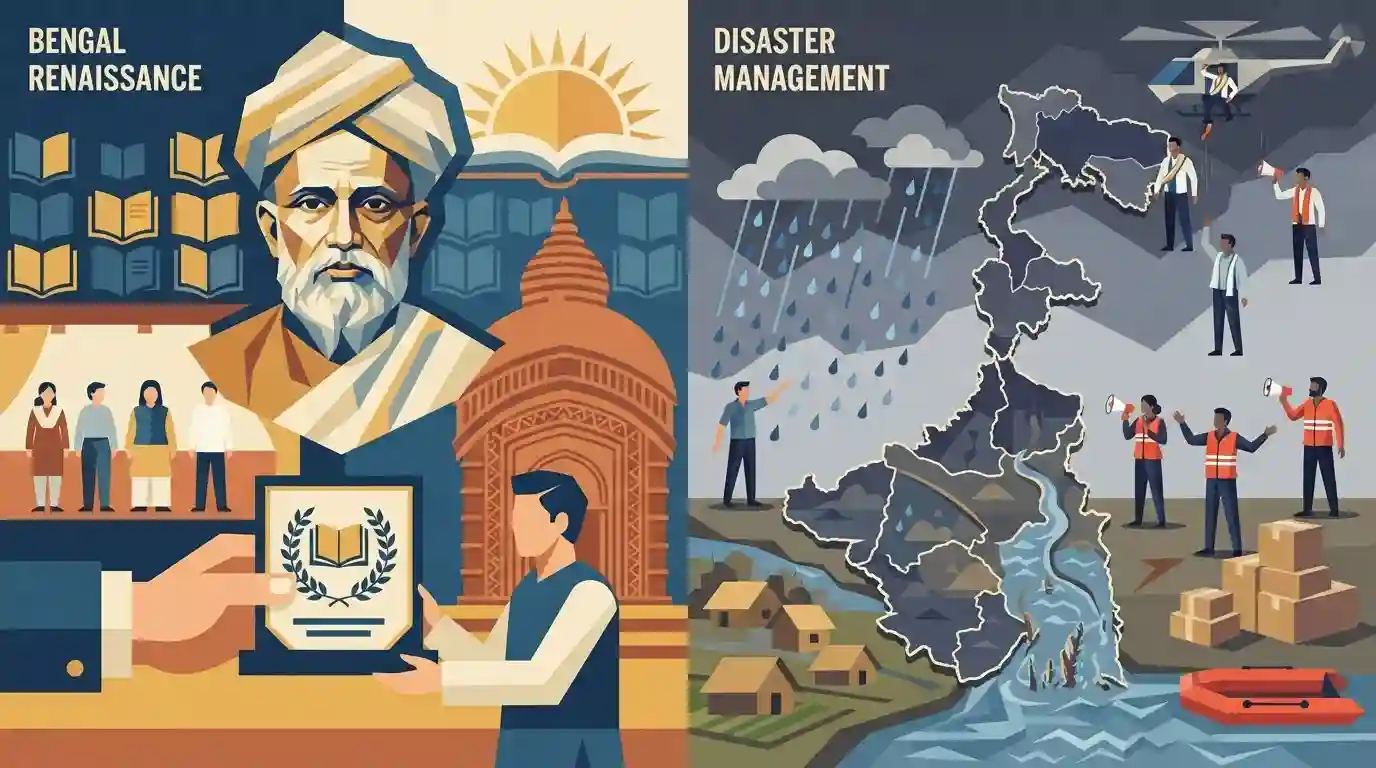
The West Bengal Cabinet has announced the renaming of the state's 'Shiksharatna Award' to the 'Vidyasagar Teacher Honour' in tribute to the pioneering 19th-century educator and reformer Ishwar Chandra Vidyasagar. In parallel, amidst heavy rainfall and looming flood threats across various districts, ministers and MLAs have been strictly directed to remain in their constituencies to personally oversee disaster management and flood relief operations.
Key Points
- The West Bengal Cabinet decided to rename the 'Shiksharatna Award' to the 'Vidyasagar Teacher Honour' to honor the legacy of Ishwar Chandra Vidyasagar.
- Ministers and MLAs have been explicitly directed to stay in their respective constituencies to monitor the flood situation.
- The move prioritizes direct administrative oversight and rapid disaster response to mitigate the impact of heavy rains in the districts.
Important Terms
Shiksharatna Award

The previous name for the West Bengal government's highest state honour recognizing outstanding teachers. The state cabinet recently rebranded it as the Vidyasagar Teacher Honour.
UPSC context
Relevant for WB Current Affairs. Exams often test the former and current names of rebranded state schemes or awards.
Vidyasagar Teacher Honour
A state government award presented annually on Teachers' Day (September 5) to meritorious educators in West Bengal. It recently replaced the former Shiksharatna Award.
UPSC context
Important for West Bengal Current Affairs and State Awards, testing awareness of recent administrative and cultural policy changes.
Ishwar Chandra Vidyasagar
A pioneering 19th-century Indian educator, linguist, and social reformer who championed women's education and Hindu widow remarriage. He was a central figure of the Bengal Renaissance.
UPSC context
Crucial for Indian History (Paper III) and the Bengal Renaissance, frequently testing his contributions to socio-religious reforms and education.
Flood Management in West Bengal
Administrative and engineering measures to mitigate flood risks across West Bengal, addressing vulnerabilities in the state's 38,168 sq. km flood-prone area, particularly in the lower Gangetic basin and North Bengal.
UPSC context
Critical for Paper IV (Geography of West Bengal and Disaster Management), assessing knowledge of the state's physiographic challenges and vulnerabilities.
Prelims Trap
"Ishwar Chandra Vidyasagar founded the Government Sanskrit College in Calcutta to blend Indian and Western educational systems."
Vidyasagar did not found the Sanskrit College (established in 1824). He became its first Indian Principal in 1851 and introduced major structural reforms, including admitting non-Brahmins.
Static Concepts Connected
Why is Vidyasagar characterized as a "traditional modernizer" in the Bengal Renaissance?
- Scriptural justification: He strategically utilized orthodox Hindu texts, specifically the Parasara Samhita, to legally and socially validate the modern concept of widow remarriage.
- Curriculum integration: As Principal, he uniquely integrated English and Western sciences into the traditional, orthodox Sanskrit College curriculum.
- Democratizing education: He systematically broke the orthodox Brahminical monopoly on ancient texts by opening Sanskrit College admissions to non-Brahmin students.
What are the geographical and administrative features of the Damodar Valley Corporation (DVC)?
- Origin and flow: The Damodar River originates from the Khamarpat Hill in the Chota Nagpur Plateau (Jharkhand) and flows through a rift valley into West Bengal.
- First multipurpose project: Established in 1948 and modeled after the US Tennessee Valley Authority (TVA), it is independent India's first multipurpose river valley project.
- Joint administration: DVC operates as a joint venture represented by the Central Government, West Bengal, and Jharkhand (formerly Bihar).
Cross-Topic Patterns
Comparative Renaissance reform methods
Vidyasagar's use of the Parasara Samhita for widow remarriage is frequently tested comparatively against Raja Ram Mohan Roy's use of the Vedas and Upanishads for abolishing Sati.
DVC dams & South Bengal floods
Monsoonal flood management in lower Bengal heavily depends on DVC's regulated water releases, directly linking state disaster management protocols with interstate river geography.

Expect multi-statement questions contrasting the specific reform texts of Vidyasagar (Parasara Samhita) with Rammohan Roy (Upanishads).
Linked PYQs · 3
Linked PYQs · 3
- 2015WBCS_PRELIMSGS1
Who is called a traditional modernizer ?
- 2015WBCS_PRELIMSGS1
The North flowing rivers of West Bengal are
- 2022WBCS_PRELIMSGS1
The western part of Teesta river in West Bengal is called
