Space technology applications for renewable energy in Northeast India
Source:The Hindu ↗
Why It Matters
The article elegantly connects advanced space technology concepts (resource sustainability) with grassroots developmental challenges (rural electrification in difficult terrains). It highlights the practical socio-economic applications of India's space endeavors and provides a concrete case study of decentralized renewable energy policy in the North Eastern region, which is highly relevant for GS-3 answers on Science & Technology, Energy Infrastructure, and Inclusive Growth.
Summary
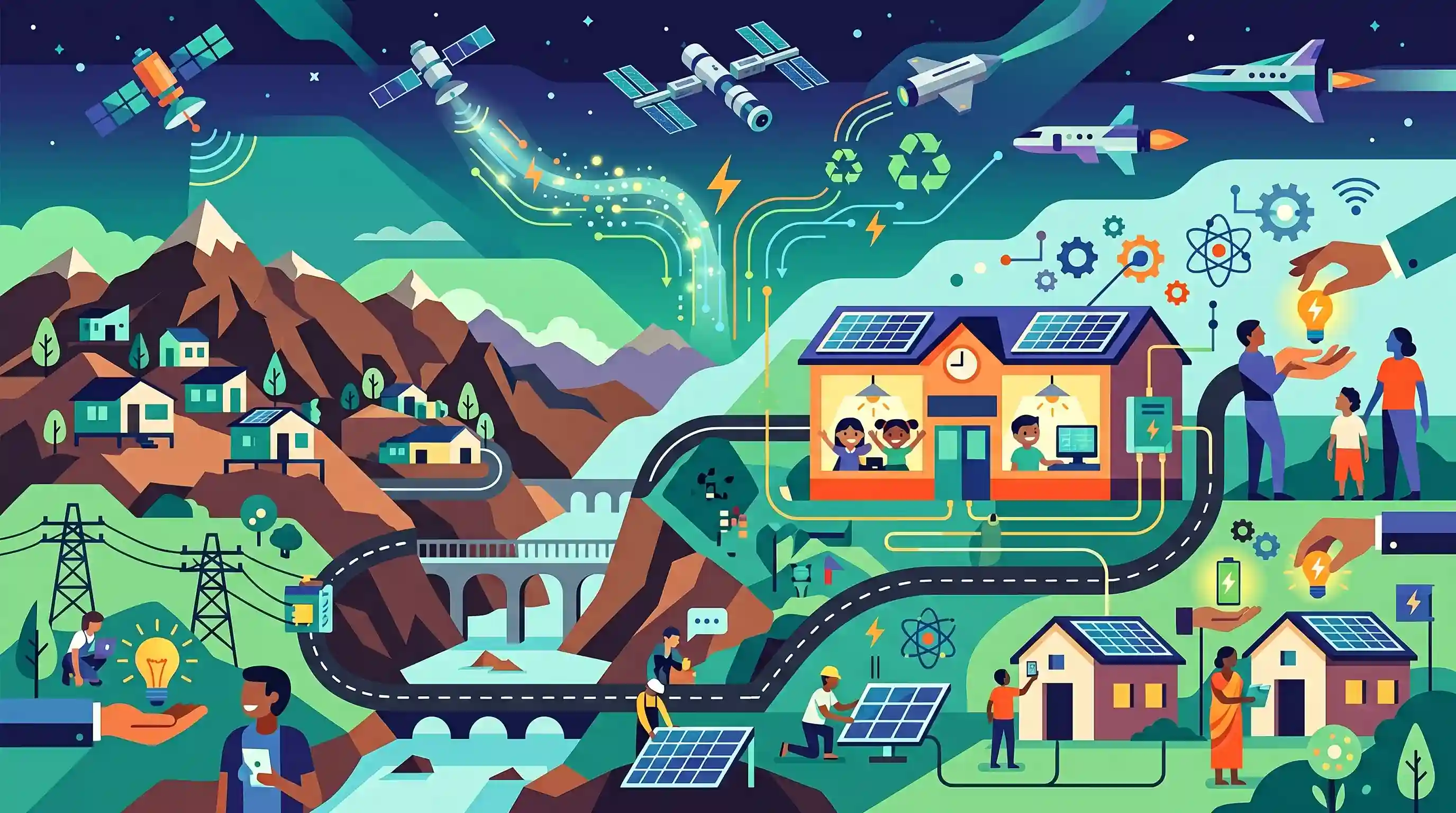
The 23rd National Space Science Symposium at NESAC, Meghalaya, highlighted the potential of adapting sustainable practices from space missions—such as efficient solar power usage and resource recycling—to boost renewable energy infrastructure in India's North East. Astronaut-designate Shubhanshu Shukla emphasized that the self-sufficient nature of space habitats can serve as a blueprint for overcoming terrain challenges in the region. Concurrently, Meghalaya's localized efforts, such as the Chief Minister's Solar Mission, are leveraging off-grid solar solutions to power remote primary schools and provide highly subsidized energy access to marginalized groups under PMAY.
Key Points
- Astronaut-designate Shubhanshu Shukla suggested that sustainable resource management and solar energy practices used in space habitats (like the ISS) can provide valuable models for expanding renewable energy on Earth.
- These space-tested practices can be uniquely beneficial for North Eastern states to overcome geographical challenges and develop robust off-grid renewable energy networks.
- Meghalaya is addressing its energy deficit through the Chief Minister’s Solar Mission, focusing on bridging last-mile connectivity in remote and hilly areas.
- MNREDA's interventions include providing heavily subsidized off-grid solar systems for primary schools to support digital education, and offering a 90% solar subsidy to PMAY beneficiaries to ensure inclusive energy access.
Important Terms
North Eastern Space Applications Centre (NESAC)

A joint initiative of the Department of Space and North Eastern Council that provides space-based technology support for regional development, disaster management, and resource mapping across Northeast India.
UPSC context
GS Paper III (S&T and Regional Development); tests institutional frameworks for applying space technology to local governance.
Chief Minister’s Solar Mission (Meghalaya)
A flagship initiative of the Meghalaya government aiming to achieve energy self-reliance through subsidized solar hybrid inverters and off-grid solutions for households, schools, and remote communities.
UPSC context
GS Paper III (Energy/Infrastructure); focuses on renewable energy transitions and state-led sustainable development models in hilly terrains.
Pradhan Mantri Awas Yojana (PMAY)
A central government scheme providing affordable housing to the poor; in Meghalaya, it is integrated with the solar mission to offer high energy subsidies to marginalized beneficiaries.
UPSC context
GS Paper II (Social Justice/Government Schemes); tests the convergence of social welfare programs with green energy initiatives.
Indian Space Research Organisation (ISRO)
India's premier space agency responsible for space research and exploration; it organizes the biennial National Space Science Symposium (NSSS) to foster scientific collaboration and innovation.
UPSC context
GS Paper III (Science & Technology); fundamental for understanding India's space program and its socio-economic applications.
Meghalaya New and Renewable Energy Development Agency (MNREDA)
The state-level nodal agency responsible for the promotion, implementation, and development of renewable energy projects, including solar and wind power, within Meghalaya.
UPSC context
GS Paper III (Energy Infrastructure); relevant for institutional roles in decentralised renewable energy management.
Shubhanshu Shukla
An Indian Air Force Group Captain and Gaganyatri (astronaut) designated for the Axiom-4 mission to the International Space Station, representing India's human spaceflight ambitions.
UPSC context
GS Paper III (S&T - Human Spaceflight); tests knowledge of key personalities and missions (Gaganyaan) in India's space sector.
Prelims Trap
NESAC is a regional center fully owned and operated by ISRO under the Ministry of Science and Technology.
NESAC is actually a joint initiative of the Department of Space (DOS) and the North Eastern Council (NEC), not purely an ISRO body.
Static Concepts Connected
What are 'space tech spin-offs' and how do they aid civilian infrastructure?
- Closed-loop recycling: Water and waste recycling systems developed for space stations (like the ISS) are adapted for sustainable resource management in isolated or arid regions on Earth.
- Efficient energy systems: High-yield solar panels, compact energy storage, and thermal control designed for satellites are repurposed to enhance off-grid rural electrification and micro-grids.
Why are off-grid solar solutions critical for India's North-Eastern terrain?
- Grid limitations: Rugged topography, dense forests, and heavy monsoons make extending and maintaining conventional centralized power transmission lines economically and physically unviable.
- Disaster resilience: Decentralized micro-grids and independent solar home systems ensure uninterrupted power supply during natural landslides or floods when centralized grids are prone to failure.
Cross-Topic Patterns
Space Tech + Last-Mile Governance
Linking space sustainability with regional off-grid energy mirrors how ISRO's satellite data (Bhuvan) is increasingly utilized for MGNREGA asset mapping, disaster forecasting, and border infrastructure planning.
Welfare Schemes + Clean Energy Transition
Integrating 90% solar subsidies with PMAY merges social housing with climate goals, reflecting the national decentralised energy push seen in PM Surya Ghar: Muft Bijli Yojana.

Mains GS-3 could link space tech spin-offs (closed-loop systems, solar) to decentralized off-grid energy infrastructure in hilly regions.
Linked PYQs · 4
Linked PYQs · 4
- 2020MainsGS3
Describe the benefits of deriving electric energy from sunlight in contrast to the conventional energy generation. What are the initiatives offered by our Government for this purpose?
- 2016MainsGS3
Discuss India's achievements in the field of Space Science and Technology. How the application of this technology has helped India in its socio-economic development?
- 2018MainsGS3
“Access to affordable, reliable, sustainable and modern energy is the sine qua non to achieve Sustainable Development Goals (SDGs).” Comment on the progress made in India in this regard.
- 2019MainsGS3
What is India's plan to have its own space station and how will it benefit our space programme?
