Kolkata Police central lock-up CCTV surveillance upgrade
Source:the-statesman ↗
Why It Matters
It highlights practical examples of administrative modernization, aligning with Supreme Court directives on CCTV usage in police stations to prevent custodial violence, and demonstrates the integration of e-governance to tackle judicial pendency.
Summary
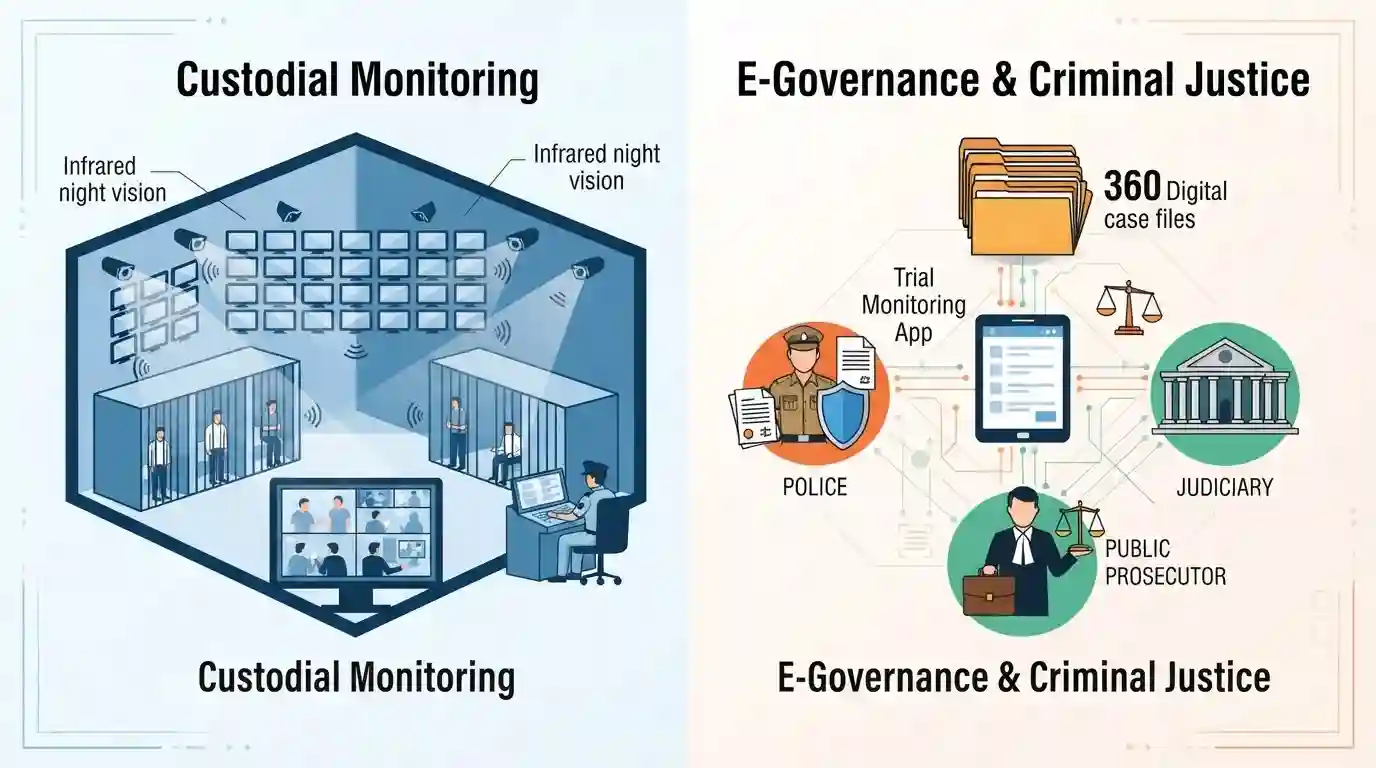
The Kolkata Police is upgrading its central lock-up infrastructure by installing 59 advanced CCTV cameras equipped with infrared and audio capabilities to enhance custodial monitoring and security. In a parallel e-governance initiative, a 'Trial Monitoring App' is being developed to track and expedite 360 long-pending criminal cases by fostering seamless digital coordination among police officers, public prosecutors, and the judiciary.
Key Points
- Kolkata Police is enhancing security at its central lock-up by installing 59 state-of-the-art CCTV cameras.
- The cameras are equipped with infrared technology for night vision and can record high-quality audio, covering up to 50-60 meters.
- The Rs 35.5 lakh surveillance project aims to prevent altercations, escape attempts, and ensure round-the-clock monitoring of inmates.
- Separately, the police are developing a 'Trial Monitoring App' to track the court proceedings of 360 old pending cases.
- This digital initiative will connect investigating officers, the trial monitoring cell, public prosecutors, and court officials to expedite the judicial process.
Important Terms
Trial Monitoring App

A digital governance platform developed by the Kolkata Police to track and expedite long-pending criminal cases by enabling real-time coordination among investigating officers, prosecutors, and court authorities.
UPSC context
Relevant for GS Paper 2 (E-Governance). Highlights digital solutions for reducing judicial pendency and improving the criminal justice system.
Custodial Monitoring
The continuous observation of police lock-ups using surveillance technologies, such as infrared and audio-enabled CCTVs, to prevent untoward incidents, custodial violence, and ensure strict police accountability.
UPSC context
Relates to GS Paper 2 (Human Rights & Police Reforms). Essential for analyzing technological interventions to uphold the fundamental rights of detainees.
Kolkata Police
The primary law enforcement agency of Kolkata, currently implementing major systemic reforms including a digital Trial Monitoring App and advanced infrared CCTV surveillance to enhance justice delivery and lock-up security.
UPSC context
Serves as a practical case study for GS Paper 2 and 3 regarding technology-driven police reforms and transparent law enforcement.
Prelims Trap
The SC mandate for installing audio-enabled CCTVs is restricted to state police stations, excluding central agencies like CBI or ED.
The Paramvir Singh Saini (2020) ruling explicitly mandates audio-video CCTVs in offices of central agencies with arrest powers (CBI, NIA, ED), not just police stations.
Static Concepts Connected
What are the key legal safeguards against custodial violence in India?
- Article 21: Guarantees the protection of life and personal liberty, implicitly prohibiting torture or cruel, inhuman, and degrading treatment.
- D.K. Basu Guidelines: Landmark SC directives mandating transparent procedures, such as preparing arrest memos, notifying relatives, and conducting regular medical examinations of the detainee.
- Judicial Inquiry: Section 176(1A) of CrPC/BNSS mandates that a Judicial Magistrate (not an Executive Magistrate) must inquire into any custodial death, rape, or disappearance.
How does Infrared (IR) technology function in night-vision CCTVs?
- Spectrum position: IR radiation sits between visible light (wavelength ~700 nm) and microwaves (up to ~1 mm) on the electromagnetic spectrum.
- Detection mechanism: It detects heat and electromagnetic radiation emitted by objects, allowing cameras to record clear footage in total darkness without emitting visible light.
- Common applications: Besides night-vision cameras, it is the standard technology used in everyday consumer electronics like television remote controls.
Cross-Topic Patterns
ICJS & Digital Justice Integration
Local apps tracking pending cases mirror the national Interoperable Criminal Justice System (ICJS), which integrates police (CCTNS), e-Courts, e-Forensics, and e-Prisons on a single cloud platform.
Tech hardware enforcing Article 21
The shift from procedural rules (D.K. Basu guidelines) to hardware mandates (night-vision CCTVs with 18-month storage) shows an evolving tech-driven approach to enforcing fundamental rights.

Expect a hybrid Prelims question combining the physics of Infrared CCTVs with the SC mandate extending this to NIA/ED for Article 21.
Linked PYQs · 2
Linked PYQs · 2
- 2020WBCS_PRELIMSGS1
TV remote control uses
- 2023WBCS_PRELIMSGS1
Which Union Ministry is associated with the pilot phase of The Open Network for Digital Commerce?
