Thermodynamic Costs and Measurement Limits in Quantum Systems
Source:The Hindu ↗
Why It Matters
Quantum technology is a rapidly emerging field with significant focus in the UPSC syllabus. Understanding the foundational principles—such as quantum measurement, superposition, and the thermodynamic limits of quantum devices—helps in tackling technical questions on qubits, quantum computing, and quantum sensors.
Summary
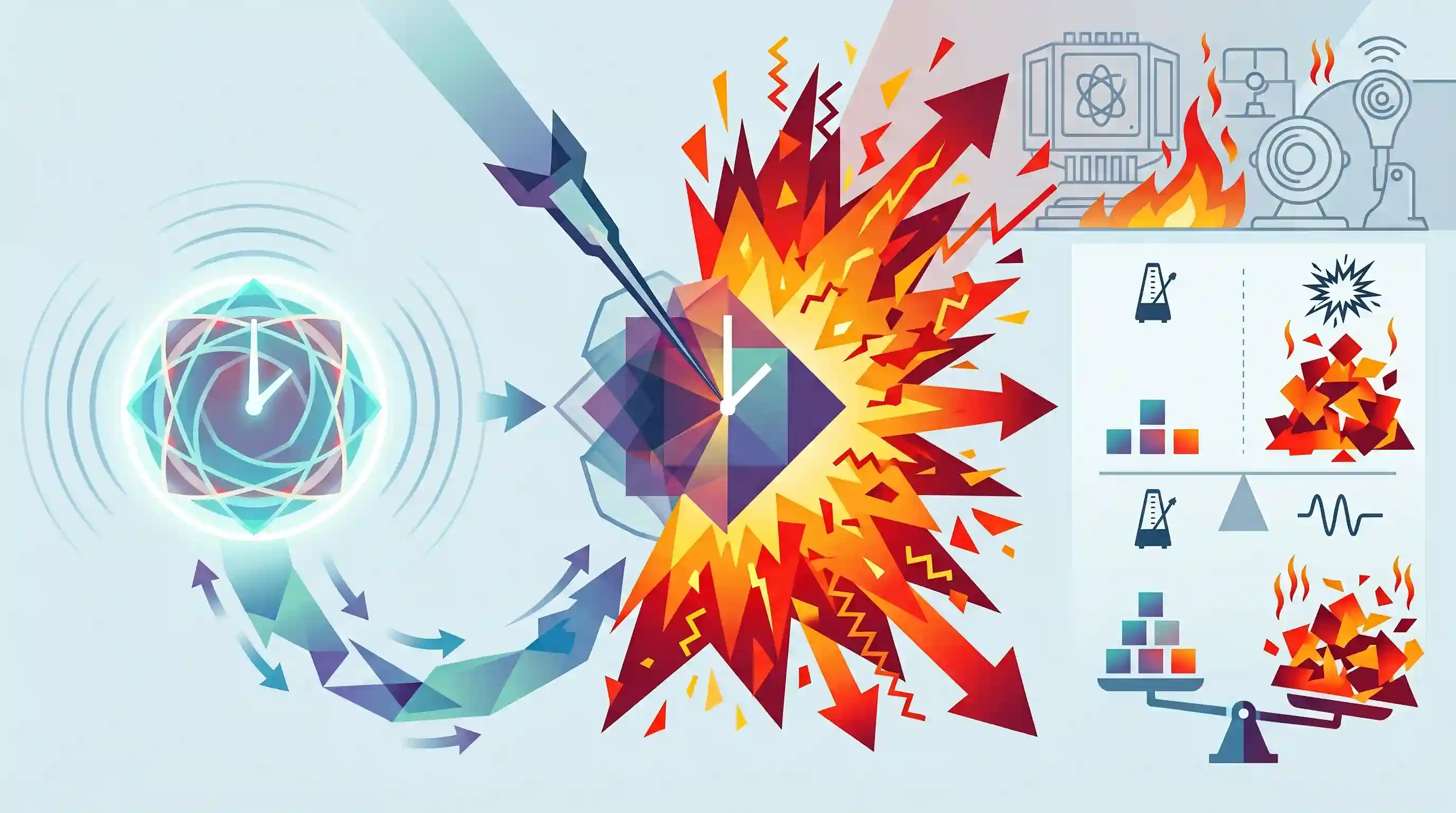
A new study on quantum clocks reveals a surprising thermodynamic reality: the energy and entropy cost associated with 'reading' the time (measuring the quantum state) can be significantly higher than the cost of the clock's internal 'ticking' mechanism. In quantum systems, the act of measurement inherently collapses the wave function, which is an irreversible process that dissipates heat and generates entropy. These findings expose a fundamental trade-off between precision and energy dissipation, bearing significant implications for the development of advanced quantum technologies, including quantum computers and sensors.
Key Points
- Recent research has shown that in quantum clocks, the act of 'reading' the time dissipates more energy (and entropy) than the internal 'ticking' mechanism itself.
- In quantum mechanics, measuring a system causes the collapse of its superposition/wave function, leading to an irreversible thermodynamic cost and entropy generation.
- The findings highlight a fundamental trade-off in quantum technologies: achieving higher precision in timekeeping inevitably demands a higher energy cost.
- This insight is crucial for the future design of energy-efficient quantum computers, sensors, and highly precise atomic or quantum clocks.
Prelims Trap
"Measuring a quantum system is an energy-free, perfectly reversible process."
Reading a quantum state forces a wave function collapse—an irreversible thermodynamic process that inherently dissipates heat and generates entropy.
Static Concepts Connected
What dictates the physical mechanics of quantum measurement?
- Superposition: A qubit exists in a probabilistic combination of multiple states (both 0 and 1) simultaneously until it is observed.
- Wave Function Collapse: The act of measurement forces the system to randomly snap into a single definite state, destroying the superposition.
- Thermodynamic Cost: This collapse is an irreversible physical process that requires energy and releases heat, creating a fundamental thermodynamic floor for quantum reading.
How do Atomic Clocks function in systems like NavIC?
- Atomic Resonance: They use the highly stable, predictable electromagnetic radiation emitted or absorbed by atoms (like Caesium-133 or Rubidium) when they change energy states.
- Navigation Role: Extremely precise timekeeping is required to calculate the exact distance between satellites and ground receivers based on radio signal travel time.
Cross-Topic Patterns
Quantum metrology and NavIC resilience
NavIC relies on Rubidium atomic clocks. Breakthroughs under the National Quantum Mission's Metrology hub aim to develop ultra-precise quantum clocks, crucial for securing India's long-term strategic navigation autonomy.
Thermodynamic limits of emerging tech
Just as classical AI data centers face massive cooling constraints, quantum computing faces fundamental thermodynamic limits (entropy generation during qubit measurement), challenging the 'green quantum' narrative.

A 2026 prelims question on the National Quantum Mission will likely pair quantum metrology hubs with NavIC's atomic clock dependency.
Linked PYQs · 3
Linked PYQs · 3
- 2022PrelimsGS1
Which one of the following is the context in which the term "qubit" is mentioned ?
- 2024PrelimsGS1
Consider the following statements: I. It is expected that Majorana 1 chip will enable quantum computing. II. Majorana 1 chip has been introduced by Amazon Web Services (AWS). III. Deep learning is a subset of machine learning. Which of the statements given above are correct?
- 2025PrelimsGS1
Consider the following statements: I. It is expected that Majorana 1 chip will enable quantum computing. II. Majorana 1 chip has been introduced by Amazon Web Services (AWS). III. Deep learning is a subset of machine learning. Which of the statements given above are correct?
