Earth Surplus Heat Emerges as Major Global Climate Challenge
Source:Indian Express ↗
Why It Matters
Understanding Earth's energy budget, ocean heat content, and the albedo effect is crucial for grasping the physical mechanisms of global warming (relevant for Prelims Geography/Environment and Mains GS1/GS3). It also highlights the governance imperative of moving from mere mitigation to serious disaster resilience and adaptation strategies.
Summary
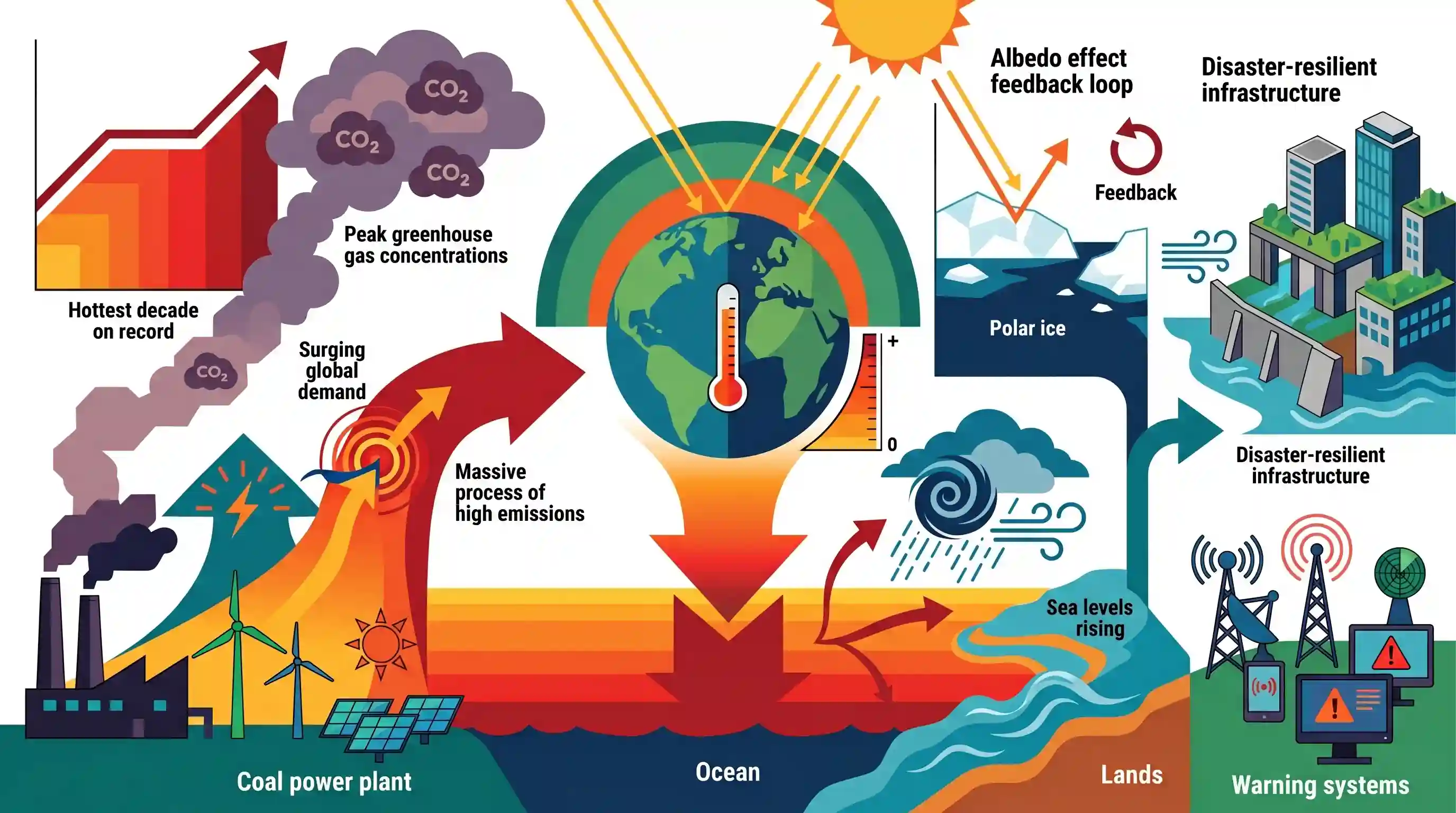
The World Meteorological Organisation's (WMO) State of Climate Report reveals that the last decade was the hottest on record, driven by peak concentrations of greenhouse gases. Even as renewables edge out coal as the leading source of electricity, surging global energy demands have caused emissions to reach new highs. This has created a critical "heat surplus," altering the Earth's energy equilibrium. The oceans have absorbed over 90% of this extra heat, resulting in warmer sea surface temperatures, intensified tropical storms, and rising sea levels. Furthermore, the melting of ice cover diminishes Earth's albedo, creating a feedback loop that exacerbates global warming. The article stresses the urgent need for a shift in focus toward climate adaptation, specifically by building disaster-resilient infrastructure and developing early warning systems.
Key Points
- The decade ending last year was the hottest on record, marked by unprecedented atmospheric concentrations of CO2, methane, and nitrous oxide.
- Despite renewable energy overtaking coal as the leading electricity source, global emissions reached record highs due to surging overall energy demands outpacing clean power additions.
- Earth is experiencing a severe energy imbalance (heat surplus), where more radiation enters the atmosphere than leaves it.
- Oceans act as the primary sink for this surplus energy, absorbing over 90% of the trapped heat, which leads to sea-level rise and more intense tropical storms.
- The melting of polar ice reduces the Earth's albedo (reflectivity), creating a dangerous feedback loop that traps even more heat.
- Mitigation must be paired with adaptation, specifically through building climate-resilient infrastructure and robust early warning systems.
Important Terms
World Meteorological Organisation (WMO)

A UN specialized agency coordinating international cooperation on atmospheric science, climatology, and hydrology. It publishes the 'State of the Global Climate' report, tracking key indicators like temperature and GHG concentrations.
UPSC context
GS Paper II (International Organisations) and Paper III (Environment). Tests knowledge of global governance and climate reporting mechanisms.
Earth's Energy Budget
The balance between incoming solar radiation absorbed by Earth and outgoing terrestrial radiation. A positive imbalance (heat surplus) causes global warming by altering Earth's radiative equilibrium.
UPSC context
GS Paper I (Physical Geography). Essential for understanding climate mechanics, solar insolation, and thermal balance.
Albedo Effect
The measure of a surface's reflectivity, ranging from 0 (absorption) to 1 (reflection). Ice has high albedo; melting reveals darker surfaces that absorb more heat, accelerating warming.
UPSC context
GS Paper I (Geography). Crucial for explaining regional warming patterns and the ice-albedo feedback mechanism.
Positive Feedback Loop
A self-reinforcing process where an initial change triggers effects that further amplify that change. Examples include the melting of ice reducing albedo or warmer oceans releasing more CO2.
UPSC context
GS Paper III (Environment). Tests understanding of non-linear climate impacts and tipping points.
Coalition for Disaster Resilient Infrastructure (CDRI)
An India-led global partnership of governments and UN agencies aiming to promote the resilience of infrastructure systems (telecom, power, transport) against climate and disaster risks.
UPSC context
GS Paper III (Disaster Management). High-priority topic for India’s leadership in global climate action.
Climate Adaptation
Adjustments in ecological, social, or economic systems in response to actual or expected climate stimuli to moderate harm (e.g., seawalls, early warning systems), distinct from emission-reducing mitigation.
UPSC context
GS Paper III (Environment/Disaster Management). Focuses on practical responses to inevitable climate impacts.
Ocean Heat Content (OHC)
The total amount of heat energy stored by the oceans, which absorb over 90% of Earth's surplus heat. It is a key indicator of long-term global warming.
UPSC context
GS Paper I (Oceanography). Important for understanding sea-level rise and cyclone intensification.
Prelims Trap
"Oceans act as the primary sink by absorbing over 90% of anthropogenic carbon dioxide emissions."
Aspirants confuse heat absorption with carbon sequestration. Oceans absorb >90% of the trapped *heat surplus*, but only ~25-30% of anthropogenic *CO2 emissions*.
Static Concepts Connected
What is the ice-albedo feedback mechanism in climate change?
- Definition: Albedo measures the reflection of solar radiation. Snow and ice have high albedo, reflecting up to 80% of incoming sunlight back into space.
- Positive Feedback: As global temperatures rise, ice melts, exposing darker ocean or land surfaces. These lower-albedo surfaces absorb more solar heat, accelerating further ice melt.
- Arctic Amplification: This runaway feedback loop causes polar regions to warm much faster than the rest of the planet, drastically altering global weather patterns.
How does Earth's Energy Budget define the current heat surplus?
- Energy Balance: It is the equilibrium between incoming shortwave solar radiation and outgoing longwave terrestrial radiation.
- Energy Imbalance: Increased greenhouse gases trap outgoing longwave radiation, resulting in a positive Earth Energy Imbalance (EEI) where more energy enters the system than leaves.
- Ocean Sink: Over 90% of this excess trapped heat is absorbed by the oceans, driving thermal expansion and marine heatwaves, rather than immediate atmospheric warming.
Cross-Topic Patterns
Ocean Heat & Cyclone Intensification
Connects to Geography. The >90% ocean heat surplus directly fuels the rapid intensification of tropical cyclones, particularly shifting historical patterns to make the Arabian Sea more prone to severe storms.
Renewables vs. The Jevons Paradox
Connects climate mitigation with economics. Despite renewables overtaking coal, absolute emissions hit record highs because aggregate energy demand outpaces clean power supply—a macro-level reflection of the Jevons paradox.

Expect a 2026 prelims question interlinking Earth's Energy Imbalance (EEI), >90% ocean heat absorption, and the ice-albedo feedback loop.
Linked PYQs · 4
Linked PYQs · 4
- 2022MainsGS3
Discuss global warming and mention its effects on the global climate. Explain the control measures to bring down the level of greenhouse gases which cause global warming, in the light of the Kyoto Protocol, 1997.
- 2024MainsGS1
What is sea surface temperature rise? How does it affect the formation of tropical cyclones?
- 2024MainsGS3
What is disaster resilience? How is it determined? Describe various elements of a resilience framework. Also mention the global targets of Sendai Framework for Disaster Risk Reduction (2015–2030).
- 2018PrelimsGS1
"Momentum for Change: Climate Neutral Now" is an initiative launched by
