Earth energy imbalance and surplus heat climate challenge
स्रोत:इंडियन एक्सप्रेस ↗
क्यों मायने रखता है
Provides crucial conceptual vocabulary ("surplus heat", "energy equilibrium", "albedo effect") that will greatly enhance Mains answers on climate change, ocean temperature rise, and disaster resilience in GS1 (Geography) and GS3 (Environment & Disaster Management).
सारांश
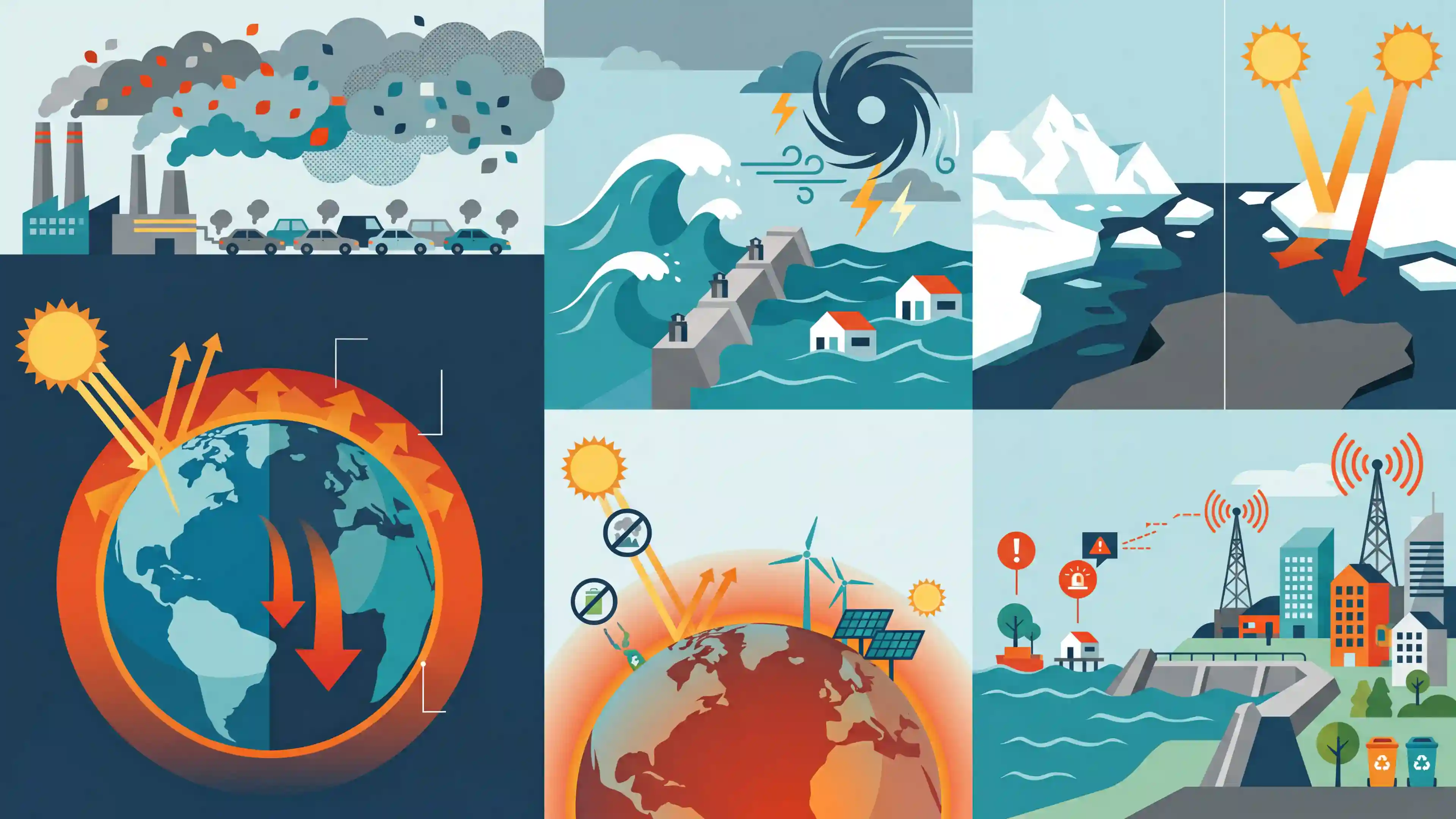
The World Meteorological Organisation (WMO) has warned that record greenhouse gas emissions have severely disturbed Earth’s energy equilibrium, leading to a massive accumulation of "surplus heat" over the past six decades. With oceans absorbing the bulk of this energy, the planet is experiencing intensified tropical storms, rising sea levels, and a reduced albedo effect due to melting ice. The editorial highlights that this entrenched heat will sustain global warming even if new emissions cease entirely, necessitating a shift from incremental mitigation measures to long-term climate adaptation, including resilient infrastructure development and improved early warning systems.
मुख्य बिंदु
- Greenhouse gases like CO2, methane, and nitrous oxide have reached unprecedented levels, disrupting the Earth's energy equilibrium by trapping more incoming solar radiation.
- The resultant "surplus heat" has accumulated over the last six decades and is largely absorbed by seas and oceans, driving stronger tropical storms and sea level rise.
- Melting polar ice diminishes the planet's albedo effect (reflectivity), meaning less solar radiation is sent back to space, which further exacerbates the energy imbalance.
- The massive amount of heat already locked in the earth system means global warming will persist for decades, even if all new greenhouse gas emissions are halted immediately.
- Governments must pivot towards long-term adaptation strategies, such as investing in resilient infrastructure and early warning systems, while insulating climate policies from short-term political cycles.
महत्वपूर्ण शब्द
World Meteorological Organisation (WMO)

A specialized United Nations agency established in 1950 that coordinates international cooperation on atmospheric science, climatology, hydrology, and geophysics.
UPSC context
GS Paper 2 (International Relations) and GS Paper 3 (Environment); tests knowledge of global governance in climate monitoring.
Earth's Energy Budget
The balance between incoming solar radiation (insolation) and outgoing terrestrial radiation; an imbalance (surplus heat) leads to global warming or cooling.
UPSC context
GS Paper 1 (Physical Geography) and GS Paper 3 (Climate Change); fundamental for understanding radiative forcing and global temperature stability.
Albedo Effect
The measure of reflectivity of a surface, ranging from 0 to 1; high albedo surfaces (ice) reflect sunlight, while low albedo surfaces (oceans) absorb it.
UPSC context
GS Paper 1 (Geography); critical for explaining positive feedback loops where melting ice accelerates further warming.
Ocean Heat Content (OHC)
The total energy stored in the ocean, which absorbs over 90% of the excess heat trapped by greenhouse gases, serving as a key indicator of climate change.
UPSC context
GS Paper 1 (Oceanography) and GS Paper 3 (Environment); tests understanding of thermal expansion and its role in sea-level rise.
Climate Adaptation
Adjustments in social, economic, or ecological systems to minimize damage from actual or expected climate change impacts, such as building resilient infrastructure.
UPSC context
GS Paper 3 (Environment/Disaster Management); tests ability to distinguish between reducing emissions (mitigation) and managing inevitable climate impacts.
Early Warning Systems (EWS)
Integrated systems for hazard monitoring and communication that provide timely information to individuals and communities to reduce disaster risk and enable preventative action.
UPSC context
GS Paper 3 (Disaster Management); emphasizes the shift from reactive relief to proactive risk reduction in climate-vulnerable regions.
प्रारंभिक ट्रैप
"Halting greenhouse gas emissions immediately will stop global warming within a few years."
High thermal inertia of oceans and the long lifespan of existing greenhouse gases mean locked-in "surplus heat" will sustain warming for decades.
संबंधित अवधारणाएँ
What is the Earth's Albedo Effect and how does it impact the energy budget?
- Reflectivity measure: Albedo is the fraction of solar energy reflected from Earth back into space. Ice and snow have high albedo, while oceans and forests have low albedo.
- Energy equilibrium: Earth's energy budget balances incoming shortwave solar radiation with outgoing longwave terrestrial radiation.
- Positive feedback loop: Melting polar ice reduces the planet's overall albedo, causing oceans to absorb more heat, which in turn melts more ice and exacerbates warming.
Why do oceans act as the primary heat sink for the planet?
- High specific heat: Water requires significantly more energy to raise its temperature compared to land or the atmosphere, allowing oceans to absorb vast amounts of heat.
- Thermal inertia: Oceans have absorbed over 90% of anthropogenic surplus heat. This inertia delays atmospheric warming but locks in long-term sea-level rise and marine ecosystem disruption.
अंतर-विषय पैटर्न
Surplus heat & marine heatwaves
Oceanic surplus heat directly drives marine heatwaves, linking this climatology concept to biodiversity loss, mass coral bleaching events, and shifting pelagic fisheries (Environment + Economy).
Adaptation via resilient infrastructure
The WMO's call for long-term adaptation elevates the importance of India-led diplomatic initiatives like the Coalition for Disaster Resilient Infrastructure (CDRI) in global climate negotiations.

Expect a tricky 2026 Prelims statement linking ocean thermal inertia, Earth's energy budget imbalance, and positive albedo feedback loops.
संबद्ध PYQ · 4
संबद्ध PYQ · 4
- 2022MainsGS3
Discuss global warming and mention its effects on the global climate. Explain the control measures to bring down the level of greenhouse gases which cause global warming, in the light of the Kyoto Protocol, 1997.
- 2024MainsGS1
What is sea surface temperature rise? How does it affect the formation of tropical cyclones?
- 2025MainsGS1
How are climate change and the sea level rise affecting the very existence of many island nations? Discuss with examples.
- 2024MainsGS3
What is disaster resilience? How is it determined? Describe various elements of a resilience framework. Also mention the global targets of Sendai Framework for Disaster Risk Reduction (2015–2030).
