Article 240 Application to Chandigarh and Federal Implications
Source:Indian Express ↗
Why It Matters
The administration of Union Territories and inter-state disputes over shared capitals or resources frequently appear in UPSC GS2. This current development tests the understanding of Article 240, the Punjab Reorganisation Act, and overarching principles of cooperative federalism in India.
Summary
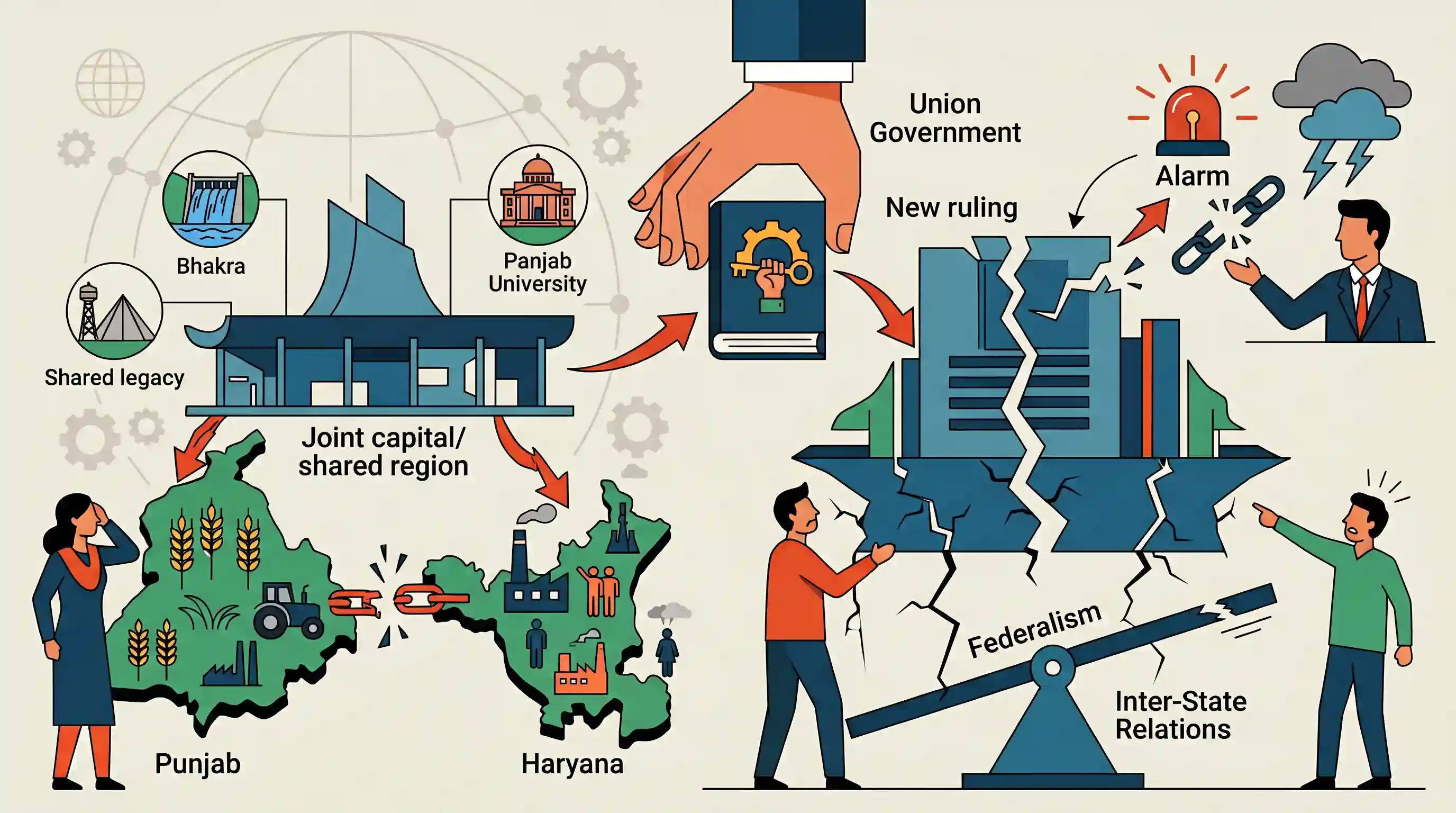
The Union government's reported consideration of bringing the Union Territory of Chandigarh under Article 240 of the Constitution has drawn sharp criticism from Congress leader Randeep Singh Surjewala. He claims this move undermines the Punjab Reorganisation Act of 1966, stripping Punjab and Haryana of their joint capital and subverting federalism. Surjewala urged the Centre to respect the shared legacy of both states concerning Chandigarh, the Bhakra Dam, and Panjab University, cautioning against inciting adversarial politics between Punjab and Haryana. The issue touches upon crucial federal and constitutional questions regarding inter-state relations and the administration of Union Territories.
Key Points
- Congress leader Randeep Singh Surjewala criticised the Centre's reported plan to include Chandigarh under Article 240 of the Constitution.
- Article 240 grants the President the power to make regulations for certain Union Territories.
- Surjewala argued the move subverts the Punjab Reorganisation Act, 1966, which established Chandigarh as the joint capital of Punjab and Haryana.
- He stated that making Chandigarh a standalone Union Territory is an assault on federalism and deprives both Punjab and Haryana of their capital rights.
- Surjewala emphasised that issues like Chandigarh, the Bhakra Dam, and Panjab University are shared legacies of both states and should not be used to create inter-state conflicts.
Important Terms
Article 240 of the Constitution

Constitutional provision empowering the President to make regulations for the peace, progress, and good governance of certain Union Territories. Such regulations can repeal or amend Acts of Parliament.
UPSC context
GS Paper II: Functions and responsibilities of the Union; governance of Union Territories; and Presidential legislative powers.
Punjab Reorganisation Act, 1966
Legislation that bifurcated the erstwhile state of Punjab into Punjab and Haryana on linguistic lines, while designating Chandigarh as a Union Territory and shared capital.
UPSC context
GS Paper II: Reorganisation of states; historical underpinnings of Indian federalism; and inter-state boundary disputes.
Bhakra Beas Management Board (BBMB)
A statutory body managing the Bhakra-Nangal and Beas projects to regulate water and power supply to Punjab, Haryana, Rajasthan, Himachal Pradesh, Delhi, and Chandigarh.
UPSC context
GS Paper II: Statutory bodies; inter-state water sharing; and federal disputes over resource management.
Panjab University (PU) administration
An inter-state body corporate originally established in Lahore; its administrative control and democratic governance (Senate/Syndicate) are currently subjects of federal dispute between the Centre and Punjab.
UPSC context
GS Paper II: Issues related to the federal structure and autonomy of educational institutions under inter-state arrangements.
Federalism
A constitutional system where power is divided between the Centre and States. In India, it is often described as 'quasi-federal' with a strong centralizing tendency.
UPSC context
GS Paper II: Basic structure of the Constitution; Centre-State relations; and tensions in the federal balance.
Union Territory (UT) Administration
A type of administrative division in India, governed directly by the Central Government through an Administrator or Lieutenant Governor appointed by the President.
UPSC context
GS Paper II: Structure and organization of the executive; administration of special areas; and UT governance models.
Prelims Trap
"The President can make regulations for the peace, progress and good government of all Union Territories."
Article 240 explicitly lists specific UTs (e.g., A&N, Lakshadweep). It does not apply to all UTs. Chandigarh is currently excluded, hence the controversy over adding it.
Static Concepts Connected
How does Article 240 differ from general UT administration?
- General Rule (Art 239): Under Art 239, UTs are generally administered by the President through an appointed Administrator, subject to laws made by Parliament.
- Special Power (Art 240): Art 240 empowers the President to make direct regulations for the peace and good government of specific UTs (like Andaman, Lakshadweep).
- Legislative Equivalence: Regulations made under Article 240 have the same force as an Act of Parliament and can amend or repeal parliamentary laws applicable to that UT.
What is the statutory basis of the Bhakra Beas Management Board (BBMB)?
- Statutory Origin: It is a statutory body constituted under Section 79 of the Punjab Reorganisation Act, 1966.
- Shared Resources: It manages and distributes water and power from the Bhakra-Nangal and Beas projects among Punjab, Haryana, Rajasthan, HP, Delhi, and Chandigarh.
- Federal Friction: The Central Government appoints its Chairman and Members, which historically causes friction regarding state sovereignty over river waters.
Cross-Topic Patterns
Asymmetric federalism in UTs
Contrasting Article 240 (direct Presidential rule overriding Parliament) with Article 239AA (Delhi's legislature) perfectly illustrates India's asymmetric federal design frequently tested in GS2.
State Reorganisation legacy
The 1966 Punjab Reorganisation Act left behind unresolved shared assets like Chandigarh and Panjab University, showcasing long-term structural challenges in India's linguistic state formation.

A Prelims statement testing whether Presidential regulations under Article 240 can repeal Parliamentary acts is highly probable in 2026.
Linked PYQs · 2
Linked PYQs · 2
- 2024MainsGS2
What changes has the Union Government recently introduced in the domain of Centre-State relations ? Suggest measures to be adopted to build the trust between the Centre and the States and for strengthening federalism.
- 2019MainsGS2
From the resolution of contentious issues regarding distribution of legislative powers by the courts, 'Principle of Federal Supremacy' and 'Harmonious Construction' have emerged. Explain.
