Suriname pledges to protect 90 percent of its tropical forests
Source:The Hindu ↗
Why It Matters
This development illustrates the intersection of ambitious international climate goals (like the 30x30 target and carbon markets) with the socio-legal realities of local and indigenous communities. It is highly relevant for UPSC candidates to compare Suriname's planned recognition of tribal lands with India's Scheduled Tribes and Other Traditional Forest Dwellers (Recognition of Forest Rights) Act, 2006.
Summary
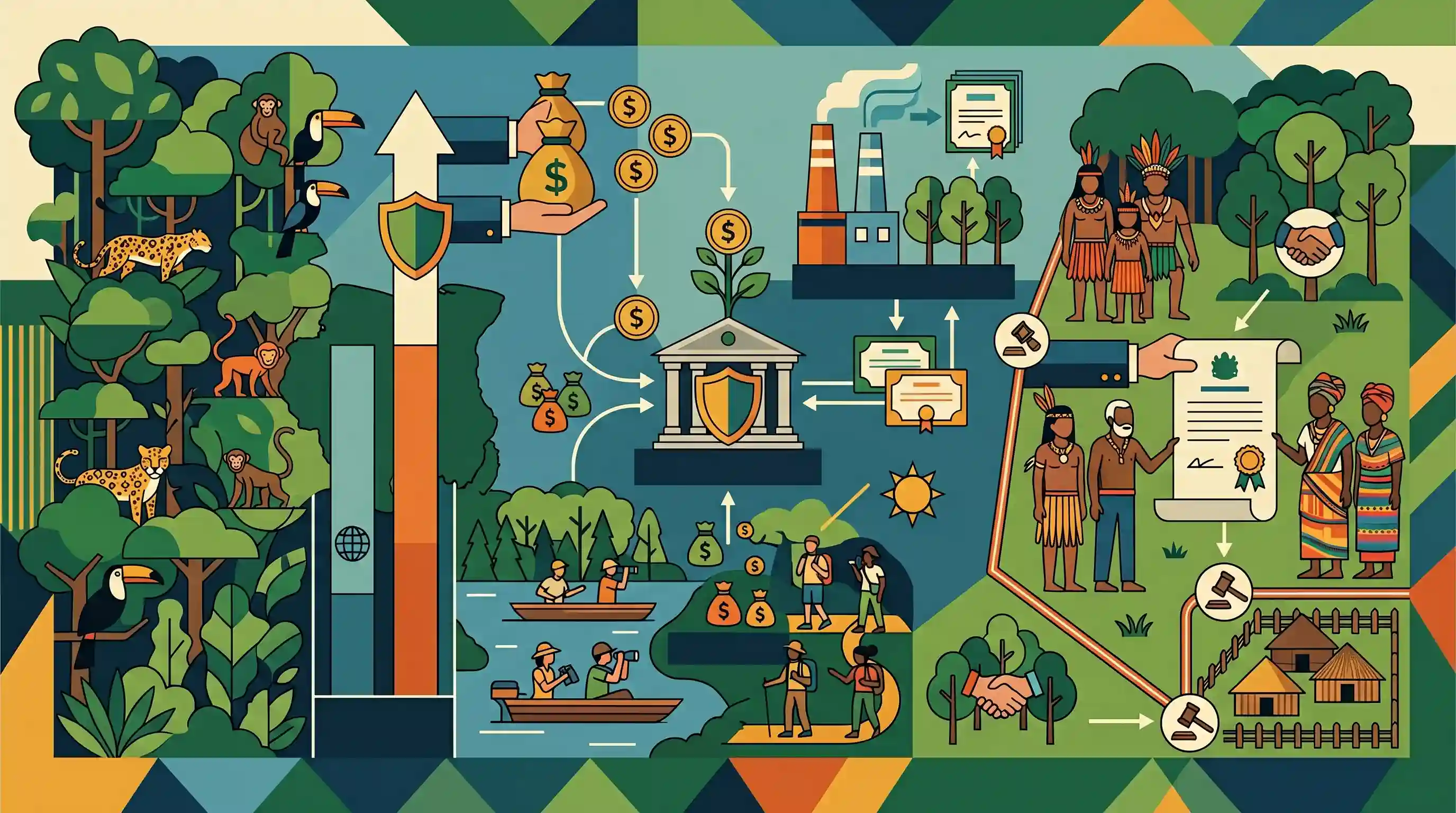
Suriname has announced an ambitious pledge to permanently shield 90% of its tropical forests, drastically surpassing the global goal of protecting 30% of nature by 2030. Backed by a $20 million donor pledge, the highly-forested country aims to leverage carbon credit markets and ecotourism to fund its conservation. Crucially, the plan involves updating laws to finally recognize the ancestral land rights of Indigenous and Maroon communities, addressing Suriname's status as the only Western Hemisphere nation lacking such legal protections, a parallel to India's own Forest Rights Act considerations.
Key Points
- Suriname has pledged to permanently protect 90% of its tropical forests, far exceeding the global 30x30 conservation target.
- With 93% forest cover, the country acts as a vital global carbon sink and intends to enter the carbon credit market while expanding ecotourism.
- The government plans to update conservation laws to legally recognize the ancestral lands of Indigenous and Maroon (descendants of escaped enslaved Africans) peoples.
- Suriname is currently the only country in the Western Hemisphere where Indigenous and tribal land rights are not legally recognized, drawing concerns from community leaders.
- Threats to the forest ecosystem include illegal mining, logging, and infrastructure expansion like roadbuilding.
Important Terms
30x30 Global Conservation Goal

Target 3 of the Kunming-Montreal Global Biodiversity Framework (2022) aiming to protect 30% of the world’s terrestrial, inland water, and coastal/marine areas by 2030.
UPSC context
GS III: Biodiversity. Tests knowledge of international environmental targets and India’s commitment as a signatory to the GBF.
Forest Rights Act (FRA), 2006
India's 2006 law recognizing the land and resource rights of forest-dwelling Scheduled Tribes and traditional dwellers, correcting historical injustices of colonial forest governance.
UPSC context
GS II & III: Social Justice and Environment. Focuses on the intersection of tribal rights and conservation management.
Carbon Sink
A natural (forests, oceans) or artificial reservoir that absorbs more carbon dioxide from the atmosphere than it releases, helping mitigate global warming.
UPSC context
GS III: Climate Change. Crucial for understanding Net-Zero targets; Suriname is one of the world's few carbon-negative nations.
Carbon Credit Markets
A trading system where carbon credits—each representing one tonne of CO2 reduced or removed—are bought and sold to offset emissions.
UPSC context
GS III: Economy and Environment. Relevant for Carbon Credit Trading Scheme (CCTS) developments in India.
Kunming-Montreal Global Biodiversity Framework (GBF)
The landmark 2022 treaty under the Convention on Biological Diversity (CBD) setting 23 global targets to halt and reverse biodiversity loss by 2030.
UPSC context
GS III: Environmental Conventions. Often compared to the Paris Agreement for its strategic importance in nature restoration.
Maroon Communities
Ethnic groups in the Americas, like those in Suriname, descended from enslaved Africans who escaped plantations and formed independent, forest-dwelling communities with distinct ancestral rights.
UPSC context
GS I & II: World History and Human Rights. Useful for comparative study of global indigenous and tribal land rights struggles.
Prelims Trap
"The 30x30 global conservation target was adopted under the UNFCCC Paris Agreement."
The 30x30 target belongs to the Kunming-Montreal Global Biodiversity Framework adopted under the Convention on Biological Diversity (CBD), not the UNFCCC.
Static Concepts Connected
What are the core targets of the Kunming-Montreal Global Biodiversity Framework?
- 30x30 Target: Conserve at least 30% of global terrestrial, inland water, and coastal/marine areas by 2030.
- Finance Target: Mobilize at least $200 billion per year in biodiversity-related funding from all sources by 2030.
- Subsidy Reduction: Identify and reduce subsidies harmful to biodiversity by at least $500 billion per year by 2030.
What are the primary rights recognized under the Forest Rights Act, 2006?
- Title Rights: Ownership of land being farmed by tribals or forest dwellers (up to 4 hectares) as of December 13, 2005.
- Use Rights: Access to minor forest produce (MFP), grazing areas, and pastoralist routes.
- Management Rights: The critical right to protect, regenerate, conserve, or manage any community forest resource for sustainable use.
Cross-Topic Patterns
Mapping Carbon Negative Nations
Suriname joins Bhutan and Panama as carbon-negative nations. UPSC often maps these unique environmental distinctions to their specific geographic positioning and forest ecosystem types.
Tribal Rights & Carbon Markets
Linking indigenous land rights (like India's FRA) to global carbon credit markets highlights a rising syllabus theme: community-led forest conservation as an official climate mitigation tool.

Carbon negative countries (Suriname, Bhutan, Panama) and the CBD's 30x30 target will likely feature as paired statements in Prelims 2026.
Linked PYQs · 3
Linked PYQs · 3
- 2013PrelimsGS1
Under the Scheduled Tribes and Other Traditional Forest Dwellers (Recognition of Forest Rights) Act, 2006, who shall be the authority to initiate the process for determining the nature and extent of individual or community forest rights or both?
- 2019PrelimsGS1
Consider the following statements: 1. As per recent amendment to the Indian Forest Act, 1927, forest dwellers have the right to fell the bamboos grown on forest areas. 2. As per the Scheduled Tribes and Other Traditional Forest Dwellers (Recognition of Forest Rights) Act, 2006, bamboo is a minor forest produce. 3. The Scheduled Tribes and Other Traditional Forest Dwellers (Recognition of Forest Rights) Act, 2006 allows ownership of minor forest produce to forest dwellers. Which of the statements given above is/are correct?
- 2025PrelimsGS1
Which organization has enacted the Nature Restoration Law (NRL) to tackle climate change and biodiversity loss?
