Wealth Inequality and Political Threat Identified by Oxfam Report
Source:The Hindu ↗
Why It Matters
The article emphasizes the intersection of extreme economic inequality and governance, providing crucial real-world examples for UPSC answers on inclusive growth (GS3), the influence of Multi-National Corporations and Civil Society Organizations (GS2), and the ethical implications of corporate control over democracy (GS4). It also highlights key global taxation frameworks (like the 15% minimum corporate tax) which are pivotal for economy questions.
Summary
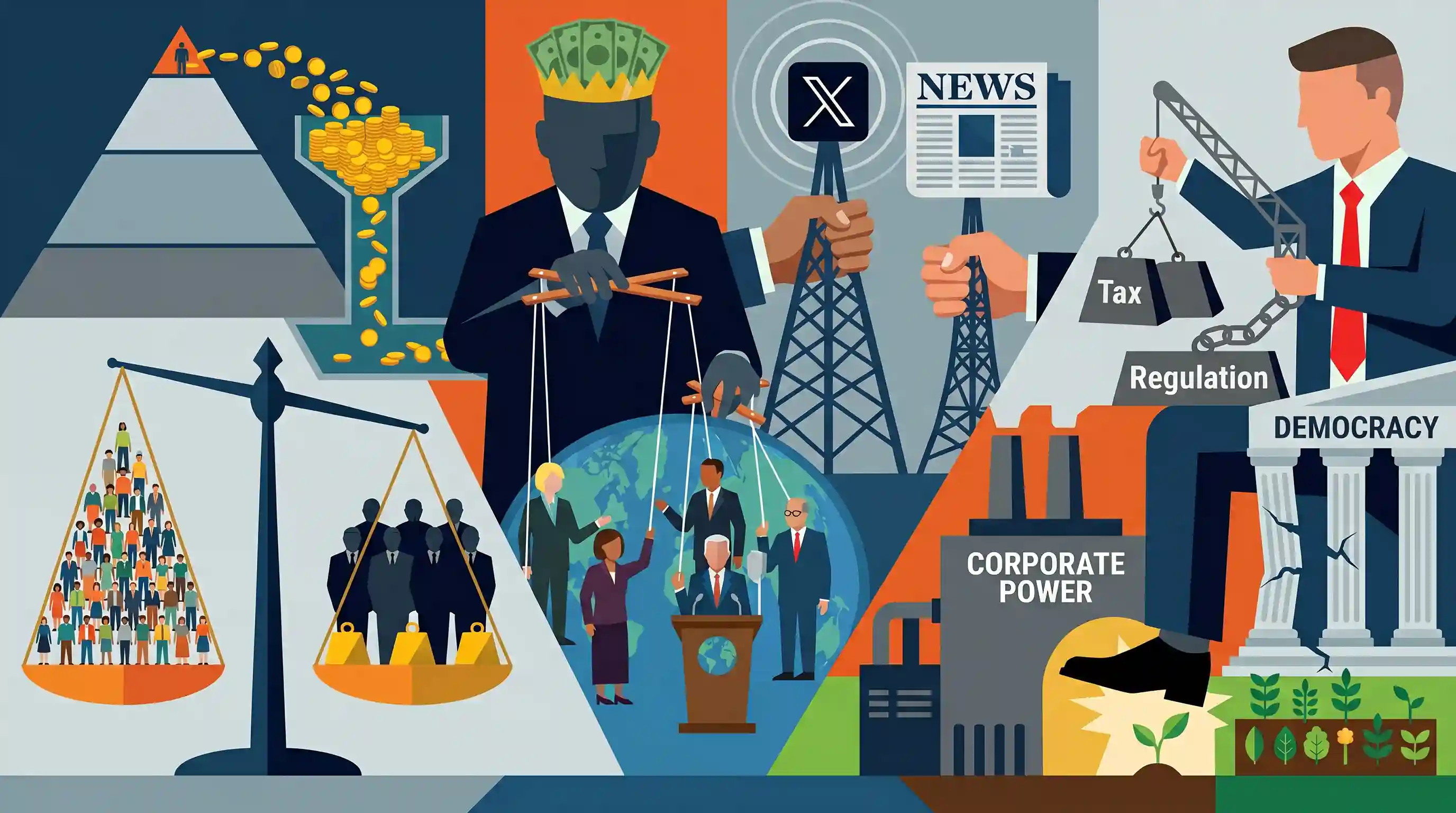
Ahead of the World Economic Forum in Davos, an Oxfam report highlights that extreme wealth concentration is evolving into a severe threat to democratic legitimacy. The report reveals that the top 12 billionaires now hold more wealth than the bottom 50% of humanity. Oxfam warns of a 'political deficit' in which ultra-wealthy individuals leverage their resources to shape global policy, often acting as unelected diplomats or controlling key media platforms like X and The Washington Post. Furthermore, anticipated US policies under Donald Trump—such as deregulation and an exemption from the 15% global minimum corporate tax—are poised to exacerbate this inequality. The surging corporate power challenges inclusive economic growth and undermines the foundations of representative democracy.
Key Points
- The combined wealth of the world's top 12 billionaires now exceeds the total wealth of the poorest half of humanity, highlighting extreme global inequality.
- Oxfam's report, released ahead of the World Economic Forum in Davos, warns of a 'political deficit' where vast wealth concentration translates directly into outsized political power.
- Billionaire control over major media and communication platforms (like X and The Washington Post) gives them unchecked influence over public discourse and democratic processes.
- Anticipated policy changes under Donald Trump, including deregulation and the withdrawal of US multinationals from the 15% global minimum corporate tax rate, threaten to accelerate wealth disparity.
- The unchecked influence of corporate leaders in geopolitics and policy-making undermines democratic legitimacy and thwarts efforts toward inclusive growth.
Important Terms
Global Minimum Corporate Tax

An OECD-led international agreement (Pillar Two) requiring a 15% floor on corporate taxes. It aims to stop multinational companies from shifting profits to low-tax jurisdictions.
UPSC context
Relevant for GS Paper III (Taxation/Economy) and GS Paper II (International Agreements/OECD). Tests knowledge of global fiscal reforms.
World Economic Forum (WEF)
A Swiss-based non-profit organization for public-private cooperation. It holds an annual meeting in Davos where global leaders discuss agendas like climate change, economic growth, and geoeconomic tensions.
UPSC context
GS Paper II (International Institutions) and GS Paper III (Economy). Important for reports like Global Risks and Gender Gap.
Oxfam
A global confederation of NGOs focused on poverty alleviation and social justice. Its annual "Inequality Inc." reports are pivotal for highlighting extreme wealth concentration and advocating for wealth taxes.
UPSC context
GS Paper II (NGOs/Civil Society) and GS Paper III (Inclusive Growth). Used as evidence for social and economic inequality arguments.
Inclusive Growth
Economic growth that is broad-based, creates equitable opportunities, and ensures benefits reach all segments of society, particularly the marginalized and poor.
UPSC context
Core GS Paper III syllabus topic. Tests understanding of sustainable development, poverty reduction, and social justice.
Gini Coefficient
A statistical measure ranging from 0 to 1 used to represent income or wealth inequality. A higher value indicates greater concentration of wealth among fewer individuals.
UPSC context
GS Paper III (Economy). Standard metric for assessing the success of inclusive growth policies and measuring economic disparity.
Prelims Trap
"The 15% Global Minimum Corporate Tax is a legally binding treaty enforced by the World Economic Forum to fund inclusive growth."
The 15% tax is part of the OECD/G20 BEPS Pillar Two framework, not the WEF. The WEF is merely an international NGO that hosts Davos discussions.
Static Concepts Connected
How is economic inequality measured in standard macroeconomics?
- Lorenz Curve: A graphical representation of income or wealth distribution, where a perfectly straight 45-degree diagonal line represents perfect equality.
- Gini Coefficient: A mathematical ratio derived from the Lorenz curve ranging from 0 to 1, where 0 represents perfect equality and 1 indicates absolute inequality.
- Kuznets Curve: An economic hypothesis suggesting that inequality initially increases with economic development and industrialization before eventually decreasing as the economy matures.
What is the OECD/G20 BEPS Framework and its Two Pillars?
- Base Erosion (BEPS): Strategies used by multinational enterprises to exploit gaps in tax rules, artificially shifting profits to low or no-tax locations.
- Pillar One: Re-allocates some taxing rights over MNCs from their home countries to the market jurisdictions where they actually have business activities and earn profits.
- Pillar Two: Introduces a global minimum corporate tax rate of 15% to prevent a 'race to the bottom' among countries competing to attract corporate investment.
Cross-Topic Patterns
Tech monopolies shaping political discourse
The concentration of wealth tied to digital platform ownership (like X) bridges GS3 Economy with GS2 Polity debates on algorithmic bias, digital regulation, and democratic election integrity.
Global Minimum Tax vs. Capital Flight
A US withdrawal from the 15% minimum tax could trigger a renewed 'race to the bottom', directly impacting developing nations' revenue generation and exacerbating sovereign debt crises.

Expect a 2026 Prelims statement mixing WEF reports (Gender Gap) with OECD's 15% minimum corporate tax to test institution mandates.
Linked PYQs · 5
Linked PYQs · 5
- 2020MainsGS3
Explain intra-generational and inter-generational issues of equity from the perspective of inclusive growth and sustainable development.
- 2025MainsGS3
Distinguish between the Human Development Index (HDI) and the Inequality-adjusted Human Development Index (IHDI) with special reference to India. Why is the IHDI considered a better indicator of inclusive growth?
- 2023MainsGS2
Discuss the role of the Competition Commission of India in containing the abuse of dominant position by the Multi-National Corporations in India. Refer to the recent decisions.
- 2025MainsGS2
Civil Society Organizations are often perceived as being anti-State actors than non-State actors. Do you agree? Justify.
- 2017PrelimsGS1
Which of the following gives 'Global Gender Gap Index' ranking to the countries of the world?
