Surat Tops National Water Conservation Rankings
Source:Indian Express ↗
Why It Matters
The success of the Jalsanchay Janbhagidari Abhiyan in Surat serves as a prime case study for UPSC mains answers on addressing India's groundwater depletion. It demonstrates how decentralized governance, community empowerment (Janbhagidari), and multi-source financing (like CSR and Finance Commission grants) can effectively implement sustainable water harvesting and conservation systems.
Summary
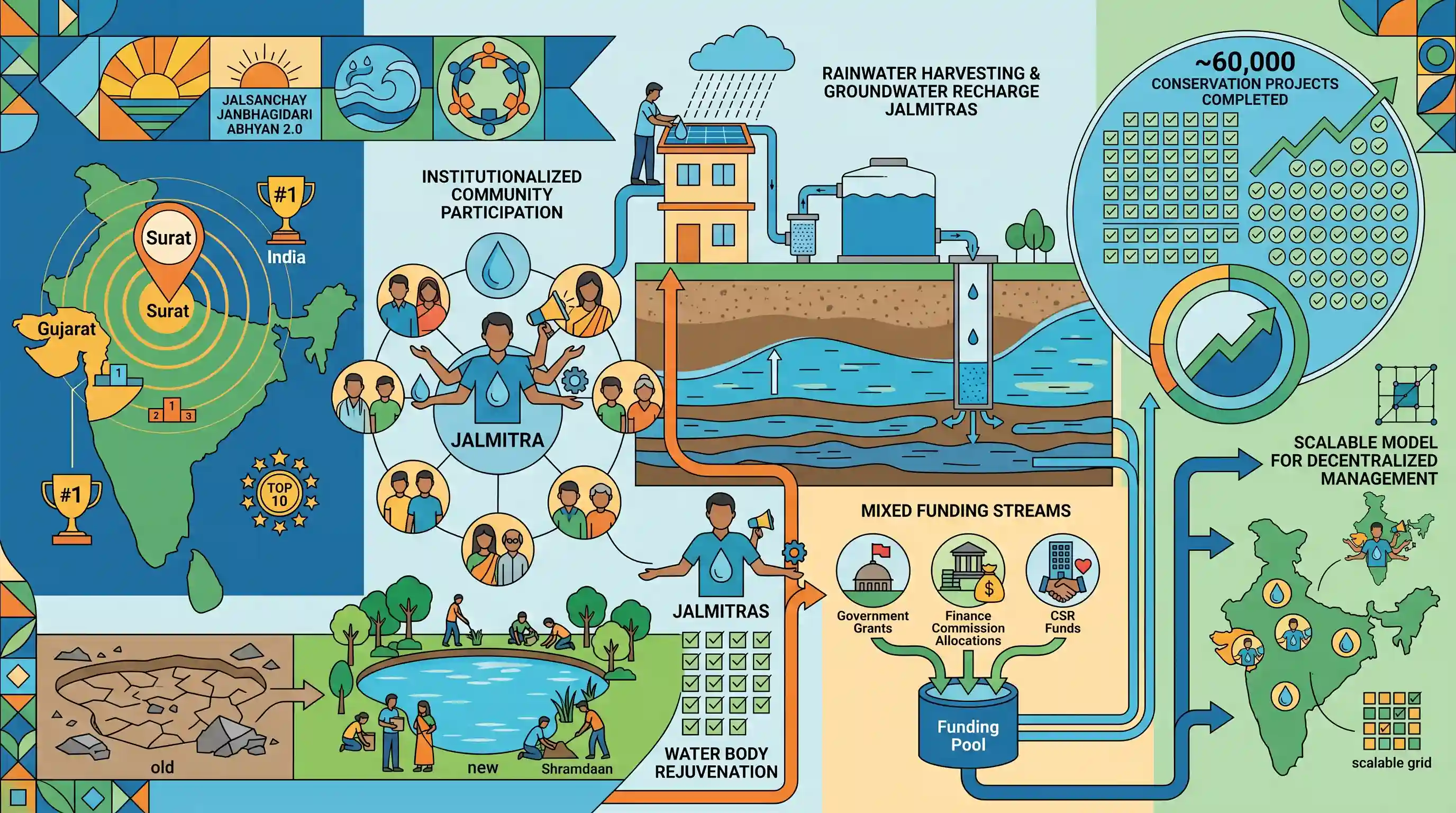
Surat has emerged as a national leader in water conservation, securing the top spot in Gujarat and ranking among India's top 10 districts. Propelled by the 'Jalsanchay Janbhagidari Abhiyan 2.0', the district has institutionalized community participation by appointing 'Jalmitras' to promote and execute rainwater harvesting, groundwater recharge, and the rejuvenation of water bodies. By effectively leveraging mixed funding streams—including government grants, Finance Commission allocations, and CSR funds—Surat has successfully completed around 60,000 conservation projects, offering a scalable model for decentralized water resource management.
Key Points
- Surat has been ranked first in Gujarat and among the top 10 districts in India for its outstanding water conservation activities.
- Under the Jalsanchay Janbhagidari Abhiyan 2.0, local citizens are enlisted as 'Jalmitras' (water ambassadors) to lead community awareness and participation.
- The initiatives focus heavily on practical conservation techniques, including rainwater harvesting, borewell and rooftop recharge, deepening of ponds, and constructing check dams.
- Approximately 60,000 water conservation works have been successfully completed in the district.
- The projects are funded through a diverse resource pool, pooling government and Finance Commission grants alongside CSR funds and contributions from cooperative institutions.
Important Terms
Jal Shakti Abhiyan

National water conservation campaign launched in 2019, emphasizing rainwater harvesting, traditional water body restoration, and groundwater recharge through community participation or 'Jan Andolan.'
UPSC context
GS Paper I (Geography/Water Resources) and GS III (Environment); focuses on national water security strategies.
Jalsanchay Janbhagidari Abhiyan
A state-specific mission (notably in Gujarat) driven by the Ministry of Jal Shakti to construct thousands of rainwater harvesting structures through community-government partnerships.
UPSC context
GS Paper II (Governance) and GS III (Environment); tests decentralized resource management and community-led development.
15th Finance Commission (Tied Grants)
Specific funds recommended by the 15th Finance Commission, mandating that 60% of rural local body grants be spent on water supply and sanitation.
UPSC context
GS Paper II (Polity/Fiscal Federalism) and GS III (Economy); tests fiscal devolution to local bodies.
Corporate Social Responsibility (CSR)
A statutory obligation under the Companies Act, 2013, requiring large firms to spend 2% of average net profits on social and environmental development.
UPSC context
GS Paper III (Economy) and GS IV (Ethics); tests private sector contribution to public infrastructure.
Jalmitra
Grassroots volunteers or trained personnel appointed to mobilize communities for water conservation, manage local water structures, and promote sustainable usage.
UPSC context
GS Paper II (Governance); highlights innovative community-based governance and social capital in rural management.
Groundwater Recharge
The hydrologic process of replenishing underground aquifers via surface water infiltration, often enhanced through artificial structures like check dams and recharge wells.
UPSC context
GS Paper I (Geography); tests scientific understanding of water resource management and aquifer sustainability.
Prelims Trap
Jalmitras are statutory officers appointed under the Central Ground Water Authority to enforce conservation.
Jalmitras are informal community volunteers designated under a participatory state/local initiative, not statutory authorities holding legal powers.
Static Concepts Connected
How are Finance Commission grants tied to local water management?
- Tied Grants: The 15th FC mandated that 60% of grants to rural local bodies be 'tied' to national priorities like drinking water supply, rainwater harvesting, and sanitation.
- Decentralized Autonomy: This ensures predictable funding for Panchayats to implement local water security plans, moving away from complete reliance on State or Central centrally sponsored schemes.
What are the core intervention areas under the Jal Shakti Abhiyan (JSA)?
- Water Conservation: Focuses heavily on targeted rainwater harvesting (Catch the Rain) and artificial recharge of groundwater structures.
- Renovation of Bodies: Includes systematic desilting, deepening, and rejuvenation of traditional local water bodies and tanks.
- Watershed Development: Emphasizes the construction of check dams, trenching, and intensive afforestation to capture surface runoff.
Cross-Topic Patterns
CSR convergence in local governance
Surat’s model highlights the convergence of private CSR funds with 15th FC tied grants, a growing trend in achieving SDGs and augmenting municipal/panchayat capacity for climate resilience.
Groundwater recharge vs. Urban Flooding
Intensive rainwater harvesting acts as a dual-purpose strategy: boosting groundwater aquifers while mitigating urban runoff and flash floods in rapidly urbanizing coastal cities like Surat.

Expect a 2026 Prelims statement testing the permissible convergence of CSR funds and 15th Finance Commission tied grants for local projects.
Linked PYQs · 4
Linked PYQs · 4
- 2018MainsGS1
The ideal solution of depleting ground water resources in India is water harvesting system." How can it be made effective in urban areas?
- 2016MainsGS1
In what way micro-watershed development projects help in water conservation in drought-prone and semi-arid regions of India?
- 2020MainsGS3
Suggest measures to improve water storage and irrigation system to make its judicious use under depleting scenario.
- 2020MainsGS3
What are the salient features of the Jal Shakti Abhiyan launched by the Government of India for water conservation and water security?
