Surat police public flogging incident and legal rights debate
Source:indiatomorrow ↗
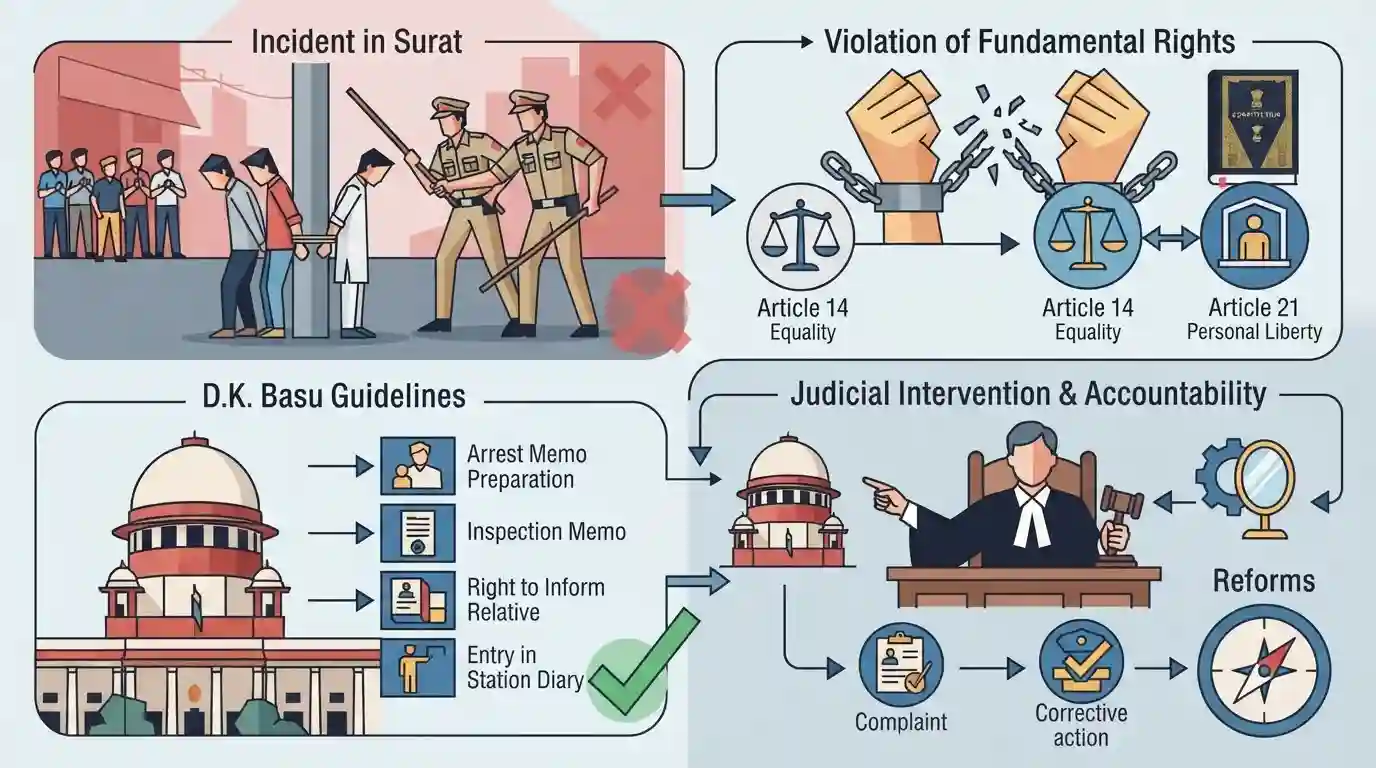
Why It Matters
Incidents of extra-judicial punishment and custodial violence raise critical questions about the rule of law, the separation of powers, and the enforcement of Fundamental Rights (Articles 14, 21, and 22). It serves as a direct case study for questions on constitutional safeguards against police brutality and the relevance of Supreme Court precedents like the D.K. Basu guidelines.
Summary
A major controversy erupted in Surat, Gujarat, after police personnel publicly flogged and paraded four accused individuals, prompting widespread legal outrage. Activists and legal professionals argued that such instances of extra-judicial 'instant justice' severely violate the fundamental rights to equality and personal liberty enshrined in Articles 14 and 21 of the Constitution. Furthermore, the incident represents a blatant disregard for the Supreme Court's established D.K. Basu guidelines, which are designed to prevent custodial violence and ensure police accountability.
Key Points
- Surat police, under a DCP, publicly paraded and assaulted accused individuals in an attempted murder case, claiming it was to deter criminals.
- Legal advocates highlighted that extra-judicial violence directly violates Article 14 (Equality before law) and Article 21 (Protection of life and personal liberty) of the Constitution.
- The incident contravenes the Supreme Court\'s landmark D.K. Basu vs State of West Bengal guidelines, which strictly forbid custodial torture and mandate the humane treatment of those arrested.
- Observers drew parallels with the 2022 Kheda flogging incident, where the Gujarat High Court convicted police personnel for contempt of court over public beatings, emphasizing that police cannot act as judges or executioners.
Important Terms
D.K. Basu Guidelines

A set of 11 mandatory procedures laid down by the Supreme Court in the 1997 D.K. Basu v. State of West Bengal case to prevent custodial violence and safeguard arrested persons' rights.
UPSC context
GS Paper II: Indian Polity, focusing on police reforms, criminal justice administration, and protection against state excesses.
Article 21 of the Constitution
A fundamental right guaranteeing that no person shall be deprived of their life or personal liberty except according to procedure established by law, protecting individuals from arbitrary state actions.
UPSC context
GS Paper II: Constitutional provisions, specifically focusing on the judicial expansion of fundamental rights and personal liberties.
Article 14 of the Constitution
A fundamental constitutional right ensuring equality before the law and equal protection of laws to all persons within India, restricting arbitrary and discriminatory state actions.
UPSC context
GS Paper II: Fundamental Rights, specifically testing equality provisions, basic structure, and the rule of law.
Gujarat High Court
The highest judicial authority in the state of Gujarat, possessing constitutional powers of judicial review, writ jurisdiction, and oversight over regional police accountability.
UPSC context
GS Paper II: Judiciary, highlighting the role of High Courts in safeguarding fundamental rights and ensuring state accountability.
Supreme Court of India
The apex judicial body in India, acting as the ultimate interpreter of the Constitution and the ultimate guarantor of fundamental rights.
UPSC context
GS Paper II: Structure and functioning of the Judiciary, covering judicial activism and separation of powers.
Minority Coordination Committee
A Gujarat-based civil society organization established in 2016 to advocate for the constitutional rights, social welfare, and equitable treatment of minority communities.
UPSC context
GS Paper II: Pressure groups, NGOs, and civil society organizations advocating for vulnerable and marginalized sections.
Prelims Trap
The right against torture is an explicitly codified, standalone Fundamental Right in the Constitution.
The right against torture is not explicitly written in the Constitution; it is an implied right read into Article 21 (Right to Life) by the Supreme Court.
Static Concepts Connected
What are the constitutional safeguards under Article 22 of the Constitution?
- Right to information: The arrested person must be informed of the grounds of arrest as soon as possible.
- Legal counsel: The right to consult and be defended by a legal practitioner of one's choice.
- Magistrate production: Mandatory production before the nearest magistrate within 24 hours, excluding travel time.
What is the doctrine of sovereign immunity regarding fundamental rights?
- Inapplicability: Established in Nilabati Behera (1993) that sovereign immunity cannot defend against state violations of fundamental rights.
- Strict liability: The state is strictly liable to pay monetary compensation to victims of custodial violence under public law.
- Constitutional remedy: Compensation acts as a constitutional remedy under Articles 32 and 226, independent of private civil suits.
Cross-Topic Patterns
Seventh Schedule vs Constitutional Tort
Police is a State list subject, complicating uniform national reforms and forcing the judiciary to issue pan-India guidelines like D.K. Basu to protect human rights.
Judicial contempt as executive check
Using the Contempt of Courts Act to punish police officers bypasses sluggish departmental disciplinary mechanisms, establishing a swift judicial tool for executive accountability.

Expect a 2026 GS-II question linking Article 21, judicial contempt powers, and the limits of sovereign immunity in custodial torture cases.
Linked PYQs · 4
Linked PYQs · 4
- 2024GPSC_PRELIMSGS1
Article 22 of the Constitution of India confers which of the following rights for a person who is arrested or detained? 1. Right to be informed of the grounds of arrest. 2. Right to consult and to be defended by a legal practitioner. 3. Right to be released after 24 hours unless the magistrate authorises further detention. Select the correct answer code:
- 2024GPSC_PRELIMSGS1
Consider the following statements. 1. Access to justice for the weaker sections of the society is a constitutional mandate to ensure fair treatment under Indian legal system. 2. Legal Services Authorities Act, 1987, was enacted by Parliament to organise Lok Adalats outside the formal adjudicatory system, to address the problems of crowded cases. 3. Equal justice and free legal aid is one of the Directive Principles of State Policy (DPSP) under the Indian Constitution Which of the above statements is/are correct?
- 2026GPSC_PRELIMSGS1
With reference to the Supreme Court's landmark judgment in the Harish Rana vs. Union of India case, consider the following statements regarding euthanasia in India: 1. The fundamental right to live with dignity under Article 21 of the Constitution encompasses dignity until death, consequently including the right to die with dignity. 2. While the law permits the withdrawal of life-support systems under strict medical guidelines, the deliberate administration of lethal substances to accelerate a patient's death remains a criminal offense. Which of the above statement(s) is/are correct?
- 2020GPSC_PRELIMSGS1
Which of the following Articles provides the right of access to the Internet?
