Surat demolition case and administrative accountability for housing
Source:theprint ↗
Why It Matters
This incident serves as a practical case study for GS-2 (Polity and Governance). It highlights the High Court's use of judicial review to check arbitrary executive actions (illegal demolitions) and enforce administrative accountability. It also underscores the responsibilities of Urban Local Bodies under the 74th Amendment Act regarding town planning and slum rehabilitation, and reiterates the constitutional mandate of the State to protect citizens' right to shelter under Article 21.
Summary
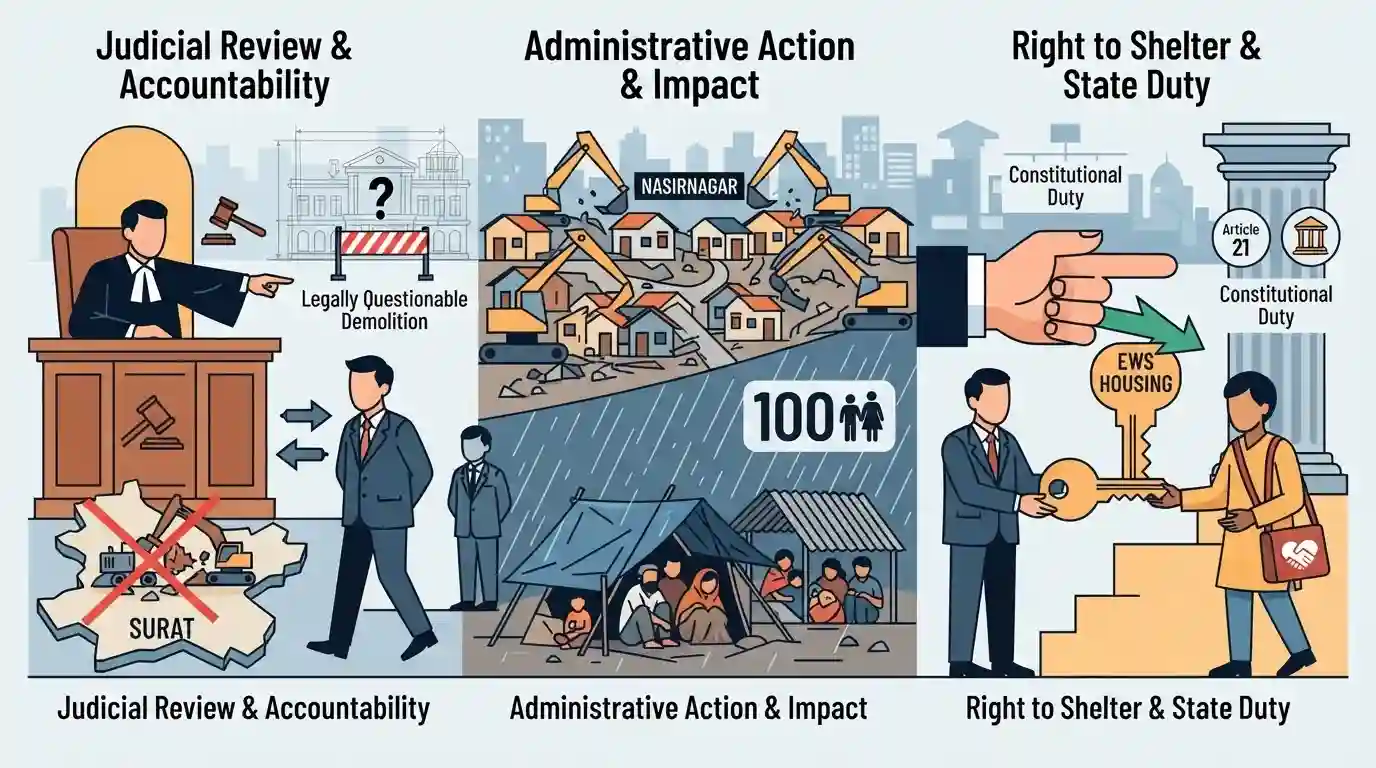
The Gujarat High Court severely reprimanded the Surat Municipal Corporation for conducting a legally questionable demolition drive in Nasirnagar, rendering about 100 families homeless during the monsoon season. Asserting that a fair inquiry could not take place while top officials retained their posts, the Court prompted the state government to immediately transfer Surat Municipal Commissioner M Nagarajan. Furthermore, the High Court criticized the municipal body's attempt to deflect responsibility by proposing an NGO to handle the victims' rehabilitation under an Economically Weaker Section (EWS) housing scheme, reminding the state and civic body of their constitutional duty to provide shelter.
Key Points
- The Gujarat state government transferred Surat Municipal Commissioner M Nagarajan after the Gujarat High Court strongly criticized a prima facie illegal demolition drive in Nasirnagar.
- The demolition drive, which occurred during monsoon without proper legal process, left nearly 100 families homeless.
- The High Court asserted that any inquiry into the demolition would be a 'farce' if the civic chief and the Deputy Commissioner of Police remained in their current positions.
- The Court rejected the civic body's proposal to outsource the victims' rehabilitation under an EWS scheme to an NGO, emphasizing that the state and corporation must bear direct responsibility for housing the displaced.
Important Terms
Economically Weaker Section (EWS) housing scheme

A government initiative providing subsidized, affordable shelter to citizens below a specific income threshold, ensuring equitable urban development and preventing arbitrary displacement.
UPSC context
Relevant for GS Paper 2 (Welfare Schemes); tests knowledge of inclusive urban policies, housing rights, and poverty alleviation.
Right to Shelter (Article 21)
An implicit fundamental right guaranteed under Article 21's Right to Life, safeguarding citizens from arbitrary eviction without due legal process and mandating state responsibility for rehabilitation.
UPSC context
Critical for GS Paper 2 (Fundamental Rights); routinely tested in essays and questions concerning social justice and human rights.
Administrative Accountability
The constitutional and ethical obligation of public officials to answer for their decisions, ensuring administrative actions—such as demolition drives—strictly adhere to statutory frameworks and procedural justice.
UPSC context
Essential for GS Paper 4 (Probity in Governance); tests the concepts of bureaucratic integrity, transparency, and disciplinary proceedings.
Gujarat High Court
The highest constitutional court in Gujarat, exercising jurisdiction under Article 226 to issue writs for the enforcement of fundamental rights and acting as a check on executive overreach or illegal administrative actions.
UPSC context
Relates to GS Paper 2 (Judiciary); illustrates judicial review, judicial activism, and the protection of citizens against arbitrary state actions.
Surat Municipal Corporation
The Urban Local Body (ULB) governing Surat, empowered under the 74th Constitutional Amendment to administer city planning, infrastructure development, housing, and civic amenities.
UPSC context
Relevant for GS Paper 2 (Local Self-Government); highlights the responsibilities, limitations, and accountability of urban municipal bodies.
Judicial Review
The power of the judiciary to examine the actions of the legislative and executive branches, ensuring they comply with the Constitution and fundamental legal procedures, striking them down if arbitrary.
UPSC context
GS Paper 2 (Indian Constitution); vital for understanding the separation of powers and the courts' role in preventing executive abuse.
Prelims Trap
The Right to Adequate Housing is explicitly listed as a Fundamental Right under Article 21 of the Indian Constitution.
It is an *implicit* right read into Article 21 (Right to Life) by the Supreme Court in landmark judgments, not an explicitly drafted provision in the constitutional text.
Static Concepts Connected
How has the Supreme Court interpreted the Right to Shelter under Article 21?
- Implicit Right: Right to shelter is not explicitly written but implicitly read into Article 21's Right to Life (e.g., Chameli Singh v. State of UP).
- Due Process requirement: Arbitrary evictions violate fundamental rights; the state must follow fair, statutory legal procedures and ensure rehabilitation for vulnerable, displaced groups.
What responsibilities does the 12th Schedule assign to Municipalities regarding urban poverty?
- 74th Amendment Act: Introduced the 12th Schedule, devolving 18 functional items to Urban Local Bodies to function as genuine institutions of self-government.
- Core Mandates: Explicitly lists 'slum improvement and upgradation' and 'urban poverty alleviation' as primary administrative responsibilities of municipal corporations.
Cross-Topic Patterns
Executive Overreach vs Judicial Review
Punitive demolitions bypass judicial trials, illegally merging executive and judicial functions. This severely violates the separation of powers and Article 21 due process.
Ethics of Impartiality in Administration
Forced transfers during ongoing inquiries uphold the natural justice principle 'Nemo judex in causa sua', actively preventing conflicts of interest in administrative accountability.

Expect a GS2 question evaluating 'bulldozer justice' against Article 21 due process and the constitutional mandates of local urban bodies.
Linked PYQs · 4
Linked PYQs · 4
- 2026GPSC_PRELIMSGS1
Consider the following Assertion and Reason: Assertion (A): The Supreme Court of India has the power of judicial review. Reason (R): Articles 13, 32 and 226 collectively form the constitutional basis of judicial review in India. Which of the following is correct with respect to the above?
- 2026GPSC_PRELIMSGS1
Consider the following Assertion and Reason: Assertion (A): Judicial review is part of the Basic Structure of the Indian Constitution. Reason (R): Judicial review ensures supremacy of the Constitution over Parliament. Which of the following is correct with respect to the above?
- 2025GPSC_PRELIMSGS1
Consider the following statements regarding important Constitutional Amendments: Statements: 1. The 42ⁿᵈ Constitutional Amendment Act, 1976 is known as the 'Mini-Constitution' as it introduced significant changes, including the words Socialist, Secular and Integrity in the Preamble. 2. The 44ᵗʰ Constitutional Amendment Act, 1978 restored certain provisions of the Fundamental Rights that were curtailed during the emergency. 3. The 73ʳᵈ Constitutional Amendment Act, 1992 provided constitutional status to urban local bodies. Which of the statement/statements given above is/are correct?
- 2017GPSC_PRELIMSGS1
District planning Committees have been constituted as mandated by
