Surat Medical College suspends four doctors over ragging incident
Source:deshgujarat ↗
આ શા માટે મહત્વનું છે
The incident underscores the persistent challenge of ragging and harassment in higher education, specifically in medical colleges. It highlights the importance of robust institutional grievance redressal mechanisms, regulatory oversight, and the prompt functioning of Anti-Ragging Committees to ensure student safety and institutional accountability.
સારાંશ
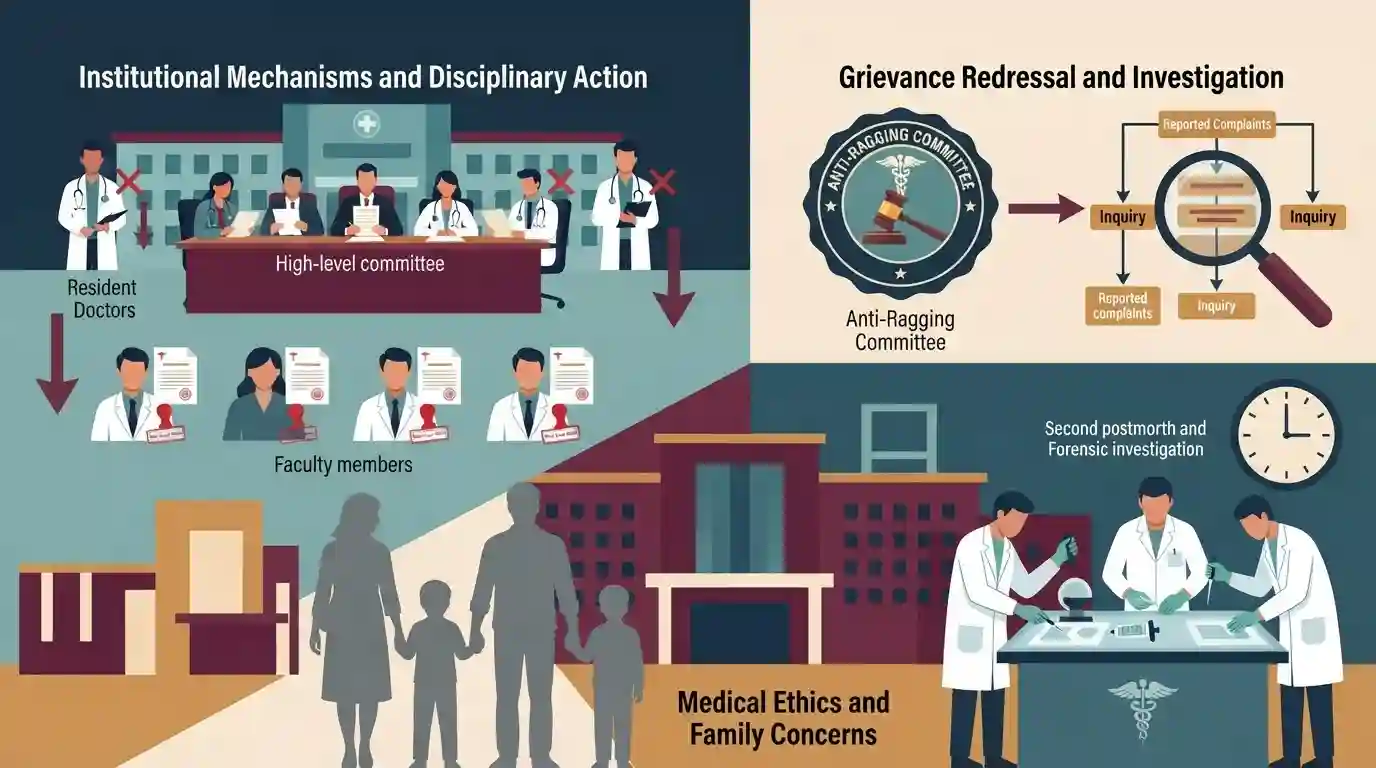
Four resident doctors at Government Medical College (GMC) in Surat have been suspended for six months, and four faculty members have been issued show-cause notices following the suicide of a 29-year-old postgraduate medical student. The disciplinary actions were taken after an investigation by a high-level committee and the Anti-Ragging Committee into allegations of harassment and gross negligence. The victim's family has raised concerns over previous similar incidents at the hospital and demanded a second postmortem and forensic investigation, which is currently underway.
મુખ્ય મુદ્દા
- Four resident doctors at Government Medical College, Surat, were suspended for six months following the suicide of a postgraduate medical student amidst ragging allegations.
- A high-level committee and the Anti-Ragging Committee investigated the matter and recorded statements from first-year residents and the victim's father.
- Four faculty members, including the Head of the Microbiology Department, were issued show-cause notices.
- The suspended doctors were barred from academic activities and ordered to vacate their hostel rooms immediately.
- The victim's family has requested a second postmortem and forensic investigation, alleging systemic issues with harassment at the institution.
મહત્વપૂર્ણ શબ્દો
Anti-Ragging Committee

A mandatory institutional body established in colleges to prevent and eliminate ragging, ensure compliance with statutory guidelines, and recommend disciplinary actions against offenders.
UPSC context
GS Paper II (Governance/Education). Tests student welfare mechanisms, administrative responsibility, and grievance redressal in higher educational institutions.
Raghavan Committee
A high-level committee set up in 2006 by the Supreme Court of India, headed by R.K. Raghavan, to suggest comprehensive measures to eradicate ragging.
UPSC context
GS Paper II (Governance). Tests understanding of landmark committees on educational reforms, campus safety, and institutional accountability.
National Medical Commission
India's apex statutory regulatory body established under the NMC Act, 2019 to regulate medical education, register medical professionals, and enforce ethical standards.
UPSC context
GS Paper II (Statutory Bodies & Health). Tests knowledge of health governance, medical education reforms, and professional ethics.
Forensic Science Laboratory
A scientific institution that analyzes physical and biological evidence from crime scenes, providing crucial objective forensic analysis to assist police and the judiciary.
UPSC context
GS Paper III (Science & Tech/Security). Tests evidence-based prosecution, police modernization, and reforms in the criminal justice system.
Government Medical College
A publicly funded and managed tertiary-level institution that provides medical and healthcare education, conducts research, and offers subsidized patient care.
UPSC context
GS Paper II (Social Sector/Health). Tests health infrastructure, medical education access, and the role of the state in public welfare.
પ્રિલિમ્સ ટ્રેપ
Ragging is defined as a specific, distinct statutory offense under a dedicated central Act passed by the Parliament.
India lacks a standalone central anti-ragging statute; offenses are instead prosecuted under general BNS provisions, state-specific acts, and regulatory frameworks (UGC/NMC) driven by judicial directives.
સંલગ્ન સ્થિર ખ્યાલો
What is the institutional framework of the Anti-Ragging Committee under UGC regulations?
- Judicial Genesis: Formed based on the R.K. Raghavan Committee guidelines appointed by the Supreme Court to curb campus harassment.
- Multi-stakeholder Composition: Uniquely mandates representation from civil/police administration, local media, NGOs, parents, and students, alongside institutional faculty.
- Key Mandate: Investigates ragging incidents, coordinates with local authorities, and recommends academic or administrative suspensions.
What are the regulatory powers of the National Medical Commission regarding student safety?
- Specialized Regulations: Enforces the 'Prevention and Prohibition of Ragging in Medical Colleges Regulations, 2021' to safeguard resident doctors.
- Institutional Penalties: Can reduce student seat intake, stop admissions, or withdraw college recognition for failing to prevent systemic ragging.
આંતર-વિષય પેટર્ન
Medical ethics + Occupational mental health
Hyper-hierarchical medical residency structures intersect with public health management, requiring reforms that balance extreme work hours with institutional grievance redressal.
Judicial activism + Education governance
The reliance on the Raghavan Committee highlights how Supreme Court directives step in to construct regulatory frameworks where central statutory legislation is absent.

UGC/NMC regulatory powers over student welfare and judicial-driven guidelines (Raghavan Committee) likely to feature in GS-2/GS-4.
સંલગ્ન PYQ · 2
સંલગ્ન PYQ · 2
- 2025GPSC_PRELIMSGS1
Which of the following statements about India's quasi-judicial bodies are correct? 1. The National Human Rights Commission (NHRC) can impose penalties for human rights violations. 2. The Central Administrative Tribunal (CAT) deals with disputes related to the service conditions of civil servants. 3. The Competition Commission of India (CCI) is responsible for regulating monopolistic trade practices. 4. The Election Commission of India (ECI) has quasi-judicial powers in matters related to the Model Code of Conduct violations. Select the correct answer using the codes below:
- 2022GPSC_PRELIMSGS1
Which of the following bodies have the leader of the Opposition in Rajya Sabha, in their appointment committees?
