Surat textile sector push for air jet weaving technology
Source:punjab-kesari ↗
Why It Matters
The textile sector is a critical pillar of Gujarat's economy. Understanding state policies (like the Gujarat Textile Policy), central schemes (PM MITRA), and technological upgrades (air-jet looms) in Surat is essential for GPSC candidates, as regional industrial development and economic geography are recurring exam themes.
Summary
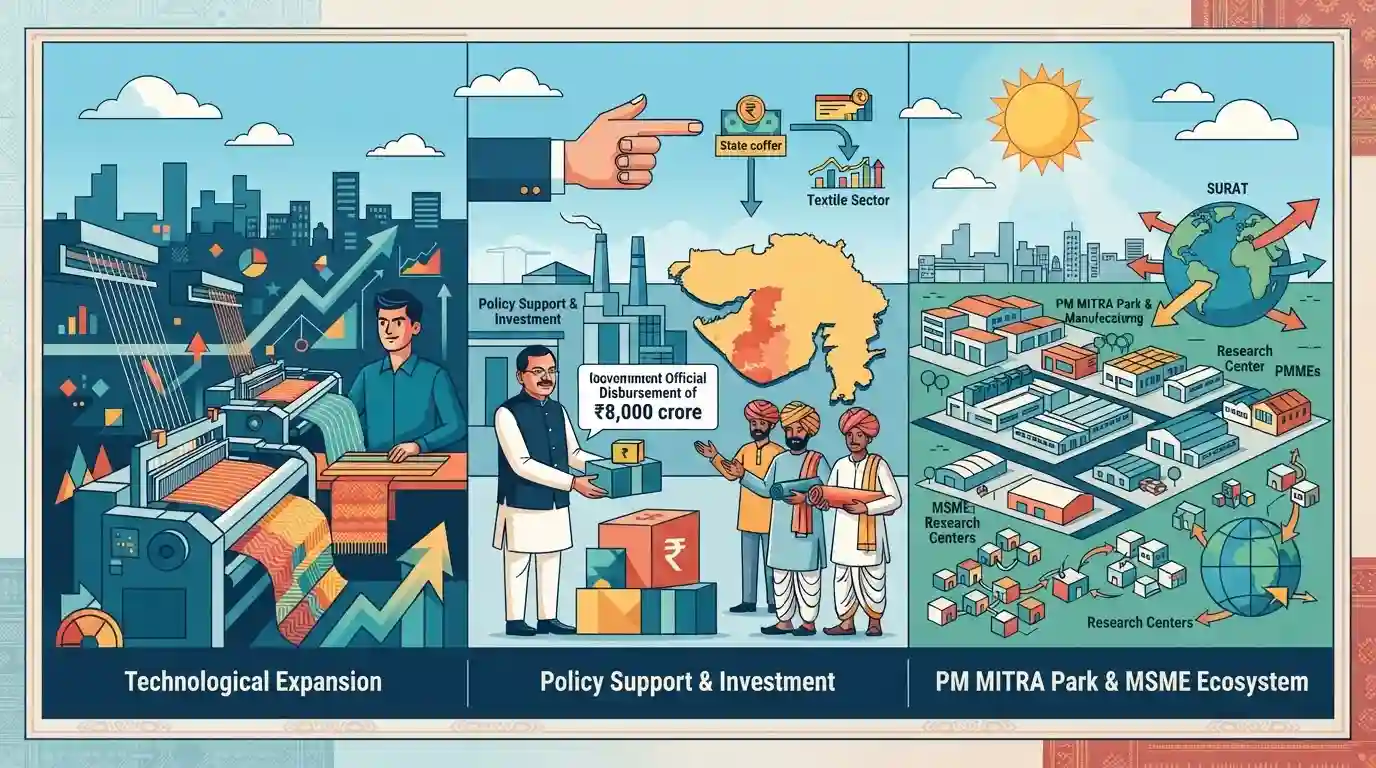
The Surat textile industry is poised for major technological expansion with the anticipated addition of 10,000 to 15,000 advanced air-jet weaving machines, signaling a shift towards value-added and sustainable manufacturing. At a recent weavers' summit, Gujarat Minister Harsh Sanghavi highlighted the state's robust support, noting that the Gujarat Textile Policy disbursed ₹8,000 crore to traders over the past year. Furthermore, the upcoming PM MITRA Park in South Gujarat is expected to establish a massive textile ecosystem, complementing administrative reforms in the MSME sector to enhance Surat's global export competitiveness.
Key Points
- Surat's textile industry plans to install 10,000 to 15,000 new air-jet weaving machines to boost high-quality, value-added production.
- Gujarat's Minister Harsh Sanghavi addressed the Weavers' Paramarsh Sammelan, stressing a shift towards sustainable and export-oriented textile manufacturing.
- The Gujarat Textile Policy has successfully disbursed ₹8,000 crore to traders within a single year, reflecting strong state backing for the sector.
- A PM MITRA Park proposed in South Gujarat is currently in the tendering stage and aims to create the largest integrated textile ecosystem in the region.
- Administrative reforms in the MSME sector have enhanced operational efficiency and ease of doing business for local weavers.
Important Terms
Gujarat Textile Policy

A state government initiative (2024-2029) designed to attract investment across the textile value chain. It offers capital, interest, and power tariff subsidies alongside payroll assistance to boost MSMEs, women's employment, and sustainable green manufacturing.
UPSC context
Crucial for GS Paper 3 (Industrial Policy), demonstrating targeted state-level interventions to enhance manufacturing and employment.
PM MITRA Park
Pradhan Mantri Mega Integrated Textile Region and Apparel parks provide world-class, plug-and-play infrastructure. Following the '5F' vision (Farm to Foreign), they co-locate the entire textile value chain to reduce logistics costs and boost global competitiveness.
UPSC context
Central to GS Paper 3 (Infrastructure), testing knowledge on mega-cluster approaches for achieving economies of scale in manufacturing.
Secure Airjet Weavers Association (SAWA)
A Surat-based industry body representing textile manufacturers operating advanced air-jet weaving machines. It advocates for technological modernization, policy support, and the transition of local MSMEs toward high-speed, value-added fabric production.
UPSC context
Relevant for GS Paper 3 (MSME Sector), serving as a case study of local industry associations driving industrial modernization.
Prelims Trap
PM MITRA parks are exclusively funded and managed by the Central Government.
They are implemented via Special Purpose Vehicles (SPVs) that are jointly owned by the Central and respective State Governments.
Static Concepts Connected
What is the institutional framework of PM MITRA Parks?
- Joint SPV: Managed by a Special Purpose Vehicle jointly owned by the Centre and the respective State Government.
- 5F Vision: Integrates the entire value chain: Farm to Fibre to Factory to Fashion to Foreign.
- Plug & Play: Provides ready infrastructure to slash logistics costs and build economies of scale.
Why do Indian textile MSMEs need structural modernization?
- Fragmented Weaving: India's power-loom sector is highly decentralized, creating inefficiencies and logistics overheads compared to integrated foreign competitors.
- Tech Upgradation: Adoption of advanced shuttleless looms (like air-jet) under schemes like ATUFS is vital to produce defect-free, export-quality fabric.
Cross-Topic Patterns
PM MITRA vs PLI Scheme
PM MITRA builds the physical, plug-and-play spatial infrastructure, whereas PLI incentivizes the actual production scale of Man-Made Fibres (MMF) and technical textiles.
GI Crafts to Modern Clusters
Surat's evolution from a 16th-century GI-tagged Zari handicraft hub to a capital-intensive MSME center reflects India's industrial transition.

Expect a multi-statement question distinguishing the infrastructure mandate of PM MITRA from the production incentives of PLI for textiles.
Linked PYQs · 3
Linked PYQs · 3
- 2025GPSC_PRELIMSGS1
______ is one of the cities chosen by the NITI Aayog for its Growth Hub (G-HUB) programme to boost their economic growth.
- 2020GPSC_PRELIMSGS1
The Zari gold industry of Surat dates to which of the following periods?
- 2025GPSC_PRELIMSGS1
Which of the following statements are correct regarding the economy of Gujarat according to the Socio-Economic Review, 2024-2025 of Gujarat? 1. Gujarat has consistently contributed over 8% to India's GST collections, highlighting its economic vitality and strength. 2. During the year 2022-23, Gujarat stood first in handling total cargo among the states of India. 3. According to the results of Annual Survey of Industries (ASI) 2022-23, Gujarat is first in the country in Industrial Production and Fixed Capital.
