Supreme Court jurisprudence on gender justice and constitutional ethos
Source:Indian Express ↗
Why It Matters
This piece provides critical analytical fodder for GS Paper 2 (Polity and Social Justice), particularly regarding the debate on 'indigenization' of the legal system versus the adoption of universal/Western constitutional principles. It is highly relevant for answers evaluating the Supreme Court's role in advancing gender justice and interpreting constitutional morality.
Summary
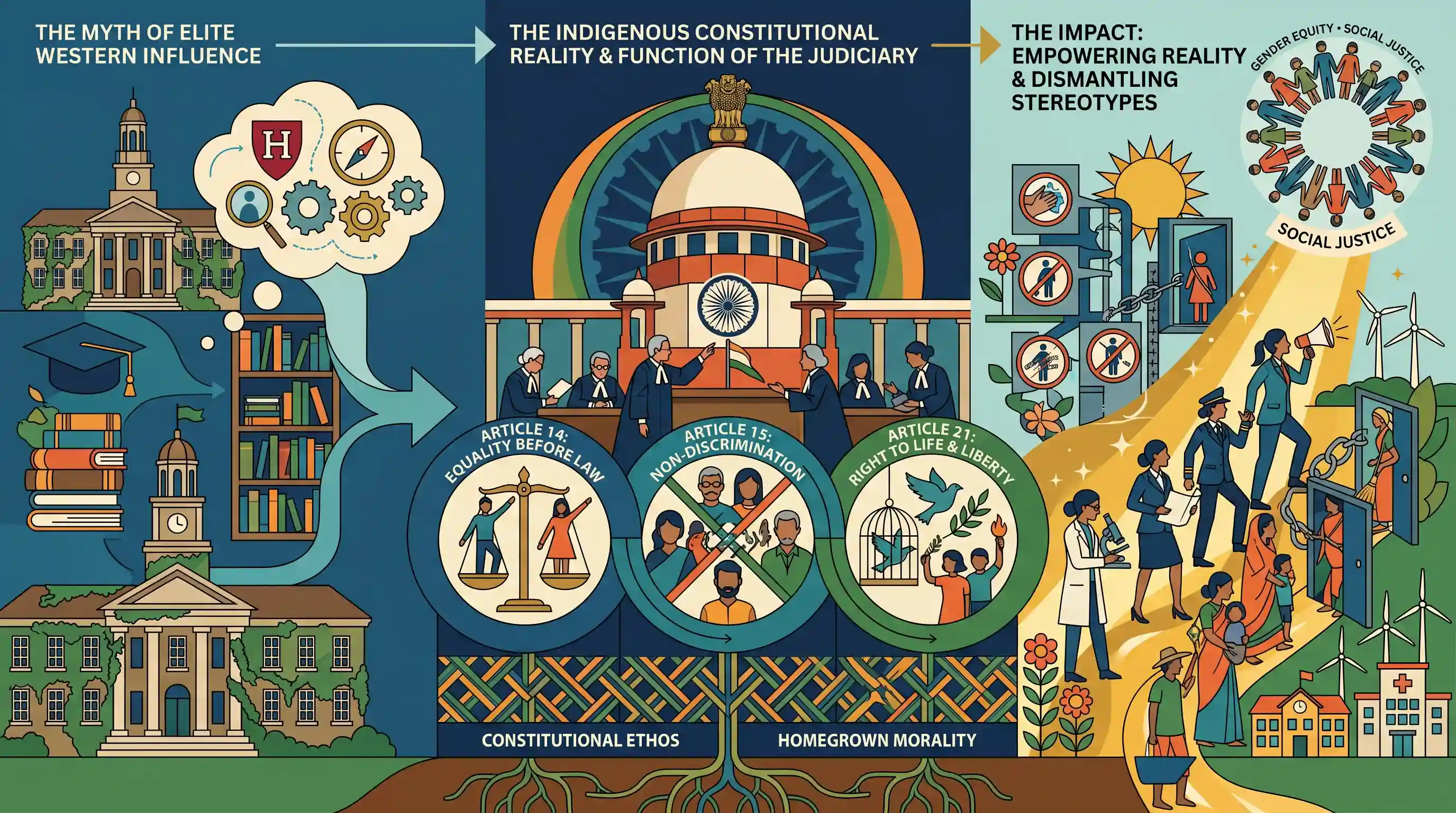
The article discusses the trajectory of the Supreme Court's jurisprudence concerning gender justice, challenging the narrative that progressive judgments are overly influenced by elite, Western ('Harvard-oriented') academic frameworks. Instead, it argues that the Court's moves toward women's empowerment and dismantling gender stereotypes are deeply grounded in the indigenous ethos of the Indian Constitution. By leveraging Articles 14, 15, and 21, the judiciary addresses the lived realities of Indian women, demonstrating that constitutional morality and gender equity are homegrown imperatives rather than imported concepts.
Key Points
- The Supreme Court's jurisprudence on gender justice is fundamentally rooted in the Indian Constitution, countering arguments that it relies on Western or elite ('Harvard-oriented') academic theories.
- Constitutional provisions such as Article 14 (Equality), Article 15 (Non-discrimination), and Article 21 (Right to Dignity) provide an indigenous framework for advancing gender equity.
- The article underscores that tackling patriarchal norms and combating gender stereotypes are essential to realizing constitutional morality within the Indian socio-cultural context.
- Reiterates the importance of addressing the lived experiences and grassroots realities of Indian women in judicial outcomes, rather than relying on imported feminist constructs.
Important Terms
Constitutional Morality

Adherence to the core values and spirit of the Constitution (like liberty and equality) over traditional societal norms. It prevents majoritarian or traditional prejudices from overriding individual fundamental rights.
UPSC context
GS Paper 2: Polity. Tests the application of judicial doctrines in protecting individual rights versus social traditions.
Transformative Constitutionalism
A judicial philosophy viewing the Constitution as a dynamic document meant to transform society by dismantling historical hierarchies and securing substantive justice for marginalized groups, including women.
UPSC context
GS Paper 2: Constitution/Social Justice. Evaluates understanding of the judiciary's role in social engineering and evolving legal interpretations.
Gender Justice
The fair and equitable treatment of all genders, ensuring dignity, non-discrimination, and equal opportunities in public and private life. It is rooted in constitutional principles of equality.
UPSC context
GS Paper 1 (Society) & GS Paper 2 (Social Justice). Relevant for questions on women's empowerment and legal reforms.
Article 15
A Fundamental Right prohibiting discrimination by the State on grounds including sex. Article 15(3) empowers the State to make special provisions (affirmative action) for the benefit of women.
UPSC context
GS Paper 2: Polity. Tests knowledge of fundamental rights and the State's power for protective discrimination.
Article 21
Guarantees the right to life and personal liberty. The Supreme Court has expanded its scope to include the right to live with dignity, privacy, and bodily autonomy.
UPSC context
GS Paper 2: Fundamental Rights. Essential for analyzing judicial activism and expanded interpretations of the "Right to Life."
Article 14
Ensures equality before the law and equal protection of the laws within India. It is a foundational principle used to challenge and strike down gender-discriminatory laws.
UPSC context
GS Paper 2: Polity. Foundational for understanding equality and the prohibition of arbitrariness in State action.
Supreme Court of India
The highest judicial forum and final interpreter of the Constitution. It increasingly employs a gender-sensitive lens to dismantle stereotypes and enforce substantive equality through landmark judgments.
UPSC context
GS Paper 2: Judiciary. Focuses on the Court's role in safeguarding the Constitution and promoting progressive jurisprudence.
Prelims Trap
"The concept of 'Constitutional Morality' is explicitly defined in the Constitution of India."
While heavily invoked by the Supreme Court and discussed by Ambedkar, the term is nowhere expressly defined or explicitly mentioned in the text of the Indian Constitution.
Static Concepts Connected
What is 'Constitutional Morality' in SC jurisprudence?
- Core Meaning: A commitment to core constitutional values (liberty, equality, dignity) over prevailing majoritarian, patriarchal, or traditional social morality.
- Historical Origin: The concept was borrowed from historian George Grote and famously invoked by Dr. B.R. Ambedkar in the Constituent Assembly debates.
- Landmark Uses: Employed as a primary tool to strike down archaic laws in cases like Joseph Shine (adultery) and Navtej Singh Johar (Section 377).
How does the Constitution ensure substantive equality for women?
- Article 15(3): Allows the State to make special provisions for women and children, explicitly overriding formal equality to address systemic social disadvantages.
- Article 39(a) & (d): Directs state policy towards securing an equal right to an adequate means of livelihood and equal pay for equal work for men and women.
- Article 42: Mandates the State to make provisions for securing just and humane conditions of work and for maternity relief.
Cross-Topic Patterns
Decolonizing the Justice System
The SC's reliance on indigenous constitutional framing for gender justice parallels the executive's broader push to decolonize and 'Indianize' criminal laws via the Bharatiya Nyaya Sanhita.
Language as a Social Determinant
The SC's 'Handbook on Combating Gender Stereotypes' links directly to GS1 society topics on how patriarchal language and legal vocabulary perpetuate systemic discrimination and workplace inequity.

Expect a 2026 GS2 Mains question contrasting 'Constitutional Morality' against majoritarian 'Social Morality' in securing gender equity.
Linked PYQs · 2
Linked PYQs · 2
- 2023MainsGS2
Explain the constitutional perspectives of Gender Justice with the help of relevant Constitutional Provisions and case laws.
- 2021MainsGS2
Discuss the desirability of greater representation to women in the higher judiciary to ensure diversity, equity and inclusiveness.
