Supreme Court Guidelines on Bulldozer Demolitions and Accountability
Source:Indian Express ↗
Why It Matters
The rising trend of using property demolition as extra-judicial punishment directly challenges constitutional democracy. It is highly relevant for UPSC aspirants as it touches upon core polity concepts like the separation of powers, due process, Article 21 (Right to Shelter/Life), Article 300A (Right to Property), and executive overreach.
Summary
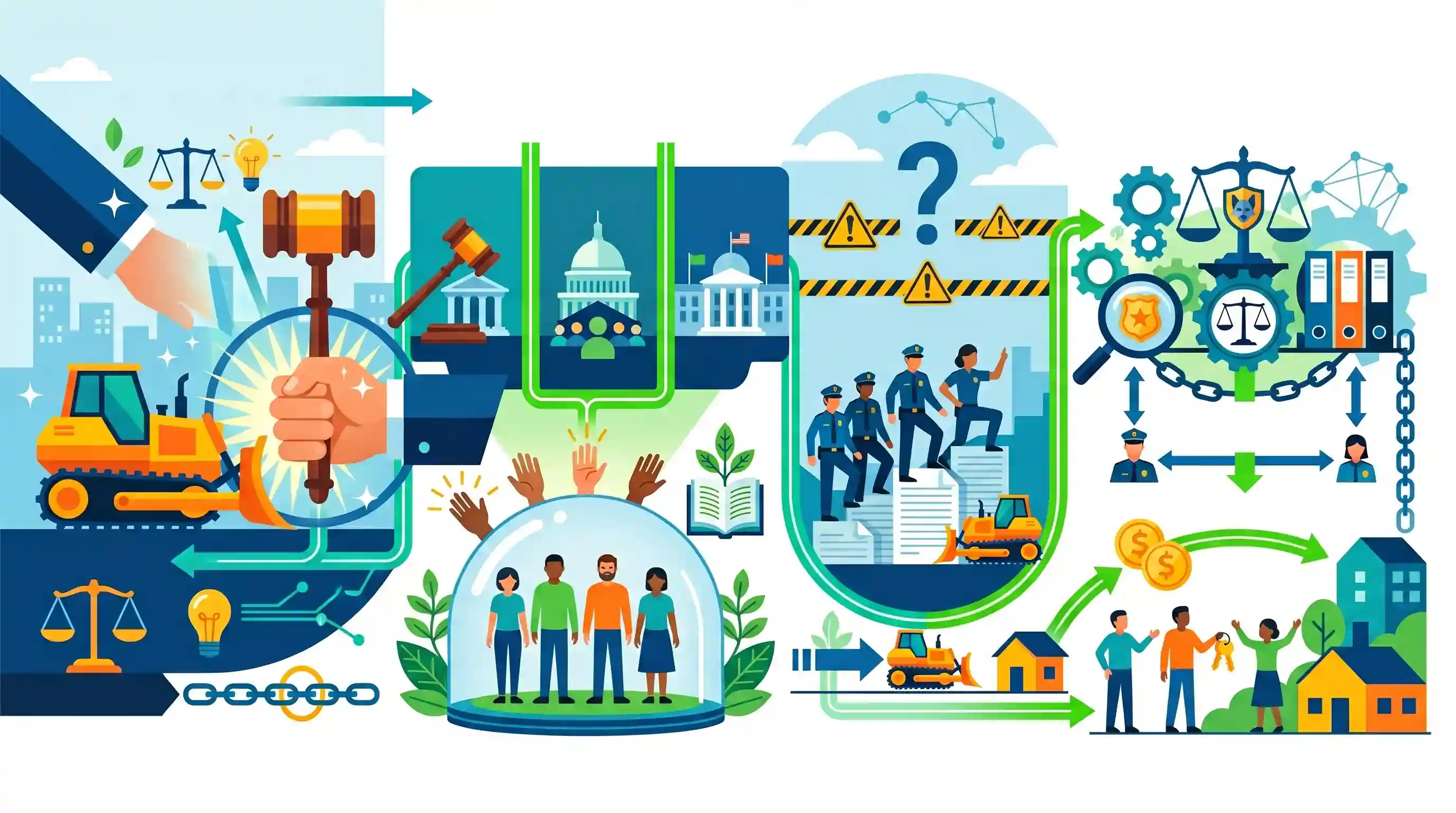
The article analyzes the Supreme Court's recent pan-India guidelines aimed at halting 'bulldozer justice'—the practice of demolishing the properties of individuals accused of crimes. While welcoming the Court's strong defense of the separation of powers and the rule of law, the author argues that guidelines alone are insufficient. To prevent the executive from bypassing the judicial process and inflicting extra-judicial punishment, there must be robust mechanisms to hold municipal and police officials strictly accountable and provide restitution to affected citizens.
Key Points
- The Supreme Court has issued guidelines to curb 'bulldozer justice', ruling that the executive cannot act as a judge and arbitrarily demolish the properties of accused individuals.
- Such punitive demolitions violate foundational constitutional principles, including the Separation of Powers, the Rule of Law, and Due Process.
- The Court mandated a 15-day notice period, an opportunity for a personal hearing, and video recording of proceedings before any structural demolition.
- Despite the welcome judicial intervention, the article argues that a permanent solution requires establishing strict accountability frameworks to penalize errant officials and ensure swift restitution for victims.
Important Terms
Rule of Law

The constitutional principle that the law is supreme, ensuring all state actions are non-arbitrary, legally justified, and applied equally. It prevents 'bulldozer justice' from becoming a form of extra-judicial punishment.
UPSC context
GS Paper 2: Fundamental to Indian constitutionalism, testing the limits of executive power and prevention of arbitrariness.
Separation of Powers
The doctrine dividing government into legislative, executive, and judicial branches to ensure checks and balances. The Supreme Court ruled that the executive cannot usurp judicial functions by declaring guilt and punishing accused individuals.
UPSC context
GS Paper 2: Essential for understanding the basic structure doctrine and the distinct roles of state organs.
Article 21
Fundamental Right guaranteeing protection of life and personal liberty. In the 'bulldozer justice' context, the Supreme Court interpreted this to include the 'Right to Shelter' and the right to live with dignity.
UPSC context
GS Paper 2: Core Fundamental Right; tests understanding of judicial expansion and the protection of individual dignity against the state.
Article 300A
A constitutional right stipulating that no person shall be deprived of their property except by authority of law. This law must be just, fair, reasonable, and follow a transparent procedure.
UPSC context
GS Paper 2/3: Tests the transition of property from a fundamental to a constitutional right and state's power of eminent domain.
Due Process of Law
The legal requirement that the state must respect all legal rights owed to a person, including mandatory notice, a fair hearing, and a reasoned order before taking punitive action.
UPSC context
GS Paper 2: Vital for questions on administrative law, natural justice, and the Maneka Gandhi case legacy.
Executive Accountability
The principle that government officials must be answerable for their actions. The Court mandated personal liability, including costs and contempt proceedings, for officials who bypass legal procedures.
UPSC context
GS Paper 2: Key for governance topics, ethics in administration, and the 'Public Trust Doctrine.'
Article 142
Grants the Supreme Court extraordinary power to pass any decree or order necessary for doing 'complete justice.' This was invoked to issue pan-India guidelines against illegal demolitions.
UPSC context
GS Paper 2: Focuses on judicial activism and the Apex Court's unique plenary powers to fill legislative vacuums.
Prelims Trap
The Supreme Court has completely banned the executive from demolishing unauthorized structures or properties.
The Court banned punitive demolitions targeting accused persons without due process. It did not ban lawful municipal demolitions of illegal encroachments following statutory procedures.
Static Concepts Connected
What is Article 300A, and how does it protect the Right to Property?
- 44th Amendment: Removed the Right to Property from Fundamental Rights (Part III) and made it a constitutional right.
- Authority of Law: Mandates that no person shall be deprived of property save by authority of law, meaning executive fiat is insufficient; valid statutory backing is required.
- Due Process Clause: The procedure for property deprivation cannot be arbitrary. It must be fair, just, and reasonable, incorporating the essence of due process.
What is the scope of the Supreme Court's power under Article 142?
- Complete Justice: Allows the Supreme Court to pass any decree or order necessary for doing 'complete justice' in any pending cause or matter.
- Gap Filling: Frequently used to issue binding pan-India guidelines when a legislative vacuum exists, operating as the law of the land until Parliament enacts legislation.
- Constitutional Limitation: While expansive, it cannot be used to supplant or override express statutory laws; it supplements them to ensure equity.
Cross-Topic Patterns
Executive Accountability & GS-4 Ethics
The personal financial liability (restitution from salary) imposed on errant officials creates a direct GS-4 case study for civil service accountability, blind obedience, and administrative ethics.
Article 142 vs Separation of Powers
The Supreme Court framing pan-India demolition guidelines under Article 142 reignites the perennial GS-2 debate on judicial activism, complete justice, and overstepping into executive domains.

Expect a 2026 GS-2 mains question linking 'bulldozer justice' with the violation of Separation of Powers and constitutional morality.
Linked PYQs · 4
Linked PYQs · 4
- 2023PrelimsGS1
In essence, what does 'Due Process of Law' mean?
- 2021PrelimsGS1
What is the position of the Right to Property in India?
- 2020MainsGS2
Judicial Legislation is antithetical to the doctrine of separation of powers as envisaged in the Indian Constitution. In this context justify the filing of large number of public interest petitions praying for issuing guidelines to executive authorities.
- 2023MainsGS2
“The Constitution of India is a living instrument with capabilities of enormous dynamism. It is a constitution made for a progressive society.” Illustrate with special reference to the expanding horizons of the right to life and personal liberty.
