Supreme Court on Post-Poll Violence and Central Forces Deployment
Source:Indian Express ↗
Why It Matters
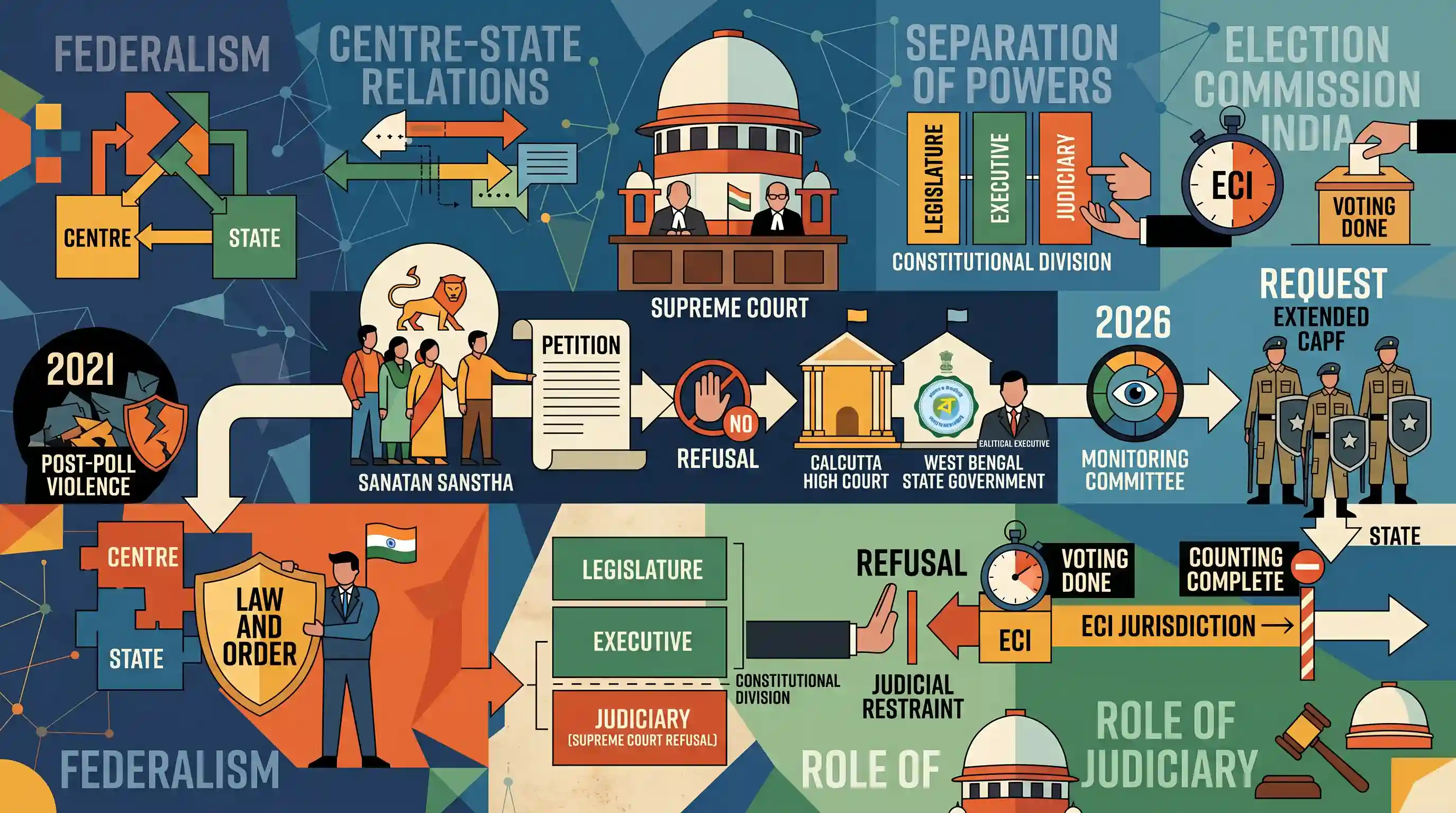
This case highlights key constitutional concepts such as the Seventh Schedule (Law and Order as a State subject), the temporal limits of the Election Commission\'s powers under Article 324, and the limits of judicial intervention in executive domains (Separation of Powers). It provides a strong contemporary example of judicial restraint against micromanaging state administration via PILs.
Summary
The Supreme Court refused to urgently entertain a petition by Sanatan Sanstha seeking the extended deployment of Central Armed Police Forces (CAPFs) in West Bengal after the 2026 Assembly election results. The petitioner sought a court-monitored committee to prevent a repeat of the 2021 post-poll violence. A bench comprising CJI Surya Kant and Justice Joymalya Bagchi directed the petitioners to the Calcutta High Court, explicitly noting that law and order is a State subject and must be left to the political executive. The Election Commission also submitted that its jurisdiction over central forces ends once the counting of votes is complete. The ruling demonstrates judicial restraint and underscores the constitutional division of powers between the Centre, State, and the Election Commission.
Key Points
- The Supreme Court declined an urgent plea seeking the continued deployment of Central Armed Police Forces (CAPFs) in West Bengal to prevent potential post-poll violence after the 2026 Assembly elections.
- A bench led by CJI Surya Kant emphasized that \'law and order\' is a State subject under the Constitution and must be managed by the elected political executive.
- The Election Commission of India (ECI) clarified that its mandate and control over central security forces cease immediately after the vote counting process concludes.
- The Court refused to set up a judicial monitoring committee to oversee force deployment, highlighting the principle of separation of powers and judicial restraint in executive domains.
- The petitioner organization was directed to approach the Calcutta High Court for any immediate relief.
Important Terms
Central Armed Police Forces (CAPF)

Seven central security agencies under the Ministry of Home Affairs (MHA), including CRPF and BSF, tasked with internal security, border guarding, and assisting states in maintaining public order.
UPSC context
GS-III (Internal Security) and GS-II (Federalism). Tests knowledge of central-state cooperation and the legal framework for security deployment.
Election Commission of India (ECI)
An autonomous constitutional authority established under Article 324 responsible for administering Union and State election processes in India, including Parliament, State Legislatures, and the President.
UPSC context
GS-II (Constitutional Bodies). Relevant for understanding the extent and limitations of ECI jurisdiction during and after the Model Code of Conduct.
Judicial Restraint
A procedural principle or judicial philosophy where courts limit their own power, deferring to the political executive or legislature on matters of policy and governance.
UPSC context
GS-II (Separation of Powers). Tests the ability to distinguish between judicial activism, restraint, and overreach in democratic governance.
Separation of Powers
A constitutional doctrine (reflected in Article 50) that prevents any one branch of government—Executive, Legislature, or Judiciary—from encroaching upon the functional domain of the others.
UPSC context
GS-II (Structure, organization and functioning of the Executive and the Judiciary). A core concept in Indian constitutional law.
Supreme Court of India
The highest judicial forum and final court of appeal under the Constitution of India, possessing original, appellate, and advisory jurisdictions (Articles 124–147).
UPSC context
GS-II (Judiciary). Tests understanding of the apex court's role in interpreting the Constitution and its discretionary powers under Article 136.
Calcutta High Court
One of the oldest High Courts in India, exercising jurisdiction over the state of West Bengal and the Union Territory of Andaman and Nicobar Islands.
UPSC context
GS-II (Judiciary). Important for understanding judicial hierarchy and the principle of exhausting lower remedies before approaching the Supreme Court.
Sanatan Sanstha
A Hindu organization that frequently files Public Interest Litigations (PILs). In this case, the petitioner seeking extended CAPF deployment in West Bengal.
UPSC context
GS-II (Role of NGOs/Civil Society). Represents how various groups utilize the legal system for public causes (PIL).
Prelims Trap
"The Election Commission retains operational control over central forces until the newly elected government is officially sworn in."
Under Article 324, the ECI's extraordinary jurisdiction and operational control over deployed central and state security forces cease immediately upon the conclusion of vote counting, not government formation.
Static Concepts Connected
How is the deployment of CAPFs constitutionally managed between the Centre and States?
- State List: 'Public Order' and 'Police' fall exclusively under List II, making states primarily responsible for maintaining law and order.
- Union List: Entry 2A of List I allows the Union to deploy its armed forces "in aid of the civil power", even in states.
- Federal Friction: While the Union has deployment powers, sending CAPFs without a state's explicit consent is highly contentious and generally avoided unless Article 355 is invoked.
What is the extent of the ECI's authority over security machinery during elections?
- Constitutional Mandate: Article 324 grants the ECI plenary powers of superintendence, direction, and control over the conduct of elections.
- Temporary Command: State police and central forces come under the ECI's direct operational command strictly during the active election period to ensure free and fair polling.
- Jurisdictional Sunset: This overriding administrative control is strictly bound by time and ends immediately once the vote counting process is completed.
Cross-Topic Patterns
ECI jurisdiction vs. State autonomy
The transition of command over security forces from the ECI back to the State executive post-counting highlights the temporary, constitutional suspension of state police autonomy during polls.
Judicial restraint in executive domains
The SC's refusal to form a monitoring committee contrasts with its past interventions in law enforcement, emphasizing a strict separation of powers regarding core policing and public order.

Expect a tricky prelims statement testing the exact moment ECI's operational command over CAPFs and state police ceases (post-counting).
Linked PYQs · 4
Linked PYQs · 4
- 2023MainsGS2
Account for the legal and political factors responsible for the reduced frequency of using Article 356 by the Union Governments since mid 1990s.
- 2020MainsGS2
Indian Constitution exhibits centralising tendencies to maintain unity and integrity of the nation. Elucidate in the perspective of the Epidemic Diseases Act, 1897; The Disaster Management Act, 2005 and recently passed Farm Acts.
- 2022MainsGS2
Discuss the role of the Election Commission of India in the light of the evolution of the Model Code of Conduct.
- 2020MainsGS2
Judicial Legislation is antithetical to the doctrine of separation of powers as envisaged in the Indian Constitution. In this context justify the filing of large number of public interest petitions praying for issuing guidelines to executive authorities.
